
Should you buy gold as oil and inflation rise? Here’s what investors need to know
Rising oil prices and inflation are typically bullish for gold, but the current market is behaving differently. With interest rates and the US dollar in focus, investors face a more complex decision than usual.
- Apr 30, 2026,
- Updated Apr 30, 2026 8:35 AM IST
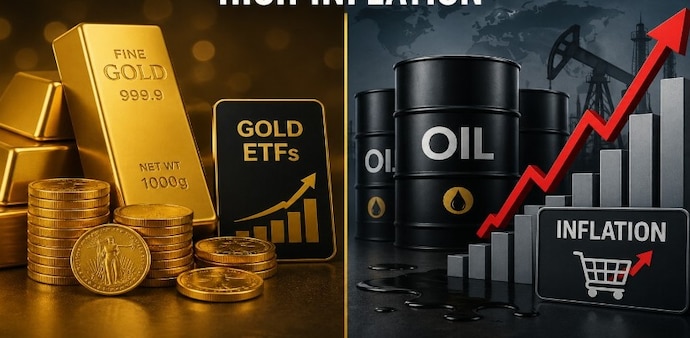
As oil prices surge past $115 per barrel and inflation risks intensify amid geopolitical tensions in West Asia, investors are once again turning their attention to gold. Traditionally viewed as a safe-haven asset, gold is expected to benefit during periods of high inflation. However, the current market cycle presents a more complex picture.
According to recent market trends, rising crude prices -- driven by supply disruptions and uncertainty around US-Iran tensions -- are pushing inflation higher across global economies. This would typically strengthen the case for gold as a hedge against declining purchasing power. Yet, gold prices have shown unexpected weakness in the short term.
Gold’s paradox
Despite inflationary pressures, gold has declined from recent highs above $5,000 per ounce to around $4,500–$4,600 levels. Spot gold was recently trading near $4,579 per ounce, reflecting cautious investor sentiment ahead of US Federal Reserve policy signals.
The key reason behind this divergence lies in interest rates. Persistent inflation has forced central banks, particularly the US Federal Reserve, to maintain a “higher-for-longer” rate stance. Higher interest rates increase the opportunity cost of holding gold, a non-yielding asset, making bonds and fixed-income instruments more attractive.
At the same time, elevated oil prices are strengthening the US dollar, further weighing on gold.
MUST READ: FD vs mutual funds vs liquid funds: Where should you park short-term money in current conditions?
Gold-oil ups and downs
Gold and oil often move together, particularly during inflationary phases, but the relationship is not consistent. Rising oil prices increase production and transportation costs, fuelling inflation and pushing investors toward gold as a hedge against currency depreciation. This creates a positive correlation at times.
However, oil is primarily driven by supply-demand dynamics and geopolitical disruptions, while gold responds more to safe-haven demand and macroeconomic uncertainty. Studies suggest a partial link — for instance, a 10% rise in oil may lift gold by around 4–5%, but this is not guaranteed, making their correlation situational rather than constant.
Ponmudi R, CEO - Enrich Money, said: "Rising crude oil prices and renewed inflation concerns are once again bringing gold into focus for investors. However, the relationship between oil, inflation, and gold is no longer as straightforward as it used to be. While higher oil prices typically fuel inflation and strengthen gold’s appeal as a hedge, the current market dynamics suggest a more complex interplay. As oil prices climb, they push up input costs across the economy, contributing to inflationary pressure. In a normal cycle, this would support gold prices, as investors seek safety in hard assets. However, persistent inflation also forces central banks to maintain a tighter monetary stance for longer, keeping interest rates elevated. This creates a headwind for gold, as it is a non-yielding asset and becomes less attractive compared to interest-bearing instruments."
He added: "This divergence is clearly visible in current market behavior. Despite global geopolitical tensions and inflationary risks, gold has not seen a sustained rally. Instead, it has remained volatile, reacting more to movements in bond yields and interest rate expectations than to inflation alone. A stronger dollar and profit booking after recent highs have also added to the pressure on gold prices in the near term."
Complex case
Market experts argue that gold is no longer just an inflation hedge -- it is increasingly influenced by real interest rates and currency movements.
Hariprasad K, SEBI-registered research analyst and Founder of Livelong Wealth, explained: “Rising oil prices and inflation would traditionally strengthen the gold case, but the current cycle is far more complex. Persistent inflation is forcing central banks to remain hawkish, which raises real yields and strengthens the dollar—both negative for gold.”
He added that markets are reacting more to these second-order effects rather than inflation itself, creating a disconnect between gold’s traditional role and its current performance.
MUST READ: Can the common man still afford gold? Expert sees prices going much higher
Long-term bullish view
Despite short-term pressure, the long-term outlook for gold remains constructive. Continued geopolitical tensions, including stalled US-Iran negotiations and supply disruptions in oil markets, are likely to keep volatility elevated.
Analysts suggest that any easing in geopolitical tensions or a shift in central bank policy could quickly revive bullish sentiment. Gold prices are still expected by some to move toward the $5,300–$5,500 range by late 2026 or early 2027.
Additionally, global gold demand rose 2% year-on-year in the first quarter of 2026, supported by strong buying of bars, coins, and central bank purchases, even as jewellery demand declined.
Should you buy gold now?
Experts suggest that the answer is not straightforward. The near-term outlook remains volatile due to interest rate uncertainty and currency strength. However, the structural case for gold as a portfolio diversifier and long-term hedge remains intact.
“Gold at this stage is better approached as gradual accumulation rather than aggressive positioning,” Hariprasad noted, adding that investors should recognise that gold’s trajectory is currently being shaped more by policy and currency dynamics than inflation alone.
Ponmudi said: "Investors need to understand that gold is currently caught between two competing forces — inflation-driven demand and interest rate-driven resistance. This tug-of-war is likely to keep prices range-bound in the short term. That said, the long-term outlook for gold remains intact. Structural drivers such as global uncertainty, currency volatility, and central bank demand continue to support the broader bullish narrative. Gold’s role as a portfolio diversifier and hedge against systemic risk has not diminished. In the current environment, a staggered accumulation strategy appears more prudent than lump-sum investment. Short-term volatility may offer better entry points, particularly during phases when interest rate fears weigh on prices. Investors with a medium- to long-term horizon can use such corrections to gradually build exposure. The key trigger to watch, however, remains the interest rate cycle. A peak or reversal in rates could act as a strong catalyst for gold, potentially unlocking the next leg of its upward move."
While rising oil prices and inflation typically support gold, the current environment highlights a shift in market dynamics. Investors should avoid making binary decisions and instead adopt a staggered investment approach, balancing short-term volatility with long-term strategic allocation.
MUST READ: RD vs FD vs Mutual Funds vs Stocks: What should you break first in an emergency?
As oil prices surge past $115 per barrel and inflation risks intensify amid geopolitical tensions in West Asia, investors are once again turning their attention to gold. Traditionally viewed as a safe-haven asset, gold is expected to benefit during periods of high inflation. However, the current market cycle presents a more complex picture.
According to recent market trends, rising crude prices -- driven by supply disruptions and uncertainty around US-Iran tensions -- are pushing inflation higher across global economies. This would typically strengthen the case for gold as a hedge against declining purchasing power. Yet, gold prices have shown unexpected weakness in the short term.
Gold’s paradox
Despite inflationary pressures, gold has declined from recent highs above $5,000 per ounce to around $4,500–$4,600 levels. Spot gold was recently trading near $4,579 per ounce, reflecting cautious investor sentiment ahead of US Federal Reserve policy signals.
The key reason behind this divergence lies in interest rates. Persistent inflation has forced central banks, particularly the US Federal Reserve, to maintain a “higher-for-longer” rate stance. Higher interest rates increase the opportunity cost of holding gold, a non-yielding asset, making bonds and fixed-income instruments more attractive.
At the same time, elevated oil prices are strengthening the US dollar, further weighing on gold.
MUST READ: FD vs mutual funds vs liquid funds: Where should you park short-term money in current conditions?
Gold-oil ups and downs
Gold and oil often move together, particularly during inflationary phases, but the relationship is not consistent. Rising oil prices increase production and transportation costs, fuelling inflation and pushing investors toward gold as a hedge against currency depreciation. This creates a positive correlation at times.
However, oil is primarily driven by supply-demand dynamics and geopolitical disruptions, while gold responds more to safe-haven demand and macroeconomic uncertainty. Studies suggest a partial link — for instance, a 10% rise in oil may lift gold by around 4–5%, but this is not guaranteed, making their correlation situational rather than constant.
Ponmudi R, CEO - Enrich Money, said: "Rising crude oil prices and renewed inflation concerns are once again bringing gold into focus for investors. However, the relationship between oil, inflation, and gold is no longer as straightforward as it used to be. While higher oil prices typically fuel inflation and strengthen gold’s appeal as a hedge, the current market dynamics suggest a more complex interplay. As oil prices climb, they push up input costs across the economy, contributing to inflationary pressure. In a normal cycle, this would support gold prices, as investors seek safety in hard assets. However, persistent inflation also forces central banks to maintain a tighter monetary stance for longer, keeping interest rates elevated. This creates a headwind for gold, as it is a non-yielding asset and becomes less attractive compared to interest-bearing instruments."
He added: "This divergence is clearly visible in current market behavior. Despite global geopolitical tensions and inflationary risks, gold has not seen a sustained rally. Instead, it has remained volatile, reacting more to movements in bond yields and interest rate expectations than to inflation alone. A stronger dollar and profit booking after recent highs have also added to the pressure on gold prices in the near term."
Complex case
Market experts argue that gold is no longer just an inflation hedge -- it is increasingly influenced by real interest rates and currency movements.
Hariprasad K, SEBI-registered research analyst and Founder of Livelong Wealth, explained: “Rising oil prices and inflation would traditionally strengthen the gold case, but the current cycle is far more complex. Persistent inflation is forcing central banks to remain hawkish, which raises real yields and strengthens the dollar—both negative for gold.”
He added that markets are reacting more to these second-order effects rather than inflation itself, creating a disconnect between gold’s traditional role and its current performance.
MUST READ: Can the common man still afford gold? Expert sees prices going much higher
Long-term bullish view
Despite short-term pressure, the long-term outlook for gold remains constructive. Continued geopolitical tensions, including stalled US-Iran negotiations and supply disruptions in oil markets, are likely to keep volatility elevated.
Analysts suggest that any easing in geopolitical tensions or a shift in central bank policy could quickly revive bullish sentiment. Gold prices are still expected by some to move toward the $5,300–$5,500 range by late 2026 or early 2027.
Additionally, global gold demand rose 2% year-on-year in the first quarter of 2026, supported by strong buying of bars, coins, and central bank purchases, even as jewellery demand declined.
Should you buy gold now?
Experts suggest that the answer is not straightforward. The near-term outlook remains volatile due to interest rate uncertainty and currency strength. However, the structural case for gold as a portfolio diversifier and long-term hedge remains intact.
“Gold at this stage is better approached as gradual accumulation rather than aggressive positioning,” Hariprasad noted, adding that investors should recognise that gold’s trajectory is currently being shaped more by policy and currency dynamics than inflation alone.
Ponmudi said: "Investors need to understand that gold is currently caught between two competing forces — inflation-driven demand and interest rate-driven resistance. This tug-of-war is likely to keep prices range-bound in the short term. That said, the long-term outlook for gold remains intact. Structural drivers such as global uncertainty, currency volatility, and central bank demand continue to support the broader bullish narrative. Gold’s role as a portfolio diversifier and hedge against systemic risk has not diminished. In the current environment, a staggered accumulation strategy appears more prudent than lump-sum investment. Short-term volatility may offer better entry points, particularly during phases when interest rate fears weigh on prices. Investors with a medium- to long-term horizon can use such corrections to gradually build exposure. The key trigger to watch, however, remains the interest rate cycle. A peak or reversal in rates could act as a strong catalyst for gold, potentially unlocking the next leg of its upward move."
While rising oil prices and inflation typically support gold, the current environment highlights a shift in market dynamics. Investors should avoid making binary decisions and instead adopt a staggered investment approach, balancing short-term volatility with long-term strategic allocation.
MUST READ: RD vs FD vs Mutual Funds vs Stocks: What should you break first in an emergency?