
Beating the benchmark but losing money: What India's equity PMS performance reveals for investors
Beating the benchmark but losing money: What India's equity PMS performance reveals for investors
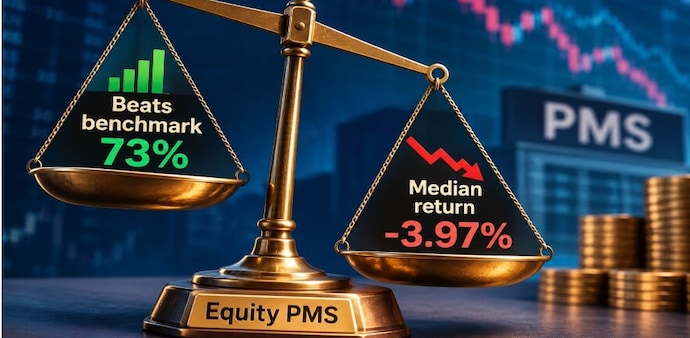
Nearly 73% of India's discretionary equity PMS strategies outperformed their benchmarks over one year, yet recorded a negative median return of 3.97%. The findings highlight why benchmark outperformance alone may not be a reliable indicator of wealth creation.
Basudha Das
- Nov 26, 2026,
- Updated Nov 26, 2026 4:33 PM IST
Professional portfolio managers may outperform the broader market without necessarily generating positive returns for investors. The latest performance data on India's portfolio management services (PMS) industry highlights this distinction, raising questions about how wealthy investors should assess investment performance during market downturns.
According to a report by Kalviro Ventures, based on data reported to the Association of Portfolio Managers in India (APMI) and the Securities and Exchange Board of India (SEBI), 73% of discretionary equity PMS strategies outperformed their respective benchmarks over one year ended October 31, 2026. However, the category recorded a negative median return of 3.97%.
Advertisement
The report covers 1,770 PMS strategies across 382 portfolio managers, with reported assets under management of Rs 5.86 lakh crore. Discretionary equity PMS alone accounts for Rs 4.11 lakh crore across 1,172 strategies.
Beating the market, but...
Benchmark outperformance measures how an investment performs relative to a reference index rather than whether it generates positive returns.
For instance, if a benchmark declines 10% while a portfolio falls 5%, the portfolio manager has outperformed the benchmark by five percentage points. However, an investor who invested Rs 50 lakh would still suffer a loss of Rs 2.5 lakh.
The report shows that discretionary equity PMS strategies recorded a median benchmark outperformance of 4.18 percentage points over one year, despite negative absolute median returns.
Advertisement
MUST READ: FD rates of up to 8.60%: How investors can maximise returns without compromising deposit safety
Short-term performance was considerably weaker. Only 10% of eligible discretionary equity PMS strategies outperformed their benchmarks in October, with the category recording a median monthly loss of 3.70%.
Can portfolio managers sustain outperformance?
The proportion of strategies outperforming their benchmarks also varied considerably across investment horizons.
While 73% of eligible discretionary equity PMS strategies beat their benchmarks over one year, the proportion stood at 55% over three years and 61% over five years.
Advertisement
Median annualised returns stood at 9.73% over three years, 11.47% over four years and 9.03% over five years.
ALSO READ: Can a father leave 95% of his wealth to his son and 5% to his daughter? What inheritance law says
However, different investment periods cover different sets of eligible strategies, making it difficult to establish whether individual portfolio managers consistently generate superior returns.
Do higher investment costs justify the returns?
PMS investments typically require a minimum commitment of Rs 50 lakh and may involve fixed management fees, performance-linked fees and other expenses, depending on the portfolio manager's fee structure.
While the report uses time-weighted returns net of fees and expenses, individual investor returns may differ depending on investment timing, withdrawals and cash flows.
Investors should also examine whether benchmark outperformance adequately compensates them for portfolio concentration, volatility and additional investment costs.
What should PMS investors track?
Advertisement
Rather than relying solely on benchmark outperformance, investors should evaluate absolute returns, maximum drawdowns, downside protection, risk-adjusted performance and consistency across market cycles.
Benchmark selection is equally important, as different PMS strategies may use different reference indices, making direct performance comparisons challenging.
Ultimately, generating alpha — returns above a benchmark — is only one measure of investment success. For investors seeking long-term wealth creation, preserving capital during downturns and generating sustainable positive returns after costs remain equally important considerations.
Read more!