











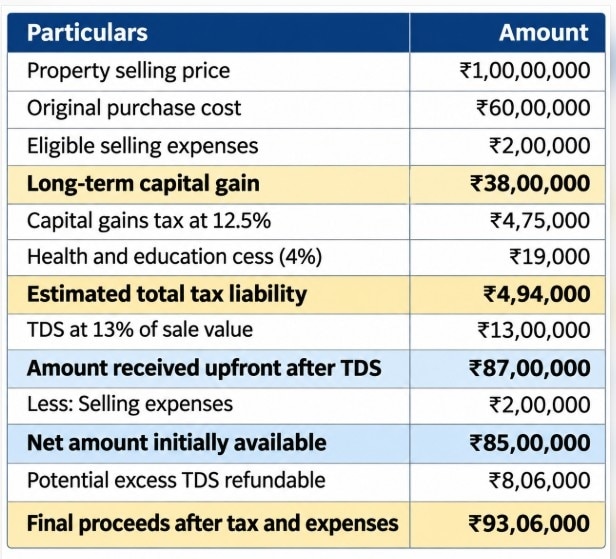



 Unlike resident property sellers, NRIs are subject to withholding provisions under Section 195 of the Income Tax Act.
Selling a property for ₹1 crore does not necessarily mean an NRI will receive the entire amount immediately. Tax deducted at source (TDS), capital gains liability and transaction expenses can significantly affect the money available after the sale.
For non-resident Indians (NRIs), the difference between the selling price and actual proceeds can be substantial, particularly when tax planning begins only after a buyer has been finalised.

 'I am honoured to return to NVIDIA': Jensen Huang makes a comeback, chipmaker's shares surge over 30%
 NVIDIA reinstates Jensen Huang as CEO after board review, says return poses no national security risk
 Budget 2027-28: Centre may ease fiscal consolidation, target 4% deficit
 Gold prices are falling. How will it affect your gold loan?
 Budget FY28 may widen PLI schemes to boost sunrise sectors, advanced technology, manufacturing
 Banking & Metal Stocks Drag Markets: Where Should Investors Look Now? | Chandan Taparia
 India Records Highest-Ever Festive Auto Sales | EV Sales Surge 53%, PV Sales Decline: FADA
 What’s Hot: Stocks, Gold & Big Money Moves | Daily Markets Show | November 23 | Business Today
 Small Caps Vs Large Caps: Where Is The Bigger Opportunity Now? | Sharad Avasthi
 Tata Sons Board Meet Postponed: Report | Noel Tata Flags Notice Violation, Seeks Board Respons

 NVIDIA shares surge 30%, but Bernstein sees more upside: Why the brokerage maintains $200 target
 SEBI cracks down on IPO grey market premiums: What changes for retail investors and listing gains?
 Wall Street rallies as NVIDIA surges 30% on Jensen Huang's return; AI stocks lead market rebound'I am honoured to return to NVIDIA': Jensen Huang makes a comeback, chipmaker's shares surge over 30%
 Why 63 moons-backed NSEL settled 13-year-old default case with investors
 Manufacturing lifts India's private sector growth in November
 ₹1.20 lakh starting price, 212km range! What TVS iQube offers daily commuters
 ₹1.49 lakh starting price, up to 40kmpl mileage! 5 affordable adventure bikes in India
 Gold Spot vs Fanta: Why Coca-Cola is bringing back an orange drink that could rival its own brand
 From chai to toilet habits: French instructor lists 11 things Europe can learn from India


