
'A once-in-a-lifetime opportunity': Skyroot CEO Pawan Chandana's words capture the significance of Vikram-1's historic launch
Skyroot Aerospace’s maiden orbital mission makes India the third country with a successful private orbital launch, validating the country's spacetech ambitions and opening a new chapter for commercial space.
- Jul 18, 2026,
- Updated Jul 18, 2026 2:10 PM IST
India's private space sector reached a defining milestone on Saturday as Skyroot Aerospace successfully launched Vikram-1, making it the country's first private company to place a rocket into orbit on its maiden attempt. The achievement is not only a landmark for India's fast-growing startup ecosystem but also positions India among a select group of nations, alongside the United States and China, with successful private orbital launch capabilities.
Founded in 2018 by former ISRO scientists Pawan Kumar Chandana and Naga Bharath Daka, Skyroot has achieved in less than eight years what few private space companies globally have managed—developing and successfully launching an orbital rocket. The Hyderabad-based startup, which recently joined the unicorn club after raising $60 million, is backed by marquee investors including GIC, Arkam Ventures, Playbook Partners, Sherpalo Ventures, and the Shanghvi Family Office, among others, and has emerged as the face of India's new-generation spacetech ambitions. In total, Skyroot Aerospace has raised around $160 million in funding till date.
MUST READ: Vikram-1 launch: India's first private orbital rocket enters space; joins US, China
The company operates out of its 200,000-square-foot Infinity Campus in Hyderabad, a state-of-the-art headquarters, design and manufacturing hub inaugurated in November 2025. The facility has become the nerve centre of Skyroot's rocket development programme and reflects the scale of infrastructure now being built by India's private space sector. Soon after the successful launch, Prime Minister Narendra Modi spoke to the Skyroot team over a telephone call, congratulating the founders and the entire team on the historic achievement.
While the company has not disclosed the exact cost of the mission, it is reported approximately to be $2-$3 million. Vikram-1 has been designed to carry small satellites weighing up to 350 kg to Low Earth Orbit (LEO). Its inaugural mission targeted a 450-km orbit with an inclination of 60 degrees, validating the rocket's capability for commercial satellite launches.
Speaking to Business Today earlier this year, Chandana had described the current phase for India's private spacetech sector as a "once in a lifetime opportunity." He had pointed to a widening gap in the global launch market, noting that while around 219 private launches were expected worldwide in 2025, only 33 were projected to be serviced by private providers outside China and SpaceX, leaving satellite operators with limited launch options.
"India's launch economics is changing," Chandana had told Business Today. "Vikram-1 has about 95% indigenous components, and we are building something faster, more efficient and more economical."
The opportunity is also being driven by the rapid rise of small satellites, which now account for more than 75% of global launches, creating strong demand for dedicated launch vehicles capable of offering quicker, more flexible and cost-effective access to space.
Industry leaders hailed the mission as a watershed moment for India's commercial space ambitions. Lt. Gen. A.K. Bhatt (Retd.), Director General of the Indian Space Association (ISpA), described the mission as "a defining milestone for India's space journey," saying Skyroot had demonstrated that India's private industry is now capable of executing end-to-end orbital missions.
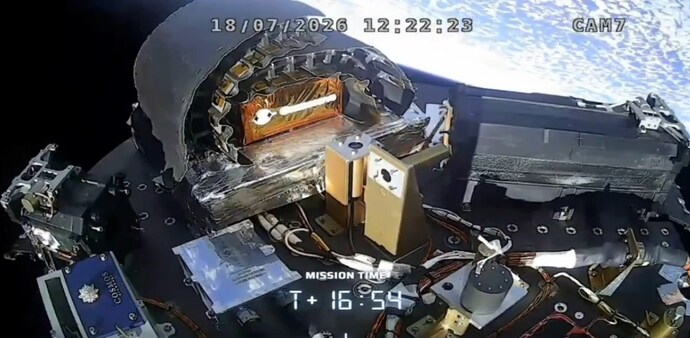
He also congratulated the teams behind the technology demonstration payloads deployed during the mission, including Cosmoserve Space's EMBRACE robotic arm for orbital debris removal, Skyroot's own SCOPE payload, and Grahaa Space's SOLARAS S3 satellite.
"The successful deployment of such complex, IP-heavy payloads proves that our private ecosystem is now building critical global infrastructure for space sustainability and high-resolution Earth intelligence," Bhatt said. He added that the all-carbon composite rocket showcased the success of India's public-private partnership model while sending a strong signal to global investors.
For India's startup ecosystem, Vikram-1 represents far more than a successful rocket launch. It signals the coming of age of Indian private spacetech, where homegrown startups are not merely supporting the country's space ambitions but are now leading them on the global stage.
India's private space sector reached a defining milestone on Saturday as Skyroot Aerospace successfully launched Vikram-1, making it the country's first private company to place a rocket into orbit on its maiden attempt. The achievement is not only a landmark for India's fast-growing startup ecosystem but also positions India among a select group of nations, alongside the United States and China, with successful private orbital launch capabilities.
Founded in 2018 by former ISRO scientists Pawan Kumar Chandana and Naga Bharath Daka, Skyroot has achieved in less than eight years what few private space companies globally have managed—developing and successfully launching an orbital rocket. The Hyderabad-based startup, which recently joined the unicorn club after raising $60 million, is backed by marquee investors including GIC, Arkam Ventures, Playbook Partners, Sherpalo Ventures, and the Shanghvi Family Office, among others, and has emerged as the face of India's new-generation spacetech ambitions. In total, Skyroot Aerospace has raised around $160 million in funding till date.
MUST READ: Vikram-1 launch: India's first private orbital rocket enters space; joins US, China
The company operates out of its 200,000-square-foot Infinity Campus in Hyderabad, a state-of-the-art headquarters, design and manufacturing hub inaugurated in November 2025. The facility has become the nerve centre of Skyroot's rocket development programme and reflects the scale of infrastructure now being built by India's private space sector. Soon after the successful launch, Prime Minister Narendra Modi spoke to the Skyroot team over a telephone call, congratulating the founders and the entire team on the historic achievement.
While the company has not disclosed the exact cost of the mission, it is reported approximately to be $2-$3 million. Vikram-1 has been designed to carry small satellites weighing up to 350 kg to Low Earth Orbit (LEO). Its inaugural mission targeted a 450-km orbit with an inclination of 60 degrees, validating the rocket's capability for commercial satellite launches.
Speaking to Business Today earlier this year, Chandana had described the current phase for India's private spacetech sector as a "once in a lifetime opportunity." He had pointed to a widening gap in the global launch market, noting that while around 219 private launches were expected worldwide in 2025, only 33 were projected to be serviced by private providers outside China and SpaceX, leaving satellite operators with limited launch options.
"India's launch economics is changing," Chandana had told Business Today. "Vikram-1 has about 95% indigenous components, and we are building something faster, more efficient and more economical."
The opportunity is also being driven by the rapid rise of small satellites, which now account for more than 75% of global launches, creating strong demand for dedicated launch vehicles capable of offering quicker, more flexible and cost-effective access to space.
Industry leaders hailed the mission as a watershed moment for India's commercial space ambitions. Lt. Gen. A.K. Bhatt (Retd.), Director General of the Indian Space Association (ISpA), described the mission as "a defining milestone for India's space journey," saying Skyroot had demonstrated that India's private industry is now capable of executing end-to-end orbital missions.
He also congratulated the teams behind the technology demonstration payloads deployed during the mission, including Cosmoserve Space's EMBRACE robotic arm for orbital debris removal, Skyroot's own SCOPE payload, and Grahaa Space's SOLARAS S3 satellite.
"The successful deployment of such complex, IP-heavy payloads proves that our private ecosystem is now building critical global infrastructure for space sustainability and high-resolution Earth intelligence," Bhatt said. He added that the all-carbon composite rocket showcased the success of India's public-private partnership model while sending a strong signal to global investors.
For India's startup ecosystem, Vikram-1 represents far more than a successful rocket launch. It signals the coming of age of Indian private spacetech, where homegrown startups are not merely supporting the country's space ambitions but are now leading them on the global stage.