
From ‘can we’ to ‘should we’: The new playbook for AI responsible innovation by Adobe
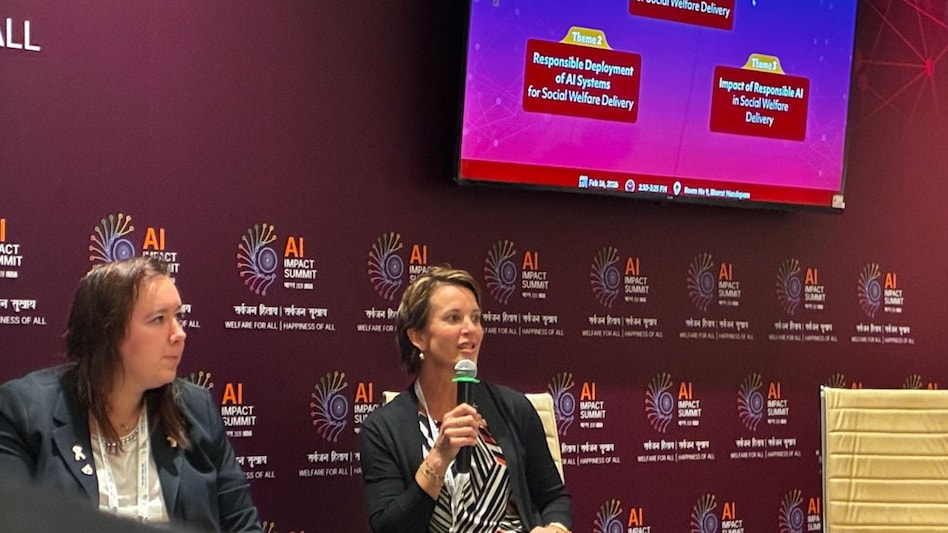
Jennifer Mulveny, Director of Government Relations, Adobe Asia Pacific, said, "Making AI work is not enough. What will work is making trustworthy AI work for India."
- Feb 16, 2026,
- Updated Feb 16, 2026 9:33 PM IST
Artificial Intelligence (AI) technology has evolved beyond simply providing chatbots that resolve queries. The technology has not only become mainstream, but it has also been made accessible to several sectors across the enterprise. However, with greater users come risks.
Experts now argue whether AI can be built, but whether it should be deployed, and how. At the India AI Impact Summit 2026, Jennifer Mulveny, Director of Government Relations, Adobe Asia Pacific, talked about a philosophical pivot that is increasingly shaping AI strategy inside large global firms.
“For Adobe, it’s not can we develop and deploy AI — it’s should we? We’ve always had to think about the ‘should,’ Mulveny said. She further added, “Every new AI tool must go through our AI Ethics Review Board. Engineers propose what they want to build, and it goes through an impact assessment.”
She noted that the human consequences should be the centre of decisions for the companies that are building AI tools that affect business operations across creative workflows, businesses and livelihoods.
Highlighting the risk, Mulveny said, “If we don’t keep humans at the centre of everything, we’re all going to find ourselves in a lot of trouble.”
She said that trust should be embedded into the AI system for it to work while keeping human interests and welfare in mind.
India as a global frontier of AI
Mulveny also talked about India as the global frontier of AI, but as a consumer, she warns that it is very crucial to understand how these AI models are built and trained, to trust the innovations they power fully.
“If governance and trust are treated as the last step, India will miss the opportunity to win in this AI race,” she said.
“Making AI work is not enough. What will work is making trustworthy AI work for India.” Hence, a shift from “Can we build this?” to “Should we deploy this?” Is crucial for maturation in AI’s global journey.
For Unparalleled coverage of India's Businesses and Economy – Subscribe to Business Today Magazine
Artificial Intelligence (AI) technology has evolved beyond simply providing chatbots that resolve queries. The technology has not only become mainstream, but it has also been made accessible to several sectors across the enterprise. However, with greater users come risks.
Experts now argue whether AI can be built, but whether it should be deployed, and how. At the India AI Impact Summit 2026, Jennifer Mulveny, Director of Government Relations, Adobe Asia Pacific, talked about a philosophical pivot that is increasingly shaping AI strategy inside large global firms.
“For Adobe, it’s not can we develop and deploy AI — it’s should we? We’ve always had to think about the ‘should,’ Mulveny said. She further added, “Every new AI tool must go through our AI Ethics Review Board. Engineers propose what they want to build, and it goes through an impact assessment.”
She noted that the human consequences should be the centre of decisions for the companies that are building AI tools that affect business operations across creative workflows, businesses and livelihoods.
Highlighting the risk, Mulveny said, “If we don’t keep humans at the centre of everything, we’re all going to find ourselves in a lot of trouble.”
She said that trust should be embedded into the AI system for it to work while keeping human interests and welfare in mind.
India as a global frontier of AI
Mulveny also talked about India as the global frontier of AI, but as a consumer, she warns that it is very crucial to understand how these AI models are built and trained, to trust the innovations they power fully.
“If governance and trust are treated as the last step, India will miss the opportunity to win in this AI race,” she said.
“Making AI work is not enough. What will work is making trustworthy AI work for India.” Hence, a shift from “Can we build this?” to “Should we deploy this?” Is crucial for maturation in AI’s global journey.
For Unparalleled coverage of India's Businesses and Economy – Subscribe to Business Today Magazine