
India AI Impact Summit 2026: Hybrid AI deployment model is way to power India’s sovereign AI ambitions, says Qualcomm’s Sahil Arora
India AI Impact Summit 2026: Qualcomm is pushing for a hybrid deployment strategy that leverages on-device intelligence alongside cloud computing to enable scalability and promote affordable AI adoption nationwide
- Feb 16, 2026,
- Updated Feb 16, 2026 12:48 PM IST
India AI Impact Summit 2026 | The Indian government is deeply committed to transforming from a consumer to a developer. As the country’s focus shifts toward building sovereign AI infrastructure, Qualcomm is pushing for a hybrid deployment strategy that leverages on-device intelligence alongside cloud computing to enable scalability and promote affordable AI adoption nationwide.
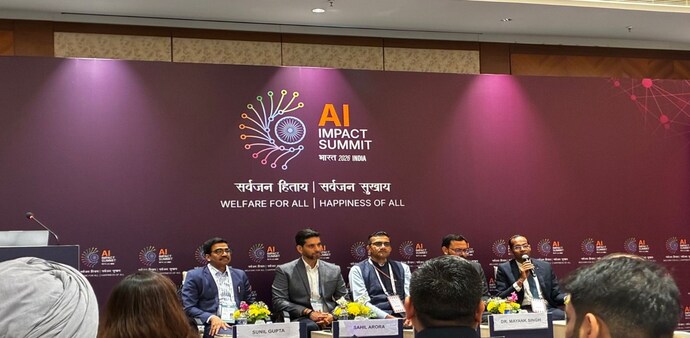
Speaking at the India AI Impact Summit 2026, Sahil Arora, Business Head, AI & Data Centres at Qualcomm, outlined how the company sees India’s AI evolving from research and model training to real-world deployment in the hands of citizens.
“AI must run where the user is”
Arora said Qualcomm’s focus goes beyond smartphones, even as it continues to dominate edge-device compute. “We have always been in the hands of consumers through smartphones. Now we are expanding into data centres. Our core focus remains performance per watt, how do you run these large language models on device and on cloud with the least power and better performance.” Arora said.
According to Arora, real India-scale AI cannot rely solely on cloud-based deployments.
He pointed out that 7B to 10B parameter models can already run on-device today, along with Automatic Speech Recognition (ASR) and Text-to-Speech (TTS) capabilities.
“If you can run small ASR models on the device and send only text to the cloud, you bring down compute and connectivity requirements, and you reduce latency. That’s critical at India’s scale.”
Further talking about India’s digital transformation through UPI and Aadhaar, Arora pointed out that India may be witnessing the beginning of its next major AI-driven shift.
“We did good work in UPI. We did good work with Aadhaar. What next?” However, he pointed out that “AI has to be at the right price to go into people’s hands.”
According to him, for a country like India, large models may not be necessary for most use cases.
“From 40 to 50 billion parameters is the sweet spot for a country like India, where most of the meaningful work can be done.”
Hybrid AI architecture
Arora emphasised that the future of AI deployment in India will be hybrid, which combines edge devices with centralised compute.
“With GPU and NPU sitting inside devices, from mobile phones to cars to even a sound box, that’s where real deployment happens. It is all about hybrid architecture between device and cloud. That’s the real India-scale deployment scenario,” he said.
His remarks come at a time when India is scaling GPU infrastructure under the India AI Mission and industry players are rapidly building domestic data centre capacity.
For Unparalleled coverage of India's Businesses and Economy – Subscribe to Business Today Magazine
India AI Impact Summit 2026 | The Indian government is deeply committed to transforming from a consumer to a developer. As the country’s focus shifts toward building sovereign AI infrastructure, Qualcomm is pushing for a hybrid deployment strategy that leverages on-device intelligence alongside cloud computing to enable scalability and promote affordable AI adoption nationwide.
Speaking at the India AI Impact Summit 2026, Sahil Arora, Business Head, AI & Data Centres at Qualcomm, outlined how the company sees India’s AI evolving from research and model training to real-world deployment in the hands of citizens.
“AI must run where the user is”
Arora said Qualcomm’s focus goes beyond smartphones, even as it continues to dominate edge-device compute. “We have always been in the hands of consumers through smartphones. Now we are expanding into data centres. Our core focus remains performance per watt, how do you run these large language models on device and on cloud with the least power and better performance.” Arora said.
According to Arora, real India-scale AI cannot rely solely on cloud-based deployments.
He pointed out that 7B to 10B parameter models can already run on-device today, along with Automatic Speech Recognition (ASR) and Text-to-Speech (TTS) capabilities.
“If you can run small ASR models on the device and send only text to the cloud, you bring down compute and connectivity requirements, and you reduce latency. That’s critical at India’s scale.”
Further talking about India’s digital transformation through UPI and Aadhaar, Arora pointed out that India may be witnessing the beginning of its next major AI-driven shift.
“We did good work in UPI. We did good work with Aadhaar. What next?” However, he pointed out that “AI has to be at the right price to go into people’s hands.”
According to him, for a country like India, large models may not be necessary for most use cases.
“From 40 to 50 billion parameters is the sweet spot for a country like India, where most of the meaningful work can be done.”
Hybrid AI architecture
Arora emphasised that the future of AI deployment in India will be hybrid, which combines edge devices with centralised compute.
“With GPU and NPU sitting inside devices, from mobile phones to cars to even a sound box, that’s where real deployment happens. It is all about hybrid architecture between device and cloud. That’s the real India-scale deployment scenario,” he said.
His remarks come at a time when India is scaling GPU infrastructure under the India AI Mission and industry players are rapidly building domestic data centre capacity.
For Unparalleled coverage of India's Businesses and Economy – Subscribe to Business Today Magazine