
India AI Impact Summit 2026: Sovereign AI is not just a tool, but strategic autonomy requirement, says ISRO’s Rajiv Chetwani
AI Impact Summit 2026: Chetwani emphasised that for the nation to be truly secure, its AI must be "sovereign." India should be moving beyond consumption and focus on becoming a fundamental pillar of national sovereignty
- Feb 17, 2026,
- Updated Feb 17, 2026 12:19 PM IST
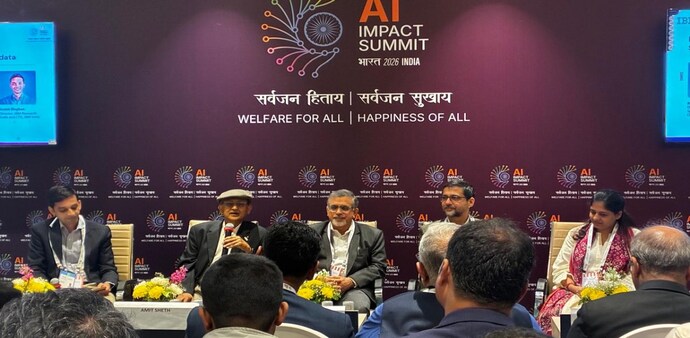
India AI Impact Summit 2026 | At the landmark session at the India AI Impact Summit 2026, Rajiv Chetwani, director at Indian Space Research Organisation (ISRO) talked about the role of artificial intelligence in national defense and space exploration.
During the panel discussion, Chetwani emphasised that for the nation to be truly secure, its AI must be "sovereign." India should be moving beyond consumption and focus on becoming a fundamental pillar of national sovereignty.
Chetwani pointed out that transparency, saying that if models are internet-connected and operated by an overseas company, India has limited visibility and legal control. He said, “Sovereign AI is viewed not just as a tool, but as a strategic autonomy requirement and a critical infrastructure in space observation. It is a strategic necessity for network security and autonomy.”
“The way I see it from this perspective is that the AI infrastructure needs to be on too much. And it's not required for direct internet consumers,” he said.
Transparency Over Dependency
The conversation also centred around the shift from "Black Box" to "Glass Box" AI. It was pointed out that for the mission-related operations, India must not rely on proprietary APIs from foreign entities where the training processes are unknown.
“We can't depend on APIs; the black box AI is not acceptable. What we need is a glass box AI with complete transparency on how the models are trained, including the lineage of training data and weights of the model. The training environment also needs to be auditable,” Chetwani said.
Hence, the government should focus on how to build a framework ensuring that data residency and compute capacity remain within national borders, protected by Indian laws.
How AI is playing a transformative role from farm to orbit
Chetwani stated that ISRO is relying on massive high-resolution geospatial data to solve terrestrial problems. He pointed out that AI applications are significantly enhancing the value of satellite imagery, providing unprecedented insights across several sectors, including agriculture, climate, disaster management, urban and environmental monitoring, and even space operations.
Chetwani said, "AI significantly enhances the value of geospatial data by providing unprecedented insight. It can be applied to agriculture for crop monitoring, for predicting yields, and even for disaster management like early prediction of floods."
For Unparalleled coverage of India's Businesses and Economy – Subscribe to Business Today Magazine
India AI Impact Summit 2026 | At the landmark session at the India AI Impact Summit 2026, Rajiv Chetwani, director at Indian Space Research Organisation (ISRO) talked about the role of artificial intelligence in national defense and space exploration.
During the panel discussion, Chetwani emphasised that for the nation to be truly secure, its AI must be "sovereign." India should be moving beyond consumption and focus on becoming a fundamental pillar of national sovereignty.
Chetwani pointed out that transparency, saying that if models are internet-connected and operated by an overseas company, India has limited visibility and legal control. He said, “Sovereign AI is viewed not just as a tool, but as a strategic autonomy requirement and a critical infrastructure in space observation. It is a strategic necessity for network security and autonomy.”
“The way I see it from this perspective is that the AI infrastructure needs to be on too much. And it's not required for direct internet consumers,” he said.
Transparency Over Dependency
The conversation also centred around the shift from "Black Box" to "Glass Box" AI. It was pointed out that for the mission-related operations, India must not rely on proprietary APIs from foreign entities where the training processes are unknown.
“We can't depend on APIs; the black box AI is not acceptable. What we need is a glass box AI with complete transparency on how the models are trained, including the lineage of training data and weights of the model. The training environment also needs to be auditable,” Chetwani said.
Hence, the government should focus on how to build a framework ensuring that data residency and compute capacity remain within national borders, protected by Indian laws.
How AI is playing a transformative role from farm to orbit
Chetwani stated that ISRO is relying on massive high-resolution geospatial data to solve terrestrial problems. He pointed out that AI applications are significantly enhancing the value of satellite imagery, providing unprecedented insights across several sectors, including agriculture, climate, disaster management, urban and environmental monitoring, and even space operations.
Chetwani said, "AI significantly enhances the value of geospatial data by providing unprecedented insight. It can be applied to agriculture for crop monitoring, for predicting yields, and even for disaster management like early prediction of floods."
For Unparalleled coverage of India's Businesses and Economy – Subscribe to Business Today Magazine