
Meet Clawdbot, the open-source AI assistant taking over social media feeds
Clawdbot is designed to act on a user’s behalf. It belongs to a category known as “agentic AI”, systems that can take actions automatically instead of only responding to questions.
- Jan 27, 2026,
- Updated Jan 27, 2026 10:44 AM IST
An open-source AI personal assistant called Clawdbot is gaining attention in Silicon Valley, as developers and early adopters experiment with the tool and share their setups online.
Over the weekend, discussion about Clawdbot surged on X (formerly Twitter), reaching near-viral levels for an open-source project. Engineers and AI enthusiasts have been posting tips, screenshots and memes.
Clawdbot is a free AI assistant that runs locally on a user’s own computer, rather than on remote company servers. It was created by developer and entrepreneur Peter Steinberger, best known for building the document software company PSPDFKit.
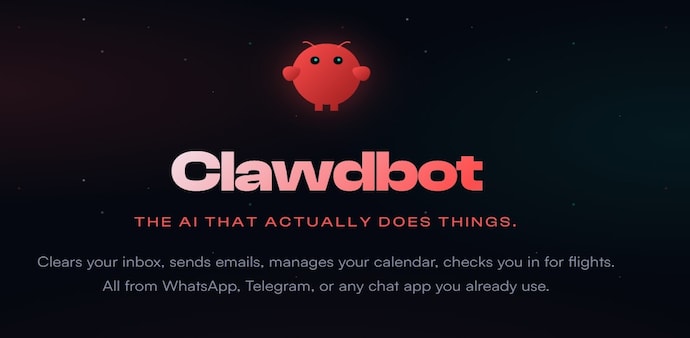
Unlike typical chatbots, Clawdbot is designed to act on a user’s behalf. It belongs to a category known as “agentic AI”, systems that can take actions automatically instead of only responding to questions. For example, Clawdbot can monitor email, calendars and documents, remember past instructions, and alert users when important messages arrive.
Users can also give Clawdbot access to services such as ChatGPT or Anthropic’s Claude, allowing it to use large language models to reason and complete tasks.
Agentic AI has been one of the industry’s biggest ambitions. Many companies predicted 2025 would be the year these systems became mainstream. So far, most high-profile attempts have struggled.
The software is typically run on a small personal computer such as Apple’s Mac Mini, though it also supports Windows and Linux.
Steinberger has made Clawdbot’s source code publicly available on GitHub, a platform where developers share and collaborate on software. Anyone can download and modify it, though setup requires technical skills. Installation instructions and system requirements are available on Clawdbot’s website.
Yes, but the risks?
Clawdbot's sudden success also comes with significant risks.
To function as intended, the assistant is given deep access to a user’s computer. That includes the ability to read and write files, run commands, execute programs and control a web browser.
In its documentation, Steinberger warns users that this creates security concerns.
“Running an AI agent with shell access on your machine is… spicy,” the project’s FAQ says. Shell access means the software can directly control core parts of the operating system.
"Clawdbot is both a product and an experiment: you’re wiring frontier-model behaviour into real messaging surfaces and real tools. There is no “perfectly secure” setup," the FAQ read.
The Clawdbot website includes a security guide and links to an audit tool on GitHub. It also outlines potential threats, such as attackers trying to trick the AI into harmful actions or manipulating it to gain access to personal data.
For Unparalleled coverage of India's Businesses and Economy – Subscribe to Business Today Magazine
An open-source AI personal assistant called Clawdbot is gaining attention in Silicon Valley, as developers and early adopters experiment with the tool and share their setups online.
Over the weekend, discussion about Clawdbot surged on X (formerly Twitter), reaching near-viral levels for an open-source project. Engineers and AI enthusiasts have been posting tips, screenshots and memes.
Clawdbot is a free AI assistant that runs locally on a user’s own computer, rather than on remote company servers. It was created by developer and entrepreneur Peter Steinberger, best known for building the document software company PSPDFKit.
Unlike typical chatbots, Clawdbot is designed to act on a user’s behalf. It belongs to a category known as “agentic AI”, systems that can take actions automatically instead of only responding to questions. For example, Clawdbot can monitor email, calendars and documents, remember past instructions, and alert users when important messages arrive.
Users can also give Clawdbot access to services such as ChatGPT or Anthropic’s Claude, allowing it to use large language models to reason and complete tasks.
Agentic AI has been one of the industry’s biggest ambitions. Many companies predicted 2025 would be the year these systems became mainstream. So far, most high-profile attempts have struggled.
The software is typically run on a small personal computer such as Apple’s Mac Mini, though it also supports Windows and Linux.
Steinberger has made Clawdbot’s source code publicly available on GitHub, a platform where developers share and collaborate on software. Anyone can download and modify it, though setup requires technical skills. Installation instructions and system requirements are available on Clawdbot’s website.
Yes, but the risks?
Clawdbot's sudden success also comes with significant risks.
To function as intended, the assistant is given deep access to a user’s computer. That includes the ability to read and write files, run commands, execute programs and control a web browser.
In its documentation, Steinberger warns users that this creates security concerns.
“Running an AI agent with shell access on your machine is… spicy,” the project’s FAQ says. Shell access means the software can directly control core parts of the operating system.
"Clawdbot is both a product and an experiment: you’re wiring frontier-model behaviour into real messaging surfaces and real tools. There is no “perfectly secure” setup," the FAQ read.
The Clawdbot website includes a security guide and links to an audit tool on GitHub. It also outlines potential threats, such as attackers trying to trick the AI into harmful actions or manipulating it to gain access to personal data.
For Unparalleled coverage of India's Businesses and Economy – Subscribe to Business Today Magazine