
Samsung, AMD team up on next-gen AI memory, signals at potential foundry tie-up
The collaboration will focus on supplying Samsung’s next-generation high-bandwidth memory (HBM4) for AMD’s upcoming Instinct MI455X AI accelerators.
- Mar 18, 2026,
- Updated Mar 18, 2026 4:21 PM IST
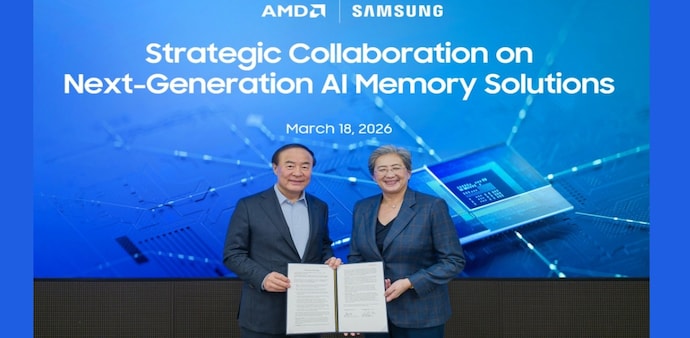
Samsung Electronics and Advanced Micro Devices (AMD) teamed up to expand collaboration on next-generation AI memory and computing technologies. The companies have signed a memorandum of understanding (MoU) to expand memory chip supplies for artificial intelligence (AI) infrastructure, Samsung confirmed on March 18.
The signing ceremony took place at Samsung's chip manufacturing complex in Pyeongtaek, Korea. It was attended by Dr Lisa Su, Chair and CEO of AMD, and Young Hyun Jun, Vice Chairman and CEO of Samsung Electronics.
Samsung stated that the collaboration will focus on supplying Samsung’s next-generation high-bandwidth memory (HBM4) for AMD’s upcoming Instinct MI455X AI accelerators, as well as optimised DDR5 memory for its sixth-generation EPYC processors.
Jun said, “From industry-leading HBM4 and next-generation memory architectures to cutting-edge foundry and advanced packaging, Samsung is uniquely positioned to deliver unrivalled turnkey capabilities that support AMD’s evolving AI roadmap.”
Notably, Samsung is already a primary supplier of HBM for AMD. It has been supplying HBM3E chips for AMD's MI350X and MI355X accelerators.
The company claims that these technologies will power next-generation AI systems combining AMD Instinct GPUs, AMD EPYC CPUs and rack-scale architectures such as the AMD Helios platform.
Samsung’s HBM4 is fabricated with a 6th-gen 10nm class DRAM process and a 4nm logic base die, delivering speeds of up to 13 Gbps and bandwidth of up to 3.3 TB/s.
Samsung said, “The AMD Instinct MI455X GPU is expected to be the optimum solution for high-performance systems handling AI model training and inference,” with the HBM4 memory standard. In addition, AMD can benefit from diversifying its supply chain,
The companies also plan to explore a foundry deal, with Samsung potentially manufacturing AMD’s future chips.
The announcement comes amid GTC 2026, as on March 16, Nvidia CEO Jensen Huang announced a foundry partnership with Samsung Korea at the GTC 2026 and also praised its HBM4 chips for AI performance.
Such crucial partnerships strengthen Samsung’s position as a leader in HBM.
For Unparalleled coverage of India's Businesses and Economy – Subscribe to Business Today Magazine
Samsung Electronics and Advanced Micro Devices (AMD) teamed up to expand collaboration on next-generation AI memory and computing technologies. The companies have signed a memorandum of understanding (MoU) to expand memory chip supplies for artificial intelligence (AI) infrastructure, Samsung confirmed on March 18.
The signing ceremony took place at Samsung's chip manufacturing complex in Pyeongtaek, Korea. It was attended by Dr Lisa Su, Chair and CEO of AMD, and Young Hyun Jun, Vice Chairman and CEO of Samsung Electronics.
Samsung stated that the collaboration will focus on supplying Samsung’s next-generation high-bandwidth memory (HBM4) for AMD’s upcoming Instinct MI455X AI accelerators, as well as optimised DDR5 memory for its sixth-generation EPYC processors.
Jun said, “From industry-leading HBM4 and next-generation memory architectures to cutting-edge foundry and advanced packaging, Samsung is uniquely positioned to deliver unrivalled turnkey capabilities that support AMD’s evolving AI roadmap.”
Notably, Samsung is already a primary supplier of HBM for AMD. It has been supplying HBM3E chips for AMD's MI350X and MI355X accelerators.
The company claims that these technologies will power next-generation AI systems combining AMD Instinct GPUs, AMD EPYC CPUs and rack-scale architectures such as the AMD Helios platform.
Samsung’s HBM4 is fabricated with a 6th-gen 10nm class DRAM process and a 4nm logic base die, delivering speeds of up to 13 Gbps and bandwidth of up to 3.3 TB/s.
Samsung said, “The AMD Instinct MI455X GPU is expected to be the optimum solution for high-performance systems handling AI model training and inference,” with the HBM4 memory standard. In addition, AMD can benefit from diversifying its supply chain,
The companies also plan to explore a foundry deal, with Samsung potentially manufacturing AMD’s future chips.
The announcement comes amid GTC 2026, as on March 16, Nvidia CEO Jensen Huang announced a foundry partnership with Samsung Korea at the GTC 2026 and also praised its HBM4 chips for AI performance.
Such crucial partnerships strengthen Samsung’s position as a leader in HBM.
For Unparalleled coverage of India's Businesses and Economy – Subscribe to Business Today Magazine