
Why Google wants to use your old smartphone to run mini data centre
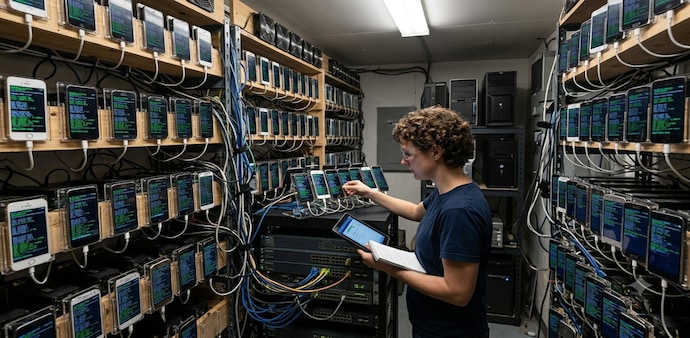
Researchers are experimenting with a concept called "phone cluster computing," where they plan to use old smartphones to build a data centre.
- Jun 22, 2026,
- Updated Jun 22, 2026 2:15 PM IST
Your old smartphone sitting in a drawer may be of greater use than you think. Google is planning to repurpose old smartphones and redeploy them to build a mini data centre. Researchers at the University of California, San Diego, in collaboration with Google, want to give smartphones a "second life" by turning them into a low-cost, environmentally friendly computing cluster for cloud-computing tasks.
This research is expected to bring a solution to the growing sustainability challenges due to the carbon footprint of computing. A Google blog post revealed why researchers are interested in turning old smartphones into computing clusters.
Turning smartphones into data centres
The researchers are experimenting with a concept called "phone cluster computing," where they use thousands of motherboards from old smartphones and link them into a distributed computing network. The setup will allow existing phone hardware to handle computing workloads similar to a data centre or cloud computing system. This reduces the need for newly built infrastructure.
With support from Google, the initial plans of the university are to build a data centre using 2,000 old Pixel smartphones. The system will then provide researchers and students with affordable cloud-computing resources. In addition, it also helps extend the life of existing hardware, reduce electronic waste, and lower carbon emissions.
The experiment further highlighted that a cluster of 20 phones could handle the workload of a university course with more than 75 students. The system also processed and graded submissions faster than the default backend running on Amazon Web Services (AWS) in that particular test.
Must read: Google starts rolling out Android 17 to Pixel phones: Check eligibility and what’s new
“A 2,000 phone deployment will be capable of supporting a hundred such classes at once,” the blog stated.
However, the research does not plan to compete with massive AI data centres operated by tech giants like Google, Amazon, and others. Instead, the team wants to create a cheaper and more environmentally friendly computing platform using retired smartphones. It was highlighted that the system will be used for basic data processing, research projects, testing environments, educational computing, or lightweight cloud services.
Why does this experiment matter?
The blog post highlighted two reasons: One that people replace hundreds of millions of smartphones each year, where the majority of them become electronic waste. And other is that the demand for computing power is rapidly increasing due to the growing artificial intelligence (AI) demand, cloud computing, and large-scale data processing.
This system may resolve several challenges as mentioned above. However, it does not come without technical issues. While still experimental, the concept may expand computing infrastructure beyond conventional servers, as it will also reduce costs and hardware requirements.
Google says that the full system could launch by Fall 2026.
For Unparalleled coverage of India's Businesses and Economy – Subscribe to Business Today Magazine
Your old smartphone sitting in a drawer may be of greater use than you think. Google is planning to repurpose old smartphones and redeploy them to build a mini data centre. Researchers at the University of California, San Diego, in collaboration with Google, want to give smartphones a "second life" by turning them into a low-cost, environmentally friendly computing cluster for cloud-computing tasks.
This research is expected to bring a solution to the growing sustainability challenges due to the carbon footprint of computing. A Google blog post revealed why researchers are interested in turning old smartphones into computing clusters.
Turning smartphones into data centres
The researchers are experimenting with a concept called "phone cluster computing," where they use thousands of motherboards from old smartphones and link them into a distributed computing network. The setup will allow existing phone hardware to handle computing workloads similar to a data centre or cloud computing system. This reduces the need for newly built infrastructure.
With support from Google, the initial plans of the university are to build a data centre using 2,000 old Pixel smartphones. The system will then provide researchers and students with affordable cloud-computing resources. In addition, it also helps extend the life of existing hardware, reduce electronic waste, and lower carbon emissions.
The experiment further highlighted that a cluster of 20 phones could handle the workload of a university course with more than 75 students. The system also processed and graded submissions faster than the default backend running on Amazon Web Services (AWS) in that particular test.
Must read: Google starts rolling out Android 17 to Pixel phones: Check eligibility and what’s new
“A 2,000 phone deployment will be capable of supporting a hundred such classes at once,” the blog stated.
However, the research does not plan to compete with massive AI data centres operated by tech giants like Google, Amazon, and others. Instead, the team wants to create a cheaper and more environmentally friendly computing platform using retired smartphones. It was highlighted that the system will be used for basic data processing, research projects, testing environments, educational computing, or lightweight cloud services.
Why does this experiment matter?
The blog post highlighted two reasons: One that people replace hundreds of millions of smartphones each year, where the majority of them become electronic waste. And other is that the demand for computing power is rapidly increasing due to the growing artificial intelligence (AI) demand, cloud computing, and large-scale data processing.
This system may resolve several challenges as mentioned above. However, it does not come without technical issues. While still experimental, the concept may expand computing infrastructure beyond conventional servers, as it will also reduce costs and hardware requirements.
Google says that the full system could launch by Fall 2026.
For Unparalleled coverage of India's Businesses and Economy – Subscribe to Business Today Magazine