
Why India's dependence on foreign AI is raising sovereignty concerns
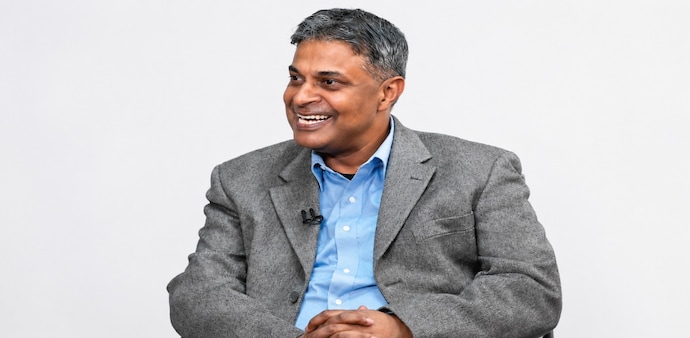
Nandan Nilekani championed India as the world's AI use-case capital. But a recent U.S. govt restriction on advanced AI access has lent weight to Sarvam AI's Vivek Raghavan's warning of "technological colonisation."
- Jun 15, 2026,
- Updated Jun 15, 2026 2:16 PM IST
As countries increasingly view control over critical technology infrastructure as a strategic imperative, the debate on technological sovereignty has taken on new urgency.
The latest trigger came when the U.S. government moved to restrict access to certain advanced AI models for foreign nationals, citing national security concerns. The development has once again sparked concern and raised a critical question: can India achieve true technological sovereignty if it continues to build primarily on platforms and foundational technologies developed elsewhere?
For decades, India has served as the world's technology back office, leveraging its engineering talent to build applications on technologies developed elsewhere. Even after ChatGPT's launch in 2022 sparked the AI race, many industry leaders argued that India should focus on AI use cases rather than expensive foundational models. Infosys Co-founder Nandan Nilekani was among the most vocal advocates of this view, urging India to become the world's "use-case capital" while leaving the development of large language models to global technology giants.
While speaking with Business Today, Vivek Raghavan, co-founder of Sarvam AI, had underscored why technological sovereignty matters and said, “Sovereignty is important in the long run. “It’s not about what we built today, tomorrow, or even 10 years from now. You have to look at the long arc.” He was blunt that without domestic AI capability, India risks becoming merely a consumer in a future shaped elsewhere, a new form of “technological colonisation.”
And he wasn’t wrong. The latest move by the US court amplified those concerns.
This is not the first instance of India's dependence on foreign technology platforms being exposed. In July 2025, Microsoft unilaterally cut off Nayara Energy, India's second-largest private oil refinery, from cloud services, Microsoft 365, Teams, and Outlook. Such episodes highlight a growing strategic vulnerability: when critical digital infrastructure is controlled elsewhere, access can become contingent on decisions beyond India's control.
To strengthen domestic AI capabilities and technological sovereignty, the Indian government launched the Rs 10,732-crore IndiaAI Mission. The push gained further momentum at the IndiaAI Impact Summit, billed as the largest AI gathering in the Global South, where Bengaluru-based startup Sarvam AI unveiled its indigenous foundational models, Sarvam 30B and Sarvam 105B, marking a significant milestone in India's quest for AI self-reliance.
As Raghavan had put it, real AI sovereignty is not just about building models. It requires control over the entire stack, right from data and algorithms to compute infrastructure and hardware.
“The most fundamental layer is energy. Running AI efficiently will increasingly depend on power availability, which is why smaller, more efficient models that consume less energy will matter. But overall, significant energy infrastructure will be needed.”
The next layer is semiconductor chips. “We are not in that race today. We will have to import. Over the long term, maybe five years, that could change. After that comes the question of how efficiently you run these imported systems at scale. That’s another gap in India today. Then come the models. We are playing in that layer. But ultimately, the models have to be orchestrated into platforms, and platforms into vertical applications. Sovereignty has to be built across all these layers.”
Without making its own graphic processing units (GPUs), countries will remain hostage to export restrictions, undermining technological independence. Yes, sovereignty is not only about hardware. Only a model trained on domestic, culturally relevant data and governed by local regulations—especially when deployed within controlled environments—can retain sovereignty over its behaviour, privacy, and output. However, technology today is no longer just an industry; it is the infrastructure on which modern economies, education systems, healthcare networks, defence capabilities and even geopolitical influence are built.
As AI becomes the operating layer of the digital world, control over foundational technologies is increasingly becoming a question of national power.
India won its political freedom in 1947. But in an era where access to computing infrastructure, AI models and critical digital platforms can be dictated by a handful of countries and corporations, a new debate is emerging. Can a nation truly be sovereign if the technologies powering its future are controlled elsewhere?
The question, then, is no longer whether India can build world-class technology. It is whether it can afford not to.
For Unparalleled coverage of India's Businesses and Economy – Subscribe to Business Today Magazine
As countries increasingly view control over critical technology infrastructure as a strategic imperative, the debate on technological sovereignty has taken on new urgency.
The latest trigger came when the U.S. government moved to restrict access to certain advanced AI models for foreign nationals, citing national security concerns. The development has once again sparked concern and raised a critical question: can India achieve true technological sovereignty if it continues to build primarily on platforms and foundational technologies developed elsewhere?
For decades, India has served as the world's technology back office, leveraging its engineering talent to build applications on technologies developed elsewhere. Even after ChatGPT's launch in 2022 sparked the AI race, many industry leaders argued that India should focus on AI use cases rather than expensive foundational models. Infosys Co-founder Nandan Nilekani was among the most vocal advocates of this view, urging India to become the world's "use-case capital" while leaving the development of large language models to global technology giants.
While speaking with Business Today, Vivek Raghavan, co-founder of Sarvam AI, had underscored why technological sovereignty matters and said, “Sovereignty is important in the long run. “It’s not about what we built today, tomorrow, or even 10 years from now. You have to look at the long arc.” He was blunt that without domestic AI capability, India risks becoming merely a consumer in a future shaped elsewhere, a new form of “technological colonisation.”
And he wasn’t wrong. The latest move by the US court amplified those concerns.
This is not the first instance of India's dependence on foreign technology platforms being exposed. In July 2025, Microsoft unilaterally cut off Nayara Energy, India's second-largest private oil refinery, from cloud services, Microsoft 365, Teams, and Outlook. Such episodes highlight a growing strategic vulnerability: when critical digital infrastructure is controlled elsewhere, access can become contingent on decisions beyond India's control.
To strengthen domestic AI capabilities and technological sovereignty, the Indian government launched the Rs 10,732-crore IndiaAI Mission. The push gained further momentum at the IndiaAI Impact Summit, billed as the largest AI gathering in the Global South, where Bengaluru-based startup Sarvam AI unveiled its indigenous foundational models, Sarvam 30B and Sarvam 105B, marking a significant milestone in India's quest for AI self-reliance.
As Raghavan had put it, real AI sovereignty is not just about building models. It requires control over the entire stack, right from data and algorithms to compute infrastructure and hardware.
“The most fundamental layer is energy. Running AI efficiently will increasingly depend on power availability, which is why smaller, more efficient models that consume less energy will matter. But overall, significant energy infrastructure will be needed.”
The next layer is semiconductor chips. “We are not in that race today. We will have to import. Over the long term, maybe five years, that could change. After that comes the question of how efficiently you run these imported systems at scale. That’s another gap in India today. Then come the models. We are playing in that layer. But ultimately, the models have to be orchestrated into platforms, and platforms into vertical applications. Sovereignty has to be built across all these layers.”
Without making its own graphic processing units (GPUs), countries will remain hostage to export restrictions, undermining technological independence. Yes, sovereignty is not only about hardware. Only a model trained on domestic, culturally relevant data and governed by local regulations—especially when deployed within controlled environments—can retain sovereignty over its behaviour, privacy, and output. However, technology today is no longer just an industry; it is the infrastructure on which modern economies, education systems, healthcare networks, defence capabilities and even geopolitical influence are built.
As AI becomes the operating layer of the digital world, control over foundational technologies is increasingly becoming a question of national power.
India won its political freedom in 1947. But in an era where access to computing infrastructure, AI models and critical digital platforms can be dictated by a handful of countries and corporations, a new debate is emerging. Can a nation truly be sovereign if the technologies powering its future are controlled elsewhere?
The question, then, is no longer whether India can build world-class technology. It is whether it can afford not to.
For Unparalleled coverage of India's Businesses and Economy – Subscribe to Business Today Magazine