
After UK and Australia, this Arab country bans social media for children. What's driving the crackdown?
Australia, Britain, and Canada have already tightened rules around children's access to social media amid concerns over online safety, cyberbullying, harmful content, and the impact of digital platforms on young people's wellbeing
- Jun 18, 2026,
- Updated Jun 18, 2026 6:59 PM IST
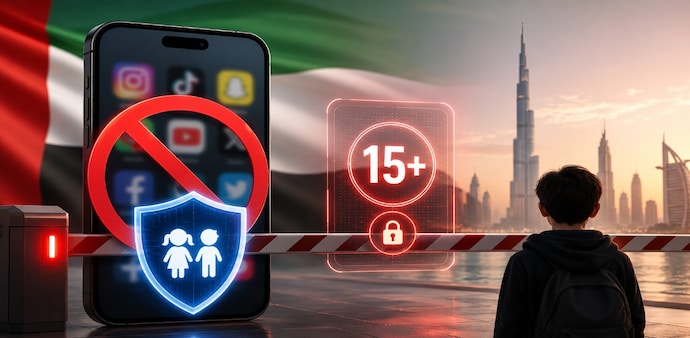
The United Arab Emirates has become the latest country to impose age restrictions on social media use by children, announcing a ban on personal social media accounts for those under 15 years of age.
The move places the UAE alongside countries such as Australia, Britain and Canada that have tightened rules around children's access to social media amid concerns over online safety, cyberbullying, harmful content and the impact of digital platforms on young people's wellbeing.
Under a cabinet resolution announced on Thursday and reported by AFP, social media companies operating in the UAE will have 12 months to comply with the new rules or face penalties, including the possibility of partial or full blocking of their platforms.
Don't Miss: ₹76 lakh from one reel, ₹25 lakh for a party: Orry reveals the price of his fame
What has the UAE announced?
According to the official WAM news agency, the cabinet resolution sets a minimum age of 15 for social media use. "Children below this age are prohibited from creating, using, or operating personal accounts on social media platforms."
The restrictions go beyond account creation. Children under 15 will also be barred from "accessing the full features of such platforms, including social interaction, publishing, commenting, sharing, joining public groups, open channels, or any large-scale interactive spaces".
Social media platforms will be required to monitor accounts and disable those belonging to under-15 users. Failure to comply could trigger enforcement action by UAE authorities.
According to WAM, the country's media and telecommunications regulators have the authority to take "all necessary measures" against non-compliant platforms, including warnings, administrative penalties and partial or complete blocking.
Must Read: Big change in Indian visa, consular services in the UAE from July 1; check details
Why are countries introducing such bans?
Governments pushing for restrictions argue that the risks associated with social media outweigh the benefits for children.
These concerns include cyberbullying, exposure to harmful content, online predators, privacy risks, and broader mental health impacts.
The UAE did not provide a detailed justification alongside the announcement, but its move mirrors arguments advanced by governments in Australia and Britain, both of which have cited child safety and wellbeing as key reasons for tightening regulations.
Australia's world-first social media ban
Australia became the first country to implement a nationwide social media ban for children when its Online Safety Amendment (Social Media Minimum Age) Bill 2024 came into effect on December 10, 2025.
The law mandates a minimum age of 16 for accounts on major social media platforms and does not allow parental consent as an exemption.
The Australian government has said the ban is necessary to protect the mental health and wellbeing of children and teenagers, arguing that threats such as cyberbullying, harmful content and online predators outweigh the positives of social media use.
The restrictions apply to platforms including YouTube, X, Facebook, Instagram, TikTok, Snapchat, Reddit, Twitch, Threads and Kick.
Technology companies can face fines of up to A$50 million if they fail to take reasonable steps to prevent under-16s from holding accounts.
However, services considered educational or child-focused, including Messenger Kids, WhatsApp, Kids Helpline, Google Classroom and YouTube Kids, are expected to remain outside the scope of the ban.
To verify users' ages, platforms are offering various methods, including age estimation through photographs or videos, while also providing alternatives to government-issued identification.
Britain goes even further
Britain this week unveiled plans that go beyond Australia's restrictions.
Prime Minister Keir Starmer said the government would ban social media access for under-16s and impose additional restrictions on gaming and livestreaming platforms.
The measures would cover Snapchat, TikTok, Instagram, YouTube, Facebook and X, while messaging services such as WhatsApp and Signal would remain exempt.
"It is clear to me a full ban is the right choice," Starmer said. "It will make a huge difference, it will make our children safer, it will make our children happier, it will give them more time, more security, more freedom to grow up, more opportunity."
Britain is also considering controls that extend beyond social media, including restrictions on strangers contacting children through gaming platforms, limits on livestreaming and potential curbs on features such as infinite scrolling.
Calling them "'World-leading blocks' on livestreaming and strangers contacting children", Starmer argued that online interactions should be subject to safeguards similar to those expected in the offline world.
"Is there a situation in the offline world where you would just let your child pair up with a stranger, an adult that you don't know anything about?" he said.
Like Australia, Britain plans to exempt children's and educational services such as YouTube Kids, Lego Play, and Google Classroom.
For Unparalleled coverage of India's Businesses and Economy – Subscribe to Business Today Magazine
The United Arab Emirates has become the latest country to impose age restrictions on social media use by children, announcing a ban on personal social media accounts for those under 15 years of age.
The move places the UAE alongside countries such as Australia, Britain and Canada that have tightened rules around children's access to social media amid concerns over online safety, cyberbullying, harmful content and the impact of digital platforms on young people's wellbeing.
Under a cabinet resolution announced on Thursday and reported by AFP, social media companies operating in the UAE will have 12 months to comply with the new rules or face penalties, including the possibility of partial or full blocking of their platforms.
Don't Miss: ₹76 lakh from one reel, ₹25 lakh for a party: Orry reveals the price of his fame
What has the UAE announced?
According to the official WAM news agency, the cabinet resolution sets a minimum age of 15 for social media use. "Children below this age are prohibited from creating, using, or operating personal accounts on social media platforms."
The restrictions go beyond account creation. Children under 15 will also be barred from "accessing the full features of such platforms, including social interaction, publishing, commenting, sharing, joining public groups, open channels, or any large-scale interactive spaces".
Social media platforms will be required to monitor accounts and disable those belonging to under-15 users. Failure to comply could trigger enforcement action by UAE authorities.
According to WAM, the country's media and telecommunications regulators have the authority to take "all necessary measures" against non-compliant platforms, including warnings, administrative penalties and partial or complete blocking.
Must Read: Big change in Indian visa, consular services in the UAE from July 1; check details
Why are countries introducing such bans?
Governments pushing for restrictions argue that the risks associated with social media outweigh the benefits for children.
These concerns include cyberbullying, exposure to harmful content, online predators, privacy risks, and broader mental health impacts.
The UAE did not provide a detailed justification alongside the announcement, but its move mirrors arguments advanced by governments in Australia and Britain, both of which have cited child safety and wellbeing as key reasons for tightening regulations.
Australia's world-first social media ban
Australia became the first country to implement a nationwide social media ban for children when its Online Safety Amendment (Social Media Minimum Age) Bill 2024 came into effect on December 10, 2025.
The law mandates a minimum age of 16 for accounts on major social media platforms and does not allow parental consent as an exemption.
The Australian government has said the ban is necessary to protect the mental health and wellbeing of children and teenagers, arguing that threats such as cyberbullying, harmful content and online predators outweigh the positives of social media use.
The restrictions apply to platforms including YouTube, X, Facebook, Instagram, TikTok, Snapchat, Reddit, Twitch, Threads and Kick.
Technology companies can face fines of up to A$50 million if they fail to take reasonable steps to prevent under-16s from holding accounts.
However, services considered educational or child-focused, including Messenger Kids, WhatsApp, Kids Helpline, Google Classroom and YouTube Kids, are expected to remain outside the scope of the ban.
To verify users' ages, platforms are offering various methods, including age estimation through photographs or videos, while also providing alternatives to government-issued identification.
Britain goes even further
Britain this week unveiled plans that go beyond Australia's restrictions.
Prime Minister Keir Starmer said the government would ban social media access for under-16s and impose additional restrictions on gaming and livestreaming platforms.
The measures would cover Snapchat, TikTok, Instagram, YouTube, Facebook and X, while messaging services such as WhatsApp and Signal would remain exempt.
"It is clear to me a full ban is the right choice," Starmer said. "It will make a huge difference, it will make our children safer, it will make our children happier, it will give them more time, more security, more freedom to grow up, more opportunity."
Britain is also considering controls that extend beyond social media, including restrictions on strangers contacting children through gaming platforms, limits on livestreaming and potential curbs on features such as infinite scrolling.
Calling them "'World-leading blocks' on livestreaming and strangers contacting children", Starmer argued that online interactions should be subject to safeguards similar to those expected in the offline world.
"Is there a situation in the offline world where you would just let your child pair up with a stranger, an adult that you don't know anything about?" he said.
Like Australia, Britain plans to exempt children's and educational services such as YouTube Kids, Lego Play, and Google Classroom.
For Unparalleled coverage of India's Businesses and Economy – Subscribe to Business Today Magazine