
Hidden AI cost: Global energy use hits 29.6 GW in 2025, says Stanford University report
Hidden AI cost: Global energy use hits 29.6 GW in 2025, says Stanford University report
The global AI computing capacity has surged by an estimated 3.3x per year, reaching a staggering 17.1 million GPUs by early 2026.
Business Today Desk
- Apr 14, 2026,
- Updated Apr 14, 2026 4:17 PM IST
Have you ever wondered what happens behind the scenes when an Artificial Intelligence (AI) chatbot responds to everyday queries, generates images, or assists with research? While breakthroughs in machine learning may appear innovative, the reality of a simple prompt often goes unnoticed. Each user query relies on a vast, complex, and expensive infrastructure that makes it all possible.
Advertisement
The Stanford University AI Index 2026 report highlights that AI progress is no longer just about advances in software and systems, as the demand has shifted toward industrial-scale hardware infrastructure. It states that global AI computing capacity has surged by an estimated 3.3x per year, reaching a staggering 17.1 million GPUs by early 2026.
This growth is so significant that it is pushing governments and tech companies to rethink energy supply, electricity grids, and global supply chains. Google, Microsoft, Amazon, and Meta are committing hundreds of billions of dollars to AI‑dedicated data centres and power infrastructure.
Also read: Inside India’s first open-access quantum test beds in Amaravati built at half the global cost
Rise in AI computing capacity
The study reveals that the scale of computing power used for AI today is immense and expanding at a rapid pace. Since 2022, AI computing capacity has increased more than threefold every year. It has now reached the equivalent of 17.1 million high-end AI chips like Nvidia’s H100.
Advertisement
The world’s AI computing capacity is majorly dominated by tech giants like Nvidia, Google, and Amazon. Stanford University study states that Nvidia provides over 60% of the world’s AI accelerator capacity, whereas Google and Amazon hold a large portion of the rest. These companies are spending heavily on infrastructure to secure hardware for custom chips, data centres, and other hardware.
“The growth in compute capacity tracks closely with investment patterns, where leading AI companies have increased their capital expenditure, and infrastructure has become the fastest growing focus area of private AI funding,” the report stated.
Advertisement
Also read: India’s data centre capacity set to reach 2GW by 2026, backed by $30 billion in investments: Report
Sobering energy cost for AI innovations
The study reveals the hidden costs behind the rapid growth of AI, and its majorly associated with the huge amount of energy required to power data centres, train complex models, and sustain continuous computational workloads.
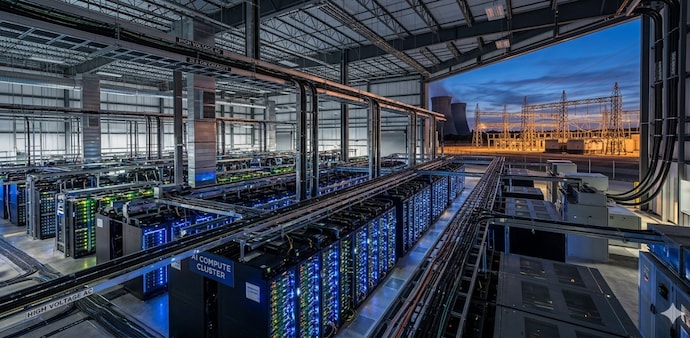
By late 2025, AI data centres were using about 29.6 gigawatts of power globally, which is equivalent to the peak electricity demand of New York State. Out of this, only about 11.8 gigawatts were used by the AI chips, and the rest of the power was used to support systems like cooling, networking, and other data centre components, the report stated.
However, the AI infrastructure goes beyond powerful chips, as the modern AI data centres also depend on a layered stack of components, consisting of a complex, layered ecosystem of hardware and infrastructure that works together behind the scenes.
These complex ecosystems depend heavily on tech companies like Taiwan Semiconductor Manufacturing Company (TSMC), Nvidia, SK Hynix, Samsung Foundry, and others, which will each serve different roles in terms of designing, manufacturing, assembly, and others.
Now, as we are halfway through 2026, securing and building AI infrastructure has become the utmost priority. While the world watches the latest AI model releases, the real battle lies in semiconductor foundries and the electrical substations, where new capacity must be added just to keep pace with AI‑related power demand.
For Unparalleled coverage of India's Businesses and Economy – Subscribe to Business Today Magazine
Have you ever wondered what happens behind the scenes when an Artificial Intelligence (AI) chatbot responds to everyday queries, generates images, or assists with research? While breakthroughs in machine learning may appear innovative, the reality of a simple prompt often goes unnoticed. Each user query relies on a vast, complex, and expensive infrastructure that makes it all possible.
Advertisement
The Stanford University AI Index 2026 report highlights that AI progress is no longer just about advances in software and systems, as the demand has shifted toward industrial-scale hardware infrastructure. It states that global AI computing capacity has surged by an estimated 3.3x per year, reaching a staggering 17.1 million GPUs by early 2026.
This growth is so significant that it is pushing governments and tech companies to rethink energy supply, electricity grids, and global supply chains. Google, Microsoft, Amazon, and Meta are committing hundreds of billions of dollars to AI‑dedicated data centres and power infrastructure.
Also read: Inside India’s first open-access quantum test beds in Amaravati built at half the global cost
Rise in AI computing capacity
The study reveals that the scale of computing power used for AI today is immense and expanding at a rapid pace. Since 2022, AI computing capacity has increased more than threefold every year. It has now reached the equivalent of 17.1 million high-end AI chips like Nvidia’s H100.
Advertisement
The world’s AI computing capacity is majorly dominated by tech giants like Nvidia, Google, and Amazon. Stanford University study states that Nvidia provides over 60% of the world’s AI accelerator capacity, whereas Google and Amazon hold a large portion of the rest. These companies are spending heavily on infrastructure to secure hardware for custom chips, data centres, and other hardware.
“The growth in compute capacity tracks closely with investment patterns, where leading AI companies have increased their capital expenditure, and infrastructure has become the fastest growing focus area of private AI funding,” the report stated.
Advertisement
Also read: India’s data centre capacity set to reach 2GW by 2026, backed by $30 billion in investments: Report
Sobering energy cost for AI innovations
The study reveals the hidden costs behind the rapid growth of AI, and its majorly associated with the huge amount of energy required to power data centres, train complex models, and sustain continuous computational workloads.
By late 2025, AI data centres were using about 29.6 gigawatts of power globally, which is equivalent to the peak electricity demand of New York State. Out of this, only about 11.8 gigawatts were used by the AI chips, and the rest of the power was used to support systems like cooling, networking, and other data centre components, the report stated.
However, the AI infrastructure goes beyond powerful chips, as the modern AI data centres also depend on a layered stack of components, consisting of a complex, layered ecosystem of hardware and infrastructure that works together behind the scenes.
These complex ecosystems depend heavily on tech companies like Taiwan Semiconductor Manufacturing Company (TSMC), Nvidia, SK Hynix, Samsung Foundry, and others, which will each serve different roles in terms of designing, manufacturing, assembly, and others.
Now, as we are halfway through 2026, securing and building AI infrastructure has become the utmost priority. While the world watches the latest AI model releases, the real battle lies in semiconductor foundries and the electrical substations, where new capacity must be added just to keep pace with AI‑related power demand.
For Unparalleled coverage of India's Businesses and Economy – Subscribe to Business Today Magazine
Read more!