
From a social media joke to national security strategy: Why Trump wants the US to own Greenland
In recent remarks, Trump argued that US ownership of Greenland is essential for national and global security. He has claimed that maintaining influence through alliances alone is no longer sufficient, stressing that control over key territories will determine future power dynamics.
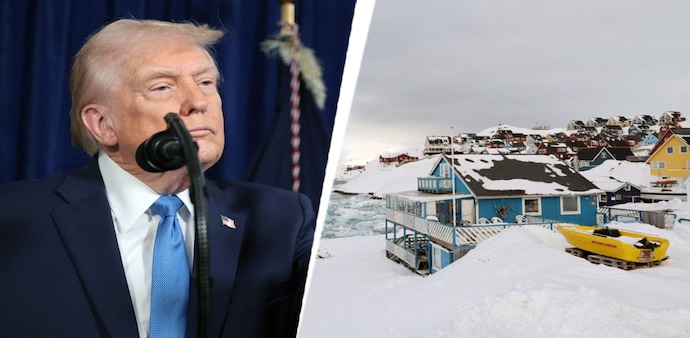
- Jan 16, 2026,
- Updated Jan 16, 2026 9:39 PM IST
US President Donald Trump’s renewed interest in acquiring Greenland has reignited a global debate over sovereignty, security, and great-power rivalry in the Arctic. Six years ago, US President Donald Trump appeared to joke about his interest in Greenland, sharing an edited image on social media of a quiet coastal town dwarfed by a towering golden skyscraper bearing his name. Today, that once-viral post has taken on new significance.
Trump’s renewed push to acquire Greenland has shifted from meme to message, as he now frames control of the Arctic island as a strategic imperative tied to missile defence, emerging sea routes, and preserving US dominance in a rapidly changing global power order. US President Donald Trump has talked about acquiring Greenland, a self-governing Danish territory, since a daring military operation to depose Venezuelan President Nicolás Maduro on January 3.
What Trump has said recently
In recent remarks, Trump argued that US ownership of Greenland is essential for national and global security. He has claimed that maintaining influence through alliances alone is no longer sufficient, stressing that control over key territories will determine future power dynamics. According to Trump, if the United States does not act decisively, rivals such as China and Russia could expand their footprint in the Arctic.
Trump has also linked Greenland directly to his broader vision of keeping the US at the “centre of power” in the Western Hemisphere, warning that strategic complacency could weaken America’s global standing.
Why Greenland is a strategic asset for the US
1. Golden Dome missile shield: One of the most significant reasons cited by Trump is Greenland’s role in his proposed “Golden Dome” missile defence system. Due to its geographic position near the Arctic Circle, Greenland sits along potential missile trajectories that could be used in a long-range attack on North America.
The island offers a critical vantage point for early-warning radars, missile tracking, and space surveillance systems. The US already operates advanced defence infrastructure there, making Greenland a cornerstone for any expanded missile shield designed to protect the American mainland.
2. Arctic Sea routes & Chinese interest: Climate change has made Arctic waters increasingly navigable, opening up new sea lanes that could dramatically shorten shipping routes between Asia, Europe, and North America. Trump has repeatedly pointed to concerns that Chinese commercial and research vessels may use Arctic routes for strategic advantage.
Control over Greenland would give the US greater leverage over emerging Arctic shipping corridors and reinforce its ability to monitor maritime activity in a region that is fast becoming a new arena of geopolitical competition.
3. Military & Geopolitical positioning: Greenland lies near the Greenland-Iceland-UK (GIUK) gap, a historically important choke point used to monitor naval movements between the Arctic and the Atlantic Ocean. For decades, this region has been central to Western defence planning.
By acquiring Greenland, the US would strengthen its strategic depth in the North Atlantic, countering potential Russian military movements and reinforcing its Arctic posture.
Resources & Long-term value
Beyond defence, Greenland is rich in rare earth minerals and other critical resources essential for modern technologies, including electric vehicles, defence systems, and renewable energy infrastructure. Reducing dependence on China for these materials has been a long-standing US objective.
The island also holds potential reserves of oil, gas, and uranium, adding to its long-term economic and strategic value as Arctic ice continues to recede.
A 2019 social media post
Trump’s Greenland ambitions first drew global attention in 2019, when he shared a now-viral tweet featuring an edited image of a Greenland coastal town with colourful houses overshadowed by a towering golden skyscraper bearing his name.
The caption read: “I promise not to do this to Greenland!”
At the time, the post was widely interpreted as humorous. Six years later, the image has resurfaced as Trump’s renewed push has turned what once seemed like a joke into a serious geopolitical conversation.
Sovereignty & pushback
Greenland is a semi-autonomous territory within the Kingdom of Denmark, and both Danish and Greenlandic leaders have firmly rejected any suggestion of a sale. Greenland’s leadership has emphasised the island’s right to self-determination, while Denmark has reiterated that sovereignty is non-negotiable.
Despite this, Trump continues to frame the issue as one of global security rather than real estate, suggesting that control over Greenland could define the balance of power in the Arctic for decades to come.
Trump’s Greenland push reflects a broader shift in US strategic thinking, where geography, missile defence, and control over future trade routes are once again central to national security planning. As Arctic ice melts and competition intensifies, Greenland has moved from the periphery of global politics to its very centre.
US President Donald Trump’s renewed interest in acquiring Greenland has reignited a global debate over sovereignty, security, and great-power rivalry in the Arctic. Six years ago, US President Donald Trump appeared to joke about his interest in Greenland, sharing an edited image on social media of a quiet coastal town dwarfed by a towering golden skyscraper bearing his name. Today, that once-viral post has taken on new significance.
Trump’s renewed push to acquire Greenland has shifted from meme to message, as he now frames control of the Arctic island as a strategic imperative tied to missile defence, emerging sea routes, and preserving US dominance in a rapidly changing global power order. US President Donald Trump has talked about acquiring Greenland, a self-governing Danish territory, since a daring military operation to depose Venezuelan President Nicolás Maduro on January 3.
What Trump has said recently
In recent remarks, Trump argued that US ownership of Greenland is essential for national and global security. He has claimed that maintaining influence through alliances alone is no longer sufficient, stressing that control over key territories will determine future power dynamics. According to Trump, if the United States does not act decisively, rivals such as China and Russia could expand their footprint in the Arctic.
Trump has also linked Greenland directly to his broader vision of keeping the US at the “centre of power” in the Western Hemisphere, warning that strategic complacency could weaken America’s global standing.
Why Greenland is a strategic asset for the US
1. Golden Dome missile shield: One of the most significant reasons cited by Trump is Greenland’s role in his proposed “Golden Dome” missile defence system. Due to its geographic position near the Arctic Circle, Greenland sits along potential missile trajectories that could be used in a long-range attack on North America.
The island offers a critical vantage point for early-warning radars, missile tracking, and space surveillance systems. The US already operates advanced defence infrastructure there, making Greenland a cornerstone for any expanded missile shield designed to protect the American mainland.
2. Arctic Sea routes & Chinese interest: Climate change has made Arctic waters increasingly navigable, opening up new sea lanes that could dramatically shorten shipping routes between Asia, Europe, and North America. Trump has repeatedly pointed to concerns that Chinese commercial and research vessels may use Arctic routes for strategic advantage.
Control over Greenland would give the US greater leverage over emerging Arctic shipping corridors and reinforce its ability to monitor maritime activity in a region that is fast becoming a new arena of geopolitical competition.
3. Military & Geopolitical positioning: Greenland lies near the Greenland-Iceland-UK (GIUK) gap, a historically important choke point used to monitor naval movements between the Arctic and the Atlantic Ocean. For decades, this region has been central to Western defence planning.
By acquiring Greenland, the US would strengthen its strategic depth in the North Atlantic, countering potential Russian military movements and reinforcing its Arctic posture.
Resources & Long-term value
Beyond defence, Greenland is rich in rare earth minerals and other critical resources essential for modern technologies, including electric vehicles, defence systems, and renewable energy infrastructure. Reducing dependence on China for these materials has been a long-standing US objective.
The island also holds potential reserves of oil, gas, and uranium, adding to its long-term economic and strategic value as Arctic ice continues to recede.
A 2019 social media post
Trump’s Greenland ambitions first drew global attention in 2019, when he shared a now-viral tweet featuring an edited image of a Greenland coastal town with colourful houses overshadowed by a towering golden skyscraper bearing his name.
The caption read: “I promise not to do this to Greenland!”
At the time, the post was widely interpreted as humorous. Six years later, the image has resurfaced as Trump’s renewed push has turned what once seemed like a joke into a serious geopolitical conversation.
Sovereignty & pushback
Greenland is a semi-autonomous territory within the Kingdom of Denmark, and both Danish and Greenlandic leaders have firmly rejected any suggestion of a sale. Greenland’s leadership has emphasised the island’s right to self-determination, while Denmark has reiterated that sovereignty is non-negotiable.
Despite this, Trump continues to frame the issue as one of global security rather than real estate, suggesting that control over Greenland could define the balance of power in the Arctic for decades to come.
Trump’s Greenland push reflects a broader shift in US strategic thinking, where geography, missile defence, and control over future trade routes are once again central to national security planning. As Arctic ice melts and competition intensifies, Greenland has moved from the periphery of global politics to its very centre.