
40 days to empty: Inside Mumbai's desperate race to conserve water as reservoirs fall below 10%
Under the new guidelines, commercial and industrial establishments — including aerated beverage and packaged drinking water bottling plants — face a steep 20% slash in water allocation.
- Jun 20, 2026,
- Updated Jun 20, 2026 3:07 PM IST
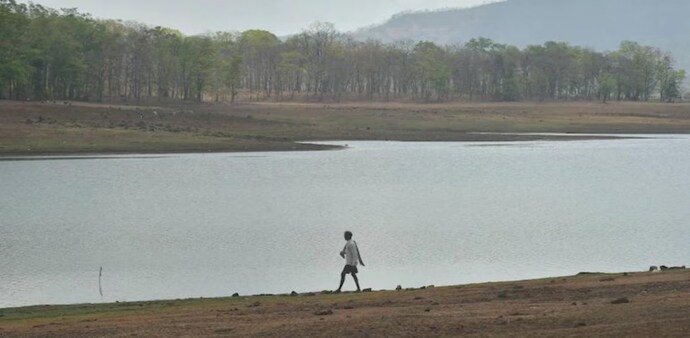
The advance of the southwest monsoon across India has stalled for eight consecutive days, leaving the reservoirs that sustain India's financial capital retreating into dust. Satellite radar imagery analyzed by the European Space Agency's Copernicus programme reveals a stark contraction of Mumbai's surface-water extent, capturing the literal shrinking of shorelines between June 2025 and June 2026.
With combined storage levels plunging to 9.34% — the lowest for this date in three years — the Brihanmumbai Municipal Corporation (BMC) has sounded the alarm. The seven lakes supplying Mumbai currently hold just 1.55 lakh million litres against an annual capacity of nearly 14.5 lakh million litres. Left with fewer than 40 days of drinking water, the civic body has radically tightened its grip on the city's water supply.
MUST READ | Monsoon 2026: IMD issues yellow alert for Mumbai, metropolis to get respite from heat on THIS date
"A meeting was held at the civic headquarters to review the current water stock situation and decide on water conservation measures so that the available water stocks are able to suffice at least till the time the monsoon picks up pace and lakes start filling," the BMC said in an official statement. "It was hence decided that all water connections provided for construction activities will be temporarily disconnected, while no new construction water connections will be approved until further orders. Water supply to swimming pools will also be suspended."
The fresh round of austerity measures expands on the 10% citywide domestic water cut that has been in place since May 15. Under the new guidelines, commercial and industrial establishments — including aerated beverage and packaged drinking water bottling plants — face a steep 20% slash in water allocation.
DON'T MISS | Monsoon loses momentum, rainfall deficit widens to 40% across India
The structural anatomy of the crisis reveals profound stress on specific water channels:
- Upper Vaitarna: The reservoir has fallen entirely below its lowest drawdown level. Its available useful live storage is officially recorded at 0%.
- Tansa: Useful capacity has plummeted to a critical 3.87%.
- Bhatsa: As the largest source in Mumbai's water network, it holds nearly 46% of all available useful water but is sitting at a fragile 8.63% of its own capacity.
- Vihar & Tulsi: The small reservoirs inside Sanjay Gandhi National Park are performing better at 41.63% and 22.53% capacity, respectively, but their volumes do little to move the needle for a city requiring 4,664 million litres of water daily.
The civic administration has directed major state-run entities, including the Central and Western Railways, the Indian Navy, and the Mumbai Port Authority, to completely maximize the use of treated sewage water for operational needs. Furthermore, public toilet operators have been instructed to rely strictly on tankers or borewells.
DO CHECKOUT | Where is Mumbai's monsoon? City records barely any rain as El Nino threat grows
Meteorologists attribute the delayed monsoon to the lingering effects of El Niño, which weakened southwesterly winds and stymied moisture transport across the Arabian Sea. While weather models suggest conditions could turn favorable around June 23, local showers will not resolve the crisis.
Until heavy, sustained downpours lock over the distant catchment areas outside city limits, Mumbai remains locked in a high-stakes waiting game against nature, running entirely on borrowed time.
The advance of the southwest monsoon across India has stalled for eight consecutive days, leaving the reservoirs that sustain India's financial capital retreating into dust. Satellite radar imagery analyzed by the European Space Agency's Copernicus programme reveals a stark contraction of Mumbai's surface-water extent, capturing the literal shrinking of shorelines between June 2025 and June 2026.
With combined storage levels plunging to 9.34% — the lowest for this date in three years — the Brihanmumbai Municipal Corporation (BMC) has sounded the alarm. The seven lakes supplying Mumbai currently hold just 1.55 lakh million litres against an annual capacity of nearly 14.5 lakh million litres. Left with fewer than 40 days of drinking water, the civic body has radically tightened its grip on the city's water supply.
MUST READ | Monsoon 2026: IMD issues yellow alert for Mumbai, metropolis to get respite from heat on THIS date
"A meeting was held at the civic headquarters to review the current water stock situation and decide on water conservation measures so that the available water stocks are able to suffice at least till the time the monsoon picks up pace and lakes start filling," the BMC said in an official statement. "It was hence decided that all water connections provided for construction activities will be temporarily disconnected, while no new construction water connections will be approved until further orders. Water supply to swimming pools will also be suspended."
The fresh round of austerity measures expands on the 10% citywide domestic water cut that has been in place since May 15. Under the new guidelines, commercial and industrial establishments — including aerated beverage and packaged drinking water bottling plants — face a steep 20% slash in water allocation.
DON'T MISS | Monsoon loses momentum, rainfall deficit widens to 40% across India
The structural anatomy of the crisis reveals profound stress on specific water channels:
- Upper Vaitarna: The reservoir has fallen entirely below its lowest drawdown level. Its available useful live storage is officially recorded at 0%.
- Tansa: Useful capacity has plummeted to a critical 3.87%.
- Bhatsa: As the largest source in Mumbai's water network, it holds nearly 46% of all available useful water but is sitting at a fragile 8.63% of its own capacity.
- Vihar & Tulsi: The small reservoirs inside Sanjay Gandhi National Park are performing better at 41.63% and 22.53% capacity, respectively, but their volumes do little to move the needle for a city requiring 4,664 million litres of water daily.
The civic administration has directed major state-run entities, including the Central and Western Railways, the Indian Navy, and the Mumbai Port Authority, to completely maximize the use of treated sewage water for operational needs. Furthermore, public toilet operators have been instructed to rely strictly on tankers or borewells.
DO CHECKOUT | Where is Mumbai's monsoon? City records barely any rain as El Nino threat grows
Meteorologists attribute the delayed monsoon to the lingering effects of El Niño, which weakened southwesterly winds and stymied moisture transport across the Arabian Sea. While weather models suggest conditions could turn favorable around June 23, local showers will not resolve the crisis.
Until heavy, sustained downpours lock over the distant catchment areas outside city limits, Mumbai remains locked in a high-stakes waiting game against nature, running entirely on borrowed time.