
Cloud kitchens vs dine-in restaurants: Which business model is making more money?
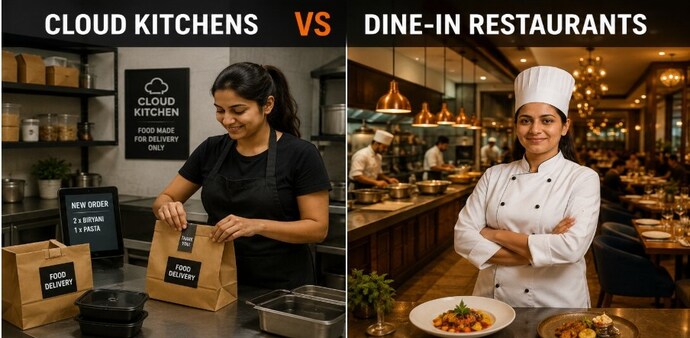
Cloud kitchens are emerging as the more profitable business model in India's rapidly growing food services industry, thanks to lower costs and a delivery-first approach. But as organised restaurant chains expand, dine-in outlets continue to hold their ground by offering experiences that online delivery cannot replicate.
- Jul 3, 2026,
- Updated Jul 3, 2026 8:20 AM IST
India's food services industry is entering a new phase where profitability, rather than just rapid expansion, is becoming the biggest differentiator. While both cloud kitchens and dine-in restaurants continue to benefit from rising consumer spending and growing online food delivery, a new report by Redseer suggests that cloud kitchens currently enjoy a structural advantage when it comes to margins.
According to the report, cloud kitchens can generate EBITDA margins of around 12%, compared with roughly 8% for comparable dine-in restaurants. The difference stems largely from lower capital requirements, leaner operations and a delivery-first business model.
Lower costs improve profitability
Cloud kitchens operate without customer seating, expensive interiors or premium high-street locations. As a result, they require significantly lower upfront investment than traditional restaurants.
Redseer estimates that opening a dine-in restaurant typically requires more than twice the initial capital needed for a cloud kitchen. If liquor licences are included, the investment requirement can rise to nearly three times that of a cloud kitchen.
Operating costs are also lower. Cloud kitchens save on rent, front-of-house staff, utilities and maintenance while concentrating resources on food preparation and delivery. Although these businesses pay commissions to online delivery platforms, the report suggests the overall economics remain more favourable because fixed costs are substantially lower.
MUST READ: Eternal, Swiggy shares: Blinkit to beat Instamart in Q1? JM's top bet has 70% upside potential
Online delivery is driving the shift
India's food delivery market has expanded rapidly over the past few years, making cloud kitchens an increasingly attractive format.
Unlike traditional restaurant chains, which derive roughly half their revenue from online orders, many digital-first brands now generate around 90% of their sales through delivery platforms. This allows them to expand into multiple cities without investing in expensive dine-in outlets.
The report also highlights that Tier-2 and smaller cities are becoming major growth centres for online food delivery, further strengthening the business case for cloud kitchens.
Why profitability remains challenging
Despite favourable industry trends, making money in the restaurant business is still difficult.
Food inflation, employee costs, rental expenses and intense competition continue to squeeze margins. Many brands have focused on rapid expansion over the past few years, but investors are now placing greater emphasis on sustainable profitability rather than topline growth alone.
According to Redseer, only around 2% of India's organised food service companies have managed to cross ₹500 crore in annual revenue, highlighting how difficult it remains to build scale while maintaining healthy margins.
MUST READ: 'Dinner, not consent': Zomato clarifies on '₹370 biryani' notification controversy
Three strategies that successful brands follow
The report identifies three common traits among profitable food businesses.
First is adopting a cloud kitchen-led operating model, which reduces occupancy costs and improves capital efficiency. Companies such as Rebel Foods, Bakingo and Mani's Dum Biryani have successfully used this approach to expand across multiple markets.
Second is maintaining focused menus with fewer stock-keeping units (SKUs). A smaller menu simplifies procurement, reduces food wastage and improves kitchen efficiency.
The third strategy is premium positioning. Brands that differentiate themselves through superior quality, healthier offerings or unique customer experiences can command higher average order values while relying less on discounts to attract customers.
MUST READ: Inside Swiggy’s battle to become an Indian-owned company and why Eternal had it easier
Dine-in restaurants still have advantages
Cloud kitchens may currently enjoy stronger unit economics, but traditional restaurants continue to play an important role.
Dining out remains an experience that cannot be replicated through delivery. Family gatherings, celebrations, business meetings and premium dining occasions continue to drive footfall at restaurants. Full-service outlets also benefit from higher-margin categories such as beverages and alcohol, which are not always available through delivery platforms.
Many established brands are therefore adopting a hybrid strategy by operating both dine-in outlets and cloud kitchens to maximise reach and profitability.
The outlook
Redseer expects India's food services market to expand from around $90 billion in 2025 to nearly $150 billion by 2030, with organised players significantly outpacing the unorganised sector. As competition intensifies, the report suggests that the most successful companies will not necessarily choose one format over another. Instead, businesses that combine efficient delivery operations, disciplined cost management, focused menus and strong brand positioning are likely to emerge as the biggest winners in India's rapidly evolving food services industry.
MUST READ: Why your Swiggy-Zomato order may get costlier now, here’s the math
India's food services industry is entering a new phase where profitability, rather than just rapid expansion, is becoming the biggest differentiator. While both cloud kitchens and dine-in restaurants continue to benefit from rising consumer spending and growing online food delivery, a new report by Redseer suggests that cloud kitchens currently enjoy a structural advantage when it comes to margins.
According to the report, cloud kitchens can generate EBITDA margins of around 12%, compared with roughly 8% for comparable dine-in restaurants. The difference stems largely from lower capital requirements, leaner operations and a delivery-first business model.
Lower costs improve profitability
Cloud kitchens operate without customer seating, expensive interiors or premium high-street locations. As a result, they require significantly lower upfront investment than traditional restaurants.
Redseer estimates that opening a dine-in restaurant typically requires more than twice the initial capital needed for a cloud kitchen. If liquor licences are included, the investment requirement can rise to nearly three times that of a cloud kitchen.
Operating costs are also lower. Cloud kitchens save on rent, front-of-house staff, utilities and maintenance while concentrating resources on food preparation and delivery. Although these businesses pay commissions to online delivery platforms, the report suggests the overall economics remain more favourable because fixed costs are substantially lower.
MUST READ: Eternal, Swiggy shares: Blinkit to beat Instamart in Q1? JM's top bet has 70% upside potential
Online delivery is driving the shift
India's food delivery market has expanded rapidly over the past few years, making cloud kitchens an increasingly attractive format.
Unlike traditional restaurant chains, which derive roughly half their revenue from online orders, many digital-first brands now generate around 90% of their sales through delivery platforms. This allows them to expand into multiple cities without investing in expensive dine-in outlets.
The report also highlights that Tier-2 and smaller cities are becoming major growth centres for online food delivery, further strengthening the business case for cloud kitchens.
Why profitability remains challenging
Despite favourable industry trends, making money in the restaurant business is still difficult.
Food inflation, employee costs, rental expenses and intense competition continue to squeeze margins. Many brands have focused on rapid expansion over the past few years, but investors are now placing greater emphasis on sustainable profitability rather than topline growth alone.
According to Redseer, only around 2% of India's organised food service companies have managed to cross ₹500 crore in annual revenue, highlighting how difficult it remains to build scale while maintaining healthy margins.
MUST READ: 'Dinner, not consent': Zomato clarifies on '₹370 biryani' notification controversy
Three strategies that successful brands follow
The report identifies three common traits among profitable food businesses.
First is adopting a cloud kitchen-led operating model, which reduces occupancy costs and improves capital efficiency. Companies such as Rebel Foods, Bakingo and Mani's Dum Biryani have successfully used this approach to expand across multiple markets.
Second is maintaining focused menus with fewer stock-keeping units (SKUs). A smaller menu simplifies procurement, reduces food wastage and improves kitchen efficiency.
The third strategy is premium positioning. Brands that differentiate themselves through superior quality, healthier offerings or unique customer experiences can command higher average order values while relying less on discounts to attract customers.
MUST READ: Inside Swiggy’s battle to become an Indian-owned company and why Eternal had it easier
Dine-in restaurants still have advantages
Cloud kitchens may currently enjoy stronger unit economics, but traditional restaurants continue to play an important role.
Dining out remains an experience that cannot be replicated through delivery. Family gatherings, celebrations, business meetings and premium dining occasions continue to drive footfall at restaurants. Full-service outlets also benefit from higher-margin categories such as beverages and alcohol, which are not always available through delivery platforms.
Many established brands are therefore adopting a hybrid strategy by operating both dine-in outlets and cloud kitchens to maximise reach and profitability.
The outlook
Redseer expects India's food services market to expand from around $90 billion in 2025 to nearly $150 billion by 2030, with organised players significantly outpacing the unorganised sector. As competition intensifies, the report suggests that the most successful companies will not necessarily choose one format over another. Instead, businesses that combine efficient delivery operations, disciplined cost management, focused menus and strong brand positioning are likely to emerge as the biggest winners in India's rapidly evolving food services industry.
MUST READ: Why your Swiggy-Zomato order may get costlier now, here’s the math