


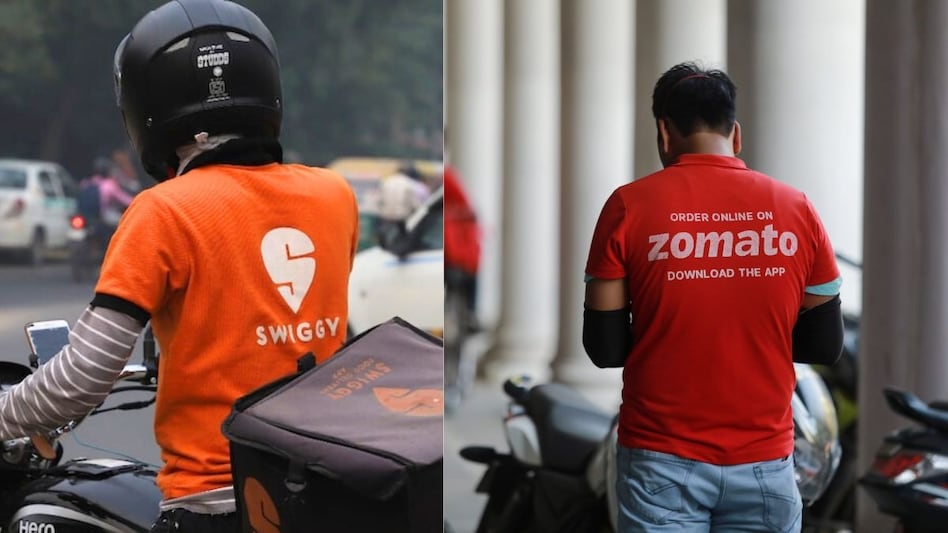
 Your Swiggy, Zomato orders might get expensive, says Elara Capital
Your Swiggy-Zomato order may now get costlier. And no points for guessing that the war’s to be blamed for it!
Here’s what’s happening – thanks to the rise in fuel prices, the overall pricing of an order is likely to go up. According to a report by Elara Capital, the average delivery cost is estimated to be in the range of ₹35-50 per order for quick commerce, and ₹55-60 for food delivery.
How the delivery cost stacks up:
If the fuel accounts for ~20 per cent of the delivery, then the implied fuel cost per order would be ₹9-10 on a blended basis.
This means that a ~4 per cent fuel price increase would imply a negative impact of ₹0.44 per order.
MUST READ | Why Swiggy wants to stop being called ‘foreign-controlled’
If fuel prices are further increased to ~₹10 per litre in the next 3-6 months, then the blended per-order impact would increase to ~₹1-1.2 per order.
“This impact is likely to be shared partly through customer pass-through, partly absorbed by the platforms and partly reflected in compression of delivery partner economics,” it said.
Then there is the question of EVs…
As per Elara Capital, if fuel prices increased by ₹10 per litre, EV and cycle penetration could be higher in quick commerce at ~30-40 per cent, while in food delivery it could be ~20 per cent.
“On a blended basis, we assume that the effective fuel-linked impact would apply to ~70 per cent of total orders. Hence, adjusted for EV/cycle penetration, even in the case of a ~₹10/ litre fuel hike, the net EBITDA impact may be closer to ~₹1-2 billion, implying only ~ 4-5/10-12 per cent FY27E adjusted EBITDA downgrade for ETERNAL/SWIGGY, respectively. The impact is higher for Swiggy given its lower profitability cushion and ongoing path towards contribution break-even in quick commerce,” it said.
DON'T MISS | ₹3-4 petrol, diesel price hike isn’t enough; Kotak sees need for ₹13–17 more per litre
Fuel-led cost pressures
The report added that Eternal (Zomato) is better placed than Swiggy to manage fuel-led cost pressures. It said this is due to the stronger pass-through ability and higher ad revenue scale.
“Eternal’s customer base is more premium and less price-sensitive, which gives the company a higher propensity to recover cost rise through platform fees, delivery fee optimisation and handling charges across both food delivery and quick commerce. Further, Eternal’s larger scale and stronger ad revenue base provide an additional margin cushion versus Swiggy. In contrast, Swiggy may face a higher impact, given lower profitability cushion in quick commerce and a more sensitive customer base. Hence, while both the platforms have pass-through levers, Eternal’s ability to absorb and recover fuel-led cost inflation is stronger,” it argued.
FAQs
Why may Swiggy and Zomato orders become costlier now?
Orders may become costlier because rising fuel prices are increasing delivery costs. As fuel is a key part of last-mile delivery, platforms may pass some of this extra burden to customers through higher delivery charges, platform fees or handling fees.
How much is the average delivery cost for quick commerce and food delivery?
According to the report cited in the article, the average delivery cost is estimated at around ₹35-50 per order for quick commerce and ₹55-60 per order for food delivery. This gives an idea of how fuel price changes can affect total order economics.
What is the impact of a fuel price hike on each order?
If fuel makes up about 20 per cent of delivery cost, the implied fuel cost works out to roughly ₹9-10 per order on a blended basis. A 4 per cent fuel price increase may lead to a negative impact of about ₹0.44 per order, while a ₹10 per litre hike could raise the impact to around ₹1-1.2 per order.
Will electric vehicles and cycles reduce the impact of higher fuel prices?
Yes, to some extent. The report says EV and cycle usage may be higher in quick commerce at around 30-40 per cent and about 20 per cent in food delivery if fuel prices rise sharply. This can soften the fuel-linked cost impact because not all orders depend fully on petrol or diesel.
Is Zomato or Swiggy better placed to handle fuel-led cost pressure?
The report suggests Zomato, referred to as Eternal, is better placed than Swiggy. It is seen as having a more premium and less price-sensitive customer base, stronger pass-through ability, larger scale and higher ad revenue, while Swiggy may face greater pressure due to a lower profitability cushion, especially in quick commerce.

 Crude oil, electronics and gems and jewellery top three imports adding to trade deficit
 What's driving the rapid growth and interest in India's gold loan market
 How REITs are becoming a rewarding investment proposition
 Banks set for Q1 credit boost, but margin pressure may spoil the party
 Sir Sam Neill, who made Jurassic Park's Dr Alan Grant unforgettable, dies at 78
 Indian I.T. Stocks Face AI Disruption: Why Growth, Margins And PE Multiples May Fall
 The AI Cost Illusion Explained | Instagram New Updates & GoPro Mission 1 Pro First Look | Tech Today
 IT Stocks Rally After TCS Q1 Results: Nifty IT Surges, ICICI Direct Shares Outlook
 India’s Astra Mk2 Missile Production May Open To Private Firms | Defence Policy Shift Explained
 AI Sector Boom: Pankaj Pandey Reveals The Best Sectors To Invest In India's Data Centre Growth
 HCLTech Q1 FY27: Profit rises 20% YoY to Rs 4,624 crore; announces Rs 12/share interim dividend
 Vedanta, demerged stocks: What should investors do? Centrum's Nilesh Jain shares his view
 Reliance Power, BLS International, Bajaj Healthcare: Analyst decodes trading strategy
  Sensex, Nifty end marginally higher after volatile session; what should investors watch now?
 Rs 1,616 to Rs 18,141 in five years: Now, this defence stock set to nearly halve, says Kotak









