
Anthropic and OpenAI push ‘Agentic’ AI into the workplace, forcing enterprises to rethink how work gets done
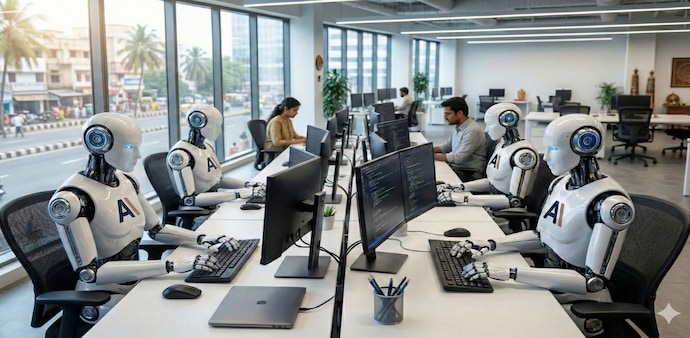
The push comes as enterprises worldwide rethink how software is built and how office tasks are performed, with developers increasingly acting as supervisors to multiple AI workers rather than writing every line of code themselves.
- Feb 6, 2026,
- Updated Feb 6, 2026 12:37 PM IST
Anthropic and OpenAI are accelerating a new phase of artificial intelligence (AI) adoption, betting that companies are ready to move beyond chatbots toward fleets of AI “agents” that can plan, execute and manage work with limited human supervision.
The push comes as enterprises worldwide rethink how software is built and how office tasks are performed, with developers increasingly acting as supervisors to multiple AI workers rather than writing every line of code themselves.
Anthropic on January 5 rolled out Claude Opus 4.6 alongside “agent teams” inside its Claude Code environment, allowing developers to run several AI agents in parallel on different parts of a project. OpenAI followed with Frontier, an enterprise platform that assigns each agent its own identity, permissions and memory, while connecting directly to corporate systems such as customer-relationship tools and data warehouses.
“What we’re fundamentally doing is basically transitioning agents into true AI co-workers,” Barret Zoph, OpenAI’s general manager of business-to-business, told CNBC.
The releases underscore a broader industry pivot from AI as a conversational assistant to AI as a delegated workforce. In effect, knowledge workers are becoming middle managers of machines.
The timing has rattled markets. Investors have grown wary that AI companies are beginning to bundle entire workflows, coding, research, compliance and customer service, into their own platforms, threatening traditional software service providers. That anxiety contributed to a sharp selloff in global software stocks earlier this week.
Yet inside enterprises, adoption is already moving quickly.
A survey of more than 200 Indian companies by EY and the Confederation of Indian Industry shows that 47% now have multiple generative AI use cases live in production, while another 10% are scaling deployments across their businesses. About 76% of executives said Generative AI will have a significant impact on their companies and 91% said speed of deployment is the single biggest factor guiding buying decisions.
The same study found that 24% of organisations are already deploying agentic AI, signalling that businesses are moving beyond copilots toward more independent digital workers.
“AI agents represent the most radical promise of this era: a workforce without limits, always available, always learning, and infinitely scalable,” the report said, while warning that hallucinations, cascading errors and governance gaps still require strong human oversight.
Anthropic’s Scott White, head of enterprise product, framed the shift in cultural terms. “Everybody has seen this transformation happen with software engineering in the last year and a half,” he told CNBC. “I think that we are now transitioning almost into vibe working.”
OpenAI is making a similar bet. Alongside Frontier, the company released GPT-5.3-Codex, a new model powering its Codex desktop app, which it describes as a “command centre for agents.” The company said its own engineers used early versions of the model to help debug training runs and manage deployments.
“Our team was blown away by how much Codex was able to accelerate its own development,” the company said.
For OpenAI and Anthropic, the enterprise land grab is only beginning. What is clear is that the role of the human worker is changing fast. As AI agents take on more execution, people are being pushed toward defining goals, reviewing outputs and making final calls.
For Unparalleled coverage of India's Businesses and Economy – Subscribe to Business Today Magazine
Anthropic and OpenAI are accelerating a new phase of artificial intelligence (AI) adoption, betting that companies are ready to move beyond chatbots toward fleets of AI “agents” that can plan, execute and manage work with limited human supervision.
The push comes as enterprises worldwide rethink how software is built and how office tasks are performed, with developers increasingly acting as supervisors to multiple AI workers rather than writing every line of code themselves.
Anthropic on January 5 rolled out Claude Opus 4.6 alongside “agent teams” inside its Claude Code environment, allowing developers to run several AI agents in parallel on different parts of a project. OpenAI followed with Frontier, an enterprise platform that assigns each agent its own identity, permissions and memory, while connecting directly to corporate systems such as customer-relationship tools and data warehouses.
“What we’re fundamentally doing is basically transitioning agents into true AI co-workers,” Barret Zoph, OpenAI’s general manager of business-to-business, told CNBC.
The releases underscore a broader industry pivot from AI as a conversational assistant to AI as a delegated workforce. In effect, knowledge workers are becoming middle managers of machines.
The timing has rattled markets. Investors have grown wary that AI companies are beginning to bundle entire workflows, coding, research, compliance and customer service, into their own platforms, threatening traditional software service providers. That anxiety contributed to a sharp selloff in global software stocks earlier this week.
Yet inside enterprises, adoption is already moving quickly.
A survey of more than 200 Indian companies by EY and the Confederation of Indian Industry shows that 47% now have multiple generative AI use cases live in production, while another 10% are scaling deployments across their businesses. About 76% of executives said Generative AI will have a significant impact on their companies and 91% said speed of deployment is the single biggest factor guiding buying decisions.
The same study found that 24% of organisations are already deploying agentic AI, signalling that businesses are moving beyond copilots toward more independent digital workers.
“AI agents represent the most radical promise of this era: a workforce without limits, always available, always learning, and infinitely scalable,” the report said, while warning that hallucinations, cascading errors and governance gaps still require strong human oversight.
Anthropic’s Scott White, head of enterprise product, framed the shift in cultural terms. “Everybody has seen this transformation happen with software engineering in the last year and a half,” he told CNBC. “I think that we are now transitioning almost into vibe working.”
OpenAI is making a similar bet. Alongside Frontier, the company released GPT-5.3-Codex, a new model powering its Codex desktop app, which it describes as a “command centre for agents.” The company said its own engineers used early versions of the model to help debug training runs and manage deployments.
“Our team was blown away by how much Codex was able to accelerate its own development,” the company said.
For OpenAI and Anthropic, the enterprise land grab is only beginning. What is clear is that the role of the human worker is changing fast. As AI agents take on more execution, people are being pushed toward defining goals, reviewing outputs and making final calls.
For Unparalleled coverage of India's Businesses and Economy – Subscribe to Business Today Magazine