
Sony a7R V review: A photo-first camera beast leveraging AI-powered autofocus; worth the splurge?
Sony a7R V review: A photo-first camera beast leveraging AI-powered autofocus; worth the splurge?
Its updated body design with a clever tilting display and exceptional EVF makes it a compelling purchase, despite the increased price. Read on for a detailed review
Pranav Dixit
- Apr 26, 2023,
- Updated Apr 26, 2023 2:54 PM IST
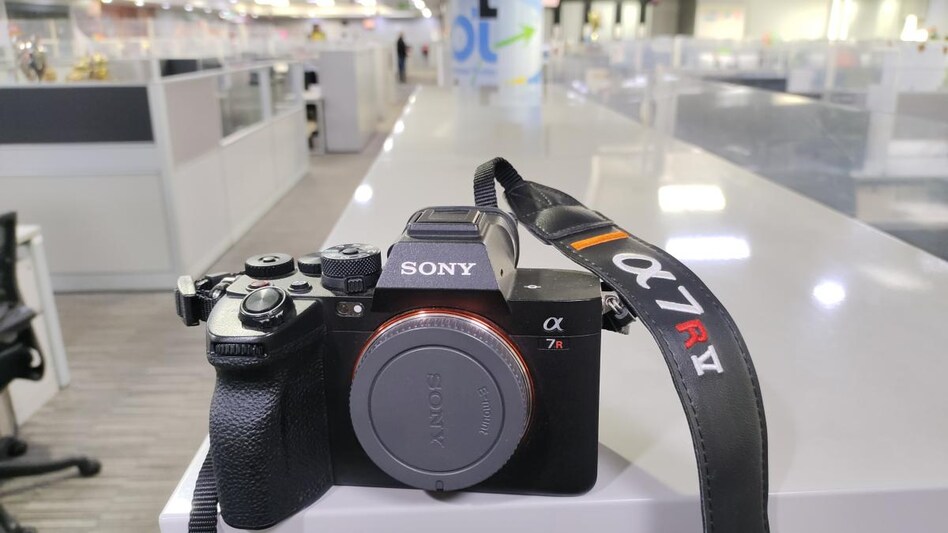
The Sony a7R V is the latest iteration of the high-resolution full-frame mirrorless camera series from Sony. Although it employs the same 61MP image sensor as its predecessor, the a7R IV, the a7R V boasts numerous enhancements and refinements. With more robust image processors, including a dedicated unit for its AI-powered autofocus system, the Mark V delivers faster response times, making it feel like a speedier camera. Its updated body design with a clever tilting display and exceptional EVF makes it a compelling purchase, despite the increased price. I coupled the camera with a Sony FE2.8/24-70 GM lens. Read on for a detailed review.
Advertisement
What’s in the Box?
Rechargeable Battery NP-FZ100, Battery Charger BC-QZ1, Power cord, Cable Protector, Shoulder strap, Body cap, Accessory shoe cap, Eyepiece cup, USB-A to USB-C cable (USB 3.2)
Introduction and Legacy
Sony's strategy with the a7R V resembles what it did with the a7R II and III, reusing the previous generation's sensor while significantly improving the camera's overall performance. The third-generation a7R reused the 42MP sensor from the a7R II but received an enhanced battery and autofocus system, while the a7R III was the first in the series to achieve 10fps.
Similarly, the a7R V follows in the footsteps of the a7R IV, sharing the same 61MP BSI CMOS sensor and similar body style. However, the a7R V has several upgrades that set it apart from its predecessor. The camera's dimensions are typical for a full-frame model, measuring approximately 131.3 x 96.9 x 82.4 mm, and weighing 723 grams with a memory card and battery included.
Advertisement
Design and Body
Building upon the design of its predecessor, the a7R V utilises a body that is similar to the a7S III, with a magnesium alloy case that is both dust and moisture-resistant. Existing users will find the buttons and dials in familiar locations but with a few enhancements, such as the [REC] button being relocated to the camera's top plate. The camera also boasts a white balance sensor for improved Auto White Balance performance in video mode.
Port-wise, the a7R V retains the flash sync terminal of the a7R IV and adds a full-sized HDMI port from the a7S III, as well as a USB 3.2 Gen 2 (10Gbps) port for faster file transfers. With an adapter, the USB port can connect the camera to an Ethernet LAN.
Advertisement
The biggest change is the inclusion of a tilting cradle behind the fully-articulated rear screen, allowing users to tilt the screen forward to access the microphone and headphone ports or flip the screen outward for conventional use.
Display and Viewfinder
I really enjoyed the Sony a7R V’s rear display is a brand-new design that features a multi-hinge system for added flexibility. It can tilt upwards and downwards through one hinge, similar to the a7R IV, and also has a dual-hinge mount on the left side, allowing it to swing out to the side for monitoring from below, above, or in front of the camera. This design offers a best-of-both-worlds approach for stills and video.
For still photography, the centred screen behind the lens is useful for low-angle shots, especially when framing architectural studies. Additionally, the screen can be swung down to the side for low-angle or ground-level portrait orientation shots, without the need to crouch down to the ground.
For video and vlogs, the swing-out articulation is a handy feature. The 3-inch LCD display is sharp and has a resolution of 2.1 million dots, which is an improvement over earlier models from Sony. The rear screen also supports touch and has good viewing angles, with a bright Sunny Weather setting that can cut through glare.
Advertisement
The viewfinder is also a significant improvement, featuring high-magnification 0.9x optics that offer a larger view of the frame. This is an upgrade over the a7R IV and even surpasses the similar Canon and Nikon cameras. The a7R V's EVF is not only big but also very sharp, with a resolution of 9.4 million dots. It provides a clear view of the scene and allows easy confirmation of focus by zooming in.
The viewfinder has different viewing modes, including a slightly zoomed-out view for clear visibility of the corners, high-quality and standard display options. The high-quality display utilises all of the pixels, while the standard display shows a downsampled view. I’d recommend using the high-speed refresh option (120fps) when using the camera for subjects in motion with autofocus. The high-resolution 60fps view is ideal for manual focus, macro, and similar scenes, providing a smooth view that is usable even in dim conditions.
Memory Card Slots
Similar to other modern Sony cameras, the a7R V is equipped with two dual-format card slots, which can accommodate UHS-II SD cards as well as the smaller CFexpress Type A cards exclusive to Sony. While there are no specific modes or functions that require the use of CFexpress Type A cards on the a7R V, their quicker write and read speeds provide a slight boost in speed to the camera, especially when capturing photos at 10fps.
Advertisement
Battery and Connectivity
Similar to other Sony cameras, the a7R V utilises the NP-FZ100 battery which offers a decent amount of power. According to the CIPA rating, you can expect around 440 (EVF) or 530 (LCD) photos per charge. In real-world usage, the battery can last even longer, especially when using burst mode for stills. However, if you plan on using the camera for video, I’d recommend carrying a spare battery, especially for important events like weddings.
The camera can be charged on the go using either micro USB or USB-C, with the latter providing enough power to both run and charge the camera when used with a PD charger. Physical connections include a full-size HDMI port, PC Sync flash socket, and 3.5mm microphone and headphone jacks. A digital hot shoe is also included for attaching flashes, microphones, and other accessories. Flash sync is available at 1/250-second in full-frame mode and 1/320-second in 26MP APS-C crop mode. However, flash sync with the e-shutter is not possible, which requires a Stacked CMOS sensor like the one found in the Sony a1.
The camera also features Bluetooth 5.0 and dual-band 802.11ac Wi-Fi for connecting with remotes and smartphones. The Imaging Edge Mobile app can be used as an intermediary to connect the camera to a smartphone, providing remote control and live feed from the lens, as well as file transfer.
Advertisement
AI Autofocus
Sony's a7R V boasts the company's most advanced autofocus system to date, incorporating AI subject recognition technology that's smarter and more capable than even high-speed sports models like the a9 II and a1. I found the autofocus to be on point in varied situations without breaking a sweat during my time with the camera.
The AI autofocus can identify and track all types of subjects, with specific modes for humans, animals, birds, insects, cars, trains, and aeroplanes. Real-Time Tracking focus is the standout feature, locking onto and tracking moving targets with precision.
The camera achieves a 10fps burst rate with its mechanical shutter, and CFe cards are recommended for action photography. While it's not the fastest camera in Sony's lineup, the a7R V's subject detection and tracking capabilities outshine its competitors, including the Canon EOS R5 and Nikon Z 7 II. However, its electronic shutter is not suitable for freezing motion and is best reserved for posed portraits and landscapes.
Still Photography
The a7R V utilises the same 60MP BSI CMOS image sensor as its predecessor, ensuring exceptional picture quality. It boasts an impressive dynamic range, 14-bit colour, and the ability to create multi-shot images with resolutions up to 240MP. With an in-body image stabilisation system offering up to eight stops of compensation, it's possible to achieve sharp handheld shots with a 1/2-second exposure.
The sensor covers a broad ISO range from ISO 100-32000, and ISO 50-102400 is available as an extended range. When it comes to picture formats, uncompressed, lossy compressed, or lossless compressed 14-bit Raw offers the most flexibility for editing. Additionally, users have the option of working with 10-bit HEIF or 8-bit JPG.
The a7R V offers new HEIF format capabilities but otherwise delivers picture quality that aligns with the a7R IV. At lower ISOs, noise is barely visible, and there's plenty of room for adjusting colour and exposure. Noise becomes more apparent at ISO 6400, and results become increasingly grainy as the sensor's ISO is pushed higher. While you can push to ISO 51200 or 102400, it's only advisable for scenes that call for it, as the results are rough and grainy.
Raw photographers will have the freedom to choose their own creative looks and tone photos to their liking during processing. However, in-camera options are available for those who want ready-to-share photos and prefer to step away from the basic colour profile.
For photographers who are concerned about large file sizes, there is an option to take Raw (or JPG) photos at reduced 26 or 15MP pixel counts with full-frame coverage. Additionally, an APS-C crop at 26MP (native) and 15MP (downsampled) is available. Medium and Small Raw options also come in handy for event photographers who may not want to use 60MP for the entire shoot but still require the extra pixels for group photos and similar shots.
Video
The a7R V boasts video features such as a flat S-Log3 profile, 10-bit 4:2:2 colour sampling, and an HLG profile for HDR projects. There are also slow-motion options of 4K60 and 1080p120. However, if recording video is your top priority, the camera may not be the best choice due to compromises in each of its recording modes.
The high-resolution 8K30 mode suffers from a crop of 1.24x and slow read speed, which can result in motion artefacts. The 4K options offer better colour sampling, but the full-frame options induce a crop or subsampled video, resulting in less crisp footage. The Super35 mode shows sharper results but still has a slow readout speed that can cause motion effects.
Sony uses XAVC for compression, which is capable but not as edit-friendly as Apple ProRes. The Nikon Z 9 and EOS R5c are more expensive options that offer 8K ProRes Raw recording and better slow-motion capabilities.
Conclusion
The a7R V is an outstanding camera for professionals and enthusiasts seeking high resolution and who are not in need of the fast bursts and video capabilities of the a1. While Canon's EOS R5 may be the better stills and video camera due to its superior controlled rolling shutter, and Fujifilm's GFX 100S may offer a level of detail and image quality that surpasses even the exceptional sensor of the a7R V, Sony's autofocus performance and the wide range of E-mount lenses are likely to provide better results in a broader range of situations than either of those cameras.
Using the a7R V instils confidence, and the benefits of 61MP of detail are evident until you shoot in extremely dark conditions. As the ISO increases, the benefits of the high pixel count start to diminish, which partly explains why the camera's video performance isn't as remarkable as its specifications suggest.
Nonetheless, if you require high levels of detail in your photography, the a7R V (body only priced at Rs 3,53,990) can deliver stunning results and is a camera that can help you achieve your desired visual outcomes.
Also Read
Instagram revamps Reels with new video editing and discovery features
Europe sets up task force on ChatGPT to create a common policy on AI privacy rules
For Unparalleled coverage of India's Businesses and Economy – Subscribe to Business Today Magazine
The Sony a7R V is the latest iteration of the high-resolution full-frame mirrorless camera series from Sony. Although it employs the same 61MP image sensor as its predecessor, the a7R IV, the a7R V boasts numerous enhancements and refinements. With more robust image processors, including a dedicated unit for its AI-powered autofocus system, the Mark V delivers faster response times, making it feel like a speedier camera. Its updated body design with a clever tilting display and exceptional EVF makes it a compelling purchase, despite the increased price. I coupled the camera with a Sony FE2.8/24-70 GM lens. Read on for a detailed review.
Advertisement
What’s in the Box?
Rechargeable Battery NP-FZ100, Battery Charger BC-QZ1, Power cord, Cable Protector, Shoulder strap, Body cap, Accessory shoe cap, Eyepiece cup, USB-A to USB-C cable (USB 3.2)
Introduction and Legacy
Sony's strategy with the a7R V resembles what it did with the a7R II and III, reusing the previous generation's sensor while significantly improving the camera's overall performance. The third-generation a7R reused the 42MP sensor from the a7R II but received an enhanced battery and autofocus system, while the a7R III was the first in the series to achieve 10fps.
Similarly, the a7R V follows in the footsteps of the a7R IV, sharing the same 61MP BSI CMOS sensor and similar body style. However, the a7R V has several upgrades that set it apart from its predecessor. The camera's dimensions are typical for a full-frame model, measuring approximately 131.3 x 96.9 x 82.4 mm, and weighing 723 grams with a memory card and battery included.
Advertisement
Design and Body
Building upon the design of its predecessor, the a7R V utilises a body that is similar to the a7S III, with a magnesium alloy case that is both dust and moisture-resistant. Existing users will find the buttons and dials in familiar locations but with a few enhancements, such as the [REC] button being relocated to the camera's top plate. The camera also boasts a white balance sensor for improved Auto White Balance performance in video mode.
Port-wise, the a7R V retains the flash sync terminal of the a7R IV and adds a full-sized HDMI port from the a7S III, as well as a USB 3.2 Gen 2 (10Gbps) port for faster file transfers. With an adapter, the USB port can connect the camera to an Ethernet LAN.
Advertisement
The biggest change is the inclusion of a tilting cradle behind the fully-articulated rear screen, allowing users to tilt the screen forward to access the microphone and headphone ports or flip the screen outward for conventional use.
Display and Viewfinder
I really enjoyed the Sony a7R V’s rear display is a brand-new design that features a multi-hinge system for added flexibility. It can tilt upwards and downwards through one hinge, similar to the a7R IV, and also has a dual-hinge mount on the left side, allowing it to swing out to the side for monitoring from below, above, or in front of the camera. This design offers a best-of-both-worlds approach for stills and video.
For still photography, the centred screen behind the lens is useful for low-angle shots, especially when framing architectural studies. Additionally, the screen can be swung down to the side for low-angle or ground-level portrait orientation shots, without the need to crouch down to the ground.
For video and vlogs, the swing-out articulation is a handy feature. The 3-inch LCD display is sharp and has a resolution of 2.1 million dots, which is an improvement over earlier models from Sony. The rear screen also supports touch and has good viewing angles, with a bright Sunny Weather setting that can cut through glare.
Advertisement
The viewfinder is also a significant improvement, featuring high-magnification 0.9x optics that offer a larger view of the frame. This is an upgrade over the a7R IV and even surpasses the similar Canon and Nikon cameras. The a7R V's EVF is not only big but also very sharp, with a resolution of 9.4 million dots. It provides a clear view of the scene and allows easy confirmation of focus by zooming in.
The viewfinder has different viewing modes, including a slightly zoomed-out view for clear visibility of the corners, high-quality and standard display options. The high-quality display utilises all of the pixels, while the standard display shows a downsampled view. I’d recommend using the high-speed refresh option (120fps) when using the camera for subjects in motion with autofocus. The high-resolution 60fps view is ideal for manual focus, macro, and similar scenes, providing a smooth view that is usable even in dim conditions.
Memory Card Slots
Similar to other modern Sony cameras, the a7R V is equipped with two dual-format card slots, which can accommodate UHS-II SD cards as well as the smaller CFexpress Type A cards exclusive to Sony. While there are no specific modes or functions that require the use of CFexpress Type A cards on the a7R V, their quicker write and read speeds provide a slight boost in speed to the camera, especially when capturing photos at 10fps.
Advertisement
Battery and Connectivity
Similar to other Sony cameras, the a7R V utilises the NP-FZ100 battery which offers a decent amount of power. According to the CIPA rating, you can expect around 440 (EVF) or 530 (LCD) photos per charge. In real-world usage, the battery can last even longer, especially when using burst mode for stills. However, if you plan on using the camera for video, I’d recommend carrying a spare battery, especially for important events like weddings.
The camera can be charged on the go using either micro USB or USB-C, with the latter providing enough power to both run and charge the camera when used with a PD charger. Physical connections include a full-size HDMI port, PC Sync flash socket, and 3.5mm microphone and headphone jacks. A digital hot shoe is also included for attaching flashes, microphones, and other accessories. Flash sync is available at 1/250-second in full-frame mode and 1/320-second in 26MP APS-C crop mode. However, flash sync with the e-shutter is not possible, which requires a Stacked CMOS sensor like the one found in the Sony a1.
The camera also features Bluetooth 5.0 and dual-band 802.11ac Wi-Fi for connecting with remotes and smartphones. The Imaging Edge Mobile app can be used as an intermediary to connect the camera to a smartphone, providing remote control and live feed from the lens, as well as file transfer.
Advertisement
AI Autofocus
Sony's a7R V boasts the company's most advanced autofocus system to date, incorporating AI subject recognition technology that's smarter and more capable than even high-speed sports models like the a9 II and a1. I found the autofocus to be on point in varied situations without breaking a sweat during my time with the camera.
The AI autofocus can identify and track all types of subjects, with specific modes for humans, animals, birds, insects, cars, trains, and aeroplanes. Real-Time Tracking focus is the standout feature, locking onto and tracking moving targets with precision.
The camera achieves a 10fps burst rate with its mechanical shutter, and CFe cards are recommended for action photography. While it's not the fastest camera in Sony's lineup, the a7R V's subject detection and tracking capabilities outshine its competitors, including the Canon EOS R5 and Nikon Z 7 II. However, its electronic shutter is not suitable for freezing motion and is best reserved for posed portraits and landscapes.
Still Photography
The a7R V utilises the same 60MP BSI CMOS image sensor as its predecessor, ensuring exceptional picture quality. It boasts an impressive dynamic range, 14-bit colour, and the ability to create multi-shot images with resolutions up to 240MP. With an in-body image stabilisation system offering up to eight stops of compensation, it's possible to achieve sharp handheld shots with a 1/2-second exposure.
The sensor covers a broad ISO range from ISO 100-32000, and ISO 50-102400 is available as an extended range. When it comes to picture formats, uncompressed, lossy compressed, or lossless compressed 14-bit Raw offers the most flexibility for editing. Additionally, users have the option of working with 10-bit HEIF or 8-bit JPG.
The a7R V offers new HEIF format capabilities but otherwise delivers picture quality that aligns with the a7R IV. At lower ISOs, noise is barely visible, and there's plenty of room for adjusting colour and exposure. Noise becomes more apparent at ISO 6400, and results become increasingly grainy as the sensor's ISO is pushed higher. While you can push to ISO 51200 or 102400, it's only advisable for scenes that call for it, as the results are rough and grainy.
Raw photographers will have the freedom to choose their own creative looks and tone photos to their liking during processing. However, in-camera options are available for those who want ready-to-share photos and prefer to step away from the basic colour profile.
For photographers who are concerned about large file sizes, there is an option to take Raw (or JPG) photos at reduced 26 or 15MP pixel counts with full-frame coverage. Additionally, an APS-C crop at 26MP (native) and 15MP (downsampled) is available. Medium and Small Raw options also come in handy for event photographers who may not want to use 60MP for the entire shoot but still require the extra pixels for group photos and similar shots.
Video
The a7R V boasts video features such as a flat S-Log3 profile, 10-bit 4:2:2 colour sampling, and an HLG profile for HDR projects. There are also slow-motion options of 4K60 and 1080p120. However, if recording video is your top priority, the camera may not be the best choice due to compromises in each of its recording modes.
The high-resolution 8K30 mode suffers from a crop of 1.24x and slow read speed, which can result in motion artefacts. The 4K options offer better colour sampling, but the full-frame options induce a crop or subsampled video, resulting in less crisp footage. The Super35 mode shows sharper results but still has a slow readout speed that can cause motion effects.
Sony uses XAVC for compression, which is capable but not as edit-friendly as Apple ProRes. The Nikon Z 9 and EOS R5c are more expensive options that offer 8K ProRes Raw recording and better slow-motion capabilities.
Conclusion
The a7R V is an outstanding camera for professionals and enthusiasts seeking high resolution and who are not in need of the fast bursts and video capabilities of the a1. While Canon's EOS R5 may be the better stills and video camera due to its superior controlled rolling shutter, and Fujifilm's GFX 100S may offer a level of detail and image quality that surpasses even the exceptional sensor of the a7R V, Sony's autofocus performance and the wide range of E-mount lenses are likely to provide better results in a broader range of situations than either of those cameras.
Using the a7R V instils confidence, and the benefits of 61MP of detail are evident until you shoot in extremely dark conditions. As the ISO increases, the benefits of the high pixel count start to diminish, which partly explains why the camera's video performance isn't as remarkable as its specifications suggest.
Nonetheless, if you require high levels of detail in your photography, the a7R V (body only priced at Rs 3,53,990) can deliver stunning results and is a camera that can help you achieve your desired visual outcomes.
Also Read
Instagram revamps Reels with new video editing and discovery features
Europe sets up task force on ChatGPT to create a common policy on AI privacy rules
For Unparalleled coverage of India's Businesses and Economy – Subscribe to Business Today Magazine
TAGS:
Read more!