
Is lab-grown gold the future or just a costly experiment?
With innovation reshaping the precious metals space, lab-grown gold is gaining attention amid soaring prices. But unlike diamonds, gold cannot simply be “grown” using standard techniques. Understanding how it is made—and whether it can compete with mined gold—reveals a much deeper story.
- Apr 6, 2026,
- Updated Apr 6, 2026 8:20 AM IST
At a time when gold prices are scaling record highs and lab-grown diamonds have gone mainstream, a natural question is emerging: can gold also be made in a laboratory? The answer is technically yes—but the reality is far more complex than it sounds.
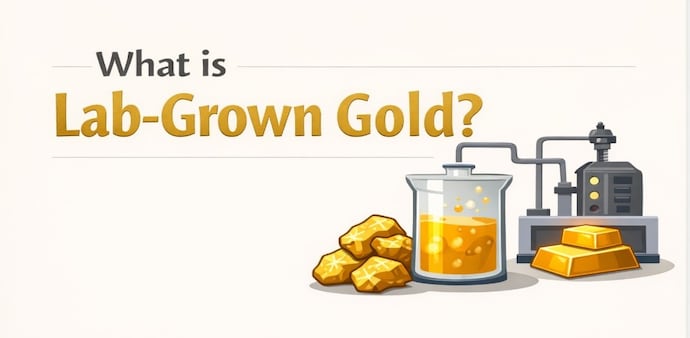
What is lab-grown gold?
Lab-grown gold refers to gold that is produced or refined outside the traditional mining process using advanced scientific techniques. Unlike diamonds, which can be “grown” by replicating natural pressure and temperature conditions, gold is a chemical element. This means it cannot simply be manufactured from scratch using conventional methods. Instead, it must be created by altering the atomic structure of another element through a process known as nuclear transmutation.
Is lab-grown gold real gold?
Yes, lab-grown gold is chemically identical to mined gold. It has the same atomic composition, density, purity (up to 24K), and physical properties. Whether mined or lab-made, gold behaves the same in jewellery and retains identical intrinsic characteristics.
ALSO READ: Gold, Silver ETF rules change: How it affects Your portfolio & returns
In controlled laboratory environments, scientists have successfully converted metals such as mercury or platinum into gold by bombarding them with high-energy particles in nuclear reactors or particle accelerators. This process changes the number of protons in the atom, effectively transforming one element into another. While the output is real gold—identical in atomic structure to mined gold—the quantities produced are microscopic and often unstable.
Alok Jain, Founder of Weekend Investing, in a Youtube video explained: “Gold is fundamentally different from materials like diamonds. Diamonds can be recreated because they are essentially structured carbon, but gold is an element—it cannot simply be ‘grown.’ To produce gold in a lab, you need nuclear-level processes such as particle accelerators, where elements are altered at the atomic level. Even then, what you get is not usable gold in bulk, but microscopic or unstable particles. So while the idea of lab-grown gold sounds similar to lab-grown diamonds, the science and practicality are entirely different. At this stage, it is more of a scientific experiment than a commercially viable reality.”
ALSO READ: Gold remains a $31 trillion market, still under-allocated in investor portfolios: Report
How is lab-grown gold made?
Lab-grown gold is created through nuclear transmutation, where elements like mercury or platinum are altered at the atomic level. These reactions require particle accelerators or nuclear reactors, making the process highly energy-intensive and technologically complex.
This is where the distinction becomes important. In theory, lab-made gold is “real” gold. It can be refined up to 24 karat and alloyed into 18K or 14K for jewellery, with the same durability and resistance to tarnish. However, in practice, lab-grown gold is not commercially viable today.
The primary constraint is economics. Producing gold through nuclear processes requires enormous energy and highly sophisticated infrastructure. The cost of creating even a tiny quantity can run into millions of dollars, making it far more expensive than extracting gold from the Earth. As a result, there is currently no scalable or commercially viable market for lab-grown gold, unlike lab-grown diamonds.
There is also a perception and market acceptance challenge. Mined gold benefits from centuries of trust, a well-established resale ecosystem, and universal acceptance across bullion markets and jewellery trade. Lab-grown gold, even if chemically identical, lacks this institutional backing, which affects liquidity and resale value.
MUST READ: How to protect your gold investments during a financial crisis
Scientific approaches to make gold
The creation of lab-grown gold broadly follows two scientific approaches. The first involves atomic-level transformation, where gold is produced by manipulating elements at the subatomic level using advanced particle technology. While this method proves that gold can be artificially created, it remains highly impractical due to its extreme cost and limited output.
The second approach is more aligned with current industry practices—refining and recovery. In this process, recycled or extracted gold is purified in controlled laboratory environments to achieve ultra-high purity levels. While this improves efficiency and sustainability, it does not represent true “creation” of gold from scratch.
As a result, unlike lab-grown diamonds—which are already commercially scalable—lab-grown gold remains largely experimental and has yet to transition into a mainstream, market-ready product.
Jain further said: “To create gold artificially, scientists must rely on nuclear transmutation—essentially changing one element into another using particle accelerators or nuclear reactors. While this has been achieved in controlled environments, the output is extremely limited. What is produced is often atom-sized quantities or unstable isotopes that are not suitable for practical use. You cannot scale this into bars, coins, or jewellery, which is what the market actually demands. Moreover, the economics simply do not work. The cost of producing even a trace amount of gold in a lab is exponentially higher than mining it from the Earth. This makes the idea of lab-grown gold as a replacement for mined gold unrealistic, at least in the foreseeable future. Nature, despite its challenges, remains the most efficient and cost-effective source of gold. Its scarcity, combined with the difficulty of extraction, is precisely what gives gold its enduring value in global markets and investment portfolios.”
MUST READ: Gold remains a $31 trillion market, still under-allocated in investor portfolios: Report
Is lab-grown gold environmentally friendly?
In theory, lab-grown gold could reduce environmental damage linked to mining, such as land degradation and water pollution. However, nuclear-based production requires massive energy input, which offsets some of these benefits. So, its sustainability advantage remains uncertain.
From an investment perspective, gold continues to serve as a hedge against inflation and economic uncertainty, regardless of its origin. Its value depends on purity and global pricing benchmarks, not whether it is mined or lab-produced. However, resale value today is far more reliable for mined gold due to established market acceptance.
In essence, lab-grown gold exists—but only within scientific experimentation. Until production becomes scalable and cost-efficient, it will remain a technological curiosity rather than a viable alternative to mined gold.
MUST REPORT: Gold, Silver ETF rules change: How it affects Your portfolio & returns
FAQs on lab-grown gold
1. What is lab-grown gold? Lab-grown gold refers to gold produced or refined using laboratory-based technologies instead of traditional mining. It is created in controlled environments, often through advanced scientific processes, rather than extracted from the Earth.
2. Is lab-grown gold real gold? Yes, lab-grown gold is real gold. It has the same atomic structure, purity, density, and physical properties as mined gold, making it chemically identical and equally valuable in composition.
3. How is lab-grown gold made? Lab-grown gold is created through nuclear transmutation, where elements like mercury or platinum are altered at the atomic level using particle accelerators or nuclear reactors. This process changes the number of protons to form gold.
4. Is lab-grown gold cheaper than mined gold? No, lab-grown gold is not cheaper. In fact, it is currently far more expensive due to the high energy, technology, and infrastructure required to produce even small quantities.5. Can lab-grown gold be used for jewellery and investment? Technically, yes. Lab-grown gold can be used for jewellery as it has the same purity levels (up to 24K) and durability. However, its role in investment is limited due to lack of widespread market acceptance and resale infrastructure.
At a time when gold prices are scaling record highs and lab-grown diamonds have gone mainstream, a natural question is emerging: can gold also be made in a laboratory? The answer is technically yes—but the reality is far more complex than it sounds.
What is lab-grown gold?
Lab-grown gold refers to gold that is produced or refined outside the traditional mining process using advanced scientific techniques. Unlike diamonds, which can be “grown” by replicating natural pressure and temperature conditions, gold is a chemical element. This means it cannot simply be manufactured from scratch using conventional methods. Instead, it must be created by altering the atomic structure of another element through a process known as nuclear transmutation.
Is lab-grown gold real gold?
Yes, lab-grown gold is chemically identical to mined gold. It has the same atomic composition, density, purity (up to 24K), and physical properties. Whether mined or lab-made, gold behaves the same in jewellery and retains identical intrinsic characteristics.
ALSO READ: Gold, Silver ETF rules change: How it affects Your portfolio & returns
In controlled laboratory environments, scientists have successfully converted metals such as mercury or platinum into gold by bombarding them with high-energy particles in nuclear reactors or particle accelerators. This process changes the number of protons in the atom, effectively transforming one element into another. While the output is real gold—identical in atomic structure to mined gold—the quantities produced are microscopic and often unstable.
Alok Jain, Founder of Weekend Investing, in a Youtube video explained: “Gold is fundamentally different from materials like diamonds. Diamonds can be recreated because they are essentially structured carbon, but gold is an element—it cannot simply be ‘grown.’ To produce gold in a lab, you need nuclear-level processes such as particle accelerators, where elements are altered at the atomic level. Even then, what you get is not usable gold in bulk, but microscopic or unstable particles. So while the idea of lab-grown gold sounds similar to lab-grown diamonds, the science and practicality are entirely different. At this stage, it is more of a scientific experiment than a commercially viable reality.”
ALSO READ: Gold remains a $31 trillion market, still under-allocated in investor portfolios: Report
How is lab-grown gold made?
Lab-grown gold is created through nuclear transmutation, where elements like mercury or platinum are altered at the atomic level. These reactions require particle accelerators or nuclear reactors, making the process highly energy-intensive and technologically complex.
This is where the distinction becomes important. In theory, lab-made gold is “real” gold. It can be refined up to 24 karat and alloyed into 18K or 14K for jewellery, with the same durability and resistance to tarnish. However, in practice, lab-grown gold is not commercially viable today.
The primary constraint is economics. Producing gold through nuclear processes requires enormous energy and highly sophisticated infrastructure. The cost of creating even a tiny quantity can run into millions of dollars, making it far more expensive than extracting gold from the Earth. As a result, there is currently no scalable or commercially viable market for lab-grown gold, unlike lab-grown diamonds.
There is also a perception and market acceptance challenge. Mined gold benefits from centuries of trust, a well-established resale ecosystem, and universal acceptance across bullion markets and jewellery trade. Lab-grown gold, even if chemically identical, lacks this institutional backing, which affects liquidity and resale value.
MUST READ: How to protect your gold investments during a financial crisis
Scientific approaches to make gold
The creation of lab-grown gold broadly follows two scientific approaches. The first involves atomic-level transformation, where gold is produced by manipulating elements at the subatomic level using advanced particle technology. While this method proves that gold can be artificially created, it remains highly impractical due to its extreme cost and limited output.
The second approach is more aligned with current industry practices—refining and recovery. In this process, recycled or extracted gold is purified in controlled laboratory environments to achieve ultra-high purity levels. While this improves efficiency and sustainability, it does not represent true “creation” of gold from scratch.
As a result, unlike lab-grown diamonds—which are already commercially scalable—lab-grown gold remains largely experimental and has yet to transition into a mainstream, market-ready product.
Jain further said: “To create gold artificially, scientists must rely on nuclear transmutation—essentially changing one element into another using particle accelerators or nuclear reactors. While this has been achieved in controlled environments, the output is extremely limited. What is produced is often atom-sized quantities or unstable isotopes that are not suitable for practical use. You cannot scale this into bars, coins, or jewellery, which is what the market actually demands. Moreover, the economics simply do not work. The cost of producing even a trace amount of gold in a lab is exponentially higher than mining it from the Earth. This makes the idea of lab-grown gold as a replacement for mined gold unrealistic, at least in the foreseeable future. Nature, despite its challenges, remains the most efficient and cost-effective source of gold. Its scarcity, combined with the difficulty of extraction, is precisely what gives gold its enduring value in global markets and investment portfolios.”
MUST READ: Gold remains a $31 trillion market, still under-allocated in investor portfolios: Report
Is lab-grown gold environmentally friendly?
In theory, lab-grown gold could reduce environmental damage linked to mining, such as land degradation and water pollution. However, nuclear-based production requires massive energy input, which offsets some of these benefits. So, its sustainability advantage remains uncertain.
From an investment perspective, gold continues to serve as a hedge against inflation and economic uncertainty, regardless of its origin. Its value depends on purity and global pricing benchmarks, not whether it is mined or lab-produced. However, resale value today is far more reliable for mined gold due to established market acceptance.
In essence, lab-grown gold exists—but only within scientific experimentation. Until production becomes scalable and cost-efficient, it will remain a technological curiosity rather than a viable alternative to mined gold.
MUST REPORT: Gold, Silver ETF rules change: How it affects Your portfolio & returns
FAQs on lab-grown gold
1. What is lab-grown gold? Lab-grown gold refers to gold produced or refined using laboratory-based technologies instead of traditional mining. It is created in controlled environments, often through advanced scientific processes, rather than extracted from the Earth.
2. Is lab-grown gold real gold? Yes, lab-grown gold is real gold. It has the same atomic structure, purity, density, and physical properties as mined gold, making it chemically identical and equally valuable in composition.
3. How is lab-grown gold made? Lab-grown gold is created through nuclear transmutation, where elements like mercury or platinum are altered at the atomic level using particle accelerators or nuclear reactors. This process changes the number of protons to form gold.
4. Is lab-grown gold cheaper than mined gold? No, lab-grown gold is not cheaper. In fact, it is currently far more expensive due to the high energy, technology, and infrastructure required to produce even small quantities.5. Can lab-grown gold be used for jewellery and investment? Technically, yes. Lab-grown gold can be used for jewellery as it has the same purity levels (up to 24K) and durability. However, its role in investment is limited due to lack of widespread market acceptance and resale infrastructure.