
BT BIG STORY: 11 days, one U-turn, and an even bigger question: Is NVIDIA’s board independent?
BT BIG STORY: 11 days, one U-turn, and an even bigger question: Is NVIDIA’s board independent?
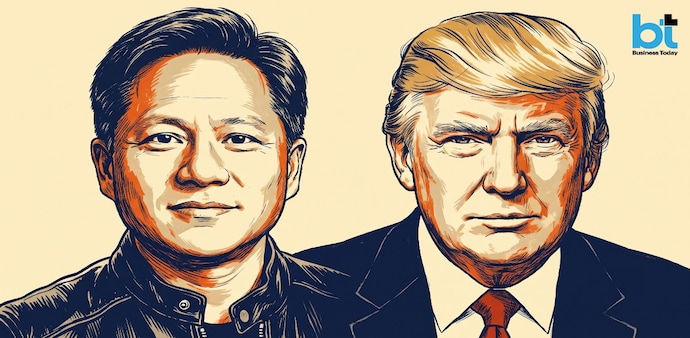
The reported role of the Trump administration in reversing Huang’s transition raises questions about board independence, succession planning and the growing influence of national security priorities on corporate governance.
Palak Agarwal
- Nov 26, 2026,
- Updated Nov 26, 2026 6:00 AM IST
Eleven days. That is how long NVIDIA's leadership transition reportedly lasted before Jensen Huang returned to the CEO's chair on November 23. What might otherwise have been a routine leadership change has turned into an unusual corporate episode, raising questions about the role of the US government, the independence of NVIDIA's board, and the growing influence of national security considerations in corporate decision-making.
Advertisement
The reinstatement, reportedly following input from the US government with President Donald Trump at the centre, raises questions about whether NVIDIA's board exercised independent judgement or whether Washington's strategic interests played a role in reversing the leadership transition. It also brings into focus the extent to which governments can influence corporate decisions when a private company becomes critical to national technological and economic priorities.
The episode could have wider implications for corporate governance in the technology sector, particularly as the race for artificial intelligence (AI) supremacy increasingly intersects with geopolitics and national security.
Shriram Subramanian, Founder and Managing Director of corporate governance advisory firm InGovern Research Services, said the episode raises questions about the extent to which government pressure can influence boardroom decisions, particularly in sectors subject to heightened regulatory and national security scrutiny.
Advertisement
"The board obviously in the US has been susceptible to influence by the government of the US, especially Donald Trump and the administration," Subramanian said, adding that NVIDIA's strategic importance may have prompted the board to accommodate the administration's concerns.
MUST READ: Jensen Huang acknowledged violating Nvidia’s ‘code of conduct’, making terrible mistakes
Washington's strategic interest in NVIDIA
NVIDIA occupies a distinctive position in the global technology landscape. Its graphics processing units (GPUs) have become central to the development and deployment of advanced AI models, making the company a critical player in the US effort to maintain its technological advantage over China.
According to corporate governance experts in the ecosystem, unlike technology companies such as Meta and Google, whose businesses are not directly centred on the global semiconductor competition, NVIDIA's products and their availability have become an important component of Washington's technology and export-control policies.
Advertisement
MUST READ: US proposes at least 17% tariff on Indian imports if trade deal is signed, 25% if no deal is reached
Subramanian said this strategic positioning could explain why the US government has taken a particular interest in the company's leadership and direction. NVIDIA's business in China, alongside its role in the broader US-China technology rivalry, makes it more exposed to geopolitical considerations than many other listed technology companies.
This creates a complicated governance environment. While NVIDIA's board is expected to act in the interests of the company and its shareholders, the government has its own national security priorities, particularly when it comes to advanced computing capabilities and the export of high-end chips.
The question, therefore, is where legitimate government engagement ends and undue influence over corporate decision making begins.
Government intervention in strategically important industries is not new. Subramanian pointed out that Western governments have historically exercised influence over critical infrastructure assets, including ports and airports, through regulatory restrictions and special governance arrangements.
ALSO READ: Nvidia row: Jensen Huang says he attends therapy daily, promises to 'do a better job'
For experts, the West has always protected their own interests arguing that governments have often prioritised national interests even while advocating market-led economic policies.
Advertisement
However, the NVIDIA episode brings this tension directly into the boardroom of a publicly listed technology company, where shareholders expect independent oversight and transparent decision-making.
Even if the reinstatement was driven by national security interests, reports that US intelligence had confirmed alleged links to Chinese espionage raise questions about the independence and credibility of the ongoing investigation. These concerns are particularly relevant given that NVIDIA has established a separate National Security and Export Control Committee, whose role adds another layer of scrutiny to how the company addresses national security risks and export-control issues.
Questions over the board's independence
At the heart of the issue is whether NVIDIA's board was able to exercise independent judgement while navigating external political pressure.
A company's board is expected to oversee management, protect shareholder interests, and ensure that major leadership decisions are based on the company's long-term interests. While directors may take into account regulatory and national security considerations, the decision-making process should remain independent and be supported by a clear rationale.
Advertisement
The reported involvement of the US government raises questions about how these considerations were weighed against the board's own assessment of the leadership transition.
ALSO READ: From Steve Jobs to Sam Altman: Eight corporate comebacks before Jensen Huang's return to Nvidia
It also puts the spotlight on the role of independent directors. Their responsibility is not merely to endorse management decisions or respond to external pressure, but to provide an effective system of checks and balances.
For investors, the issue is particularly relevant because corporate governance risks do not always translate immediately into financial losses or operational disruption. A board that is perceived as susceptible to external influence could raise concerns about the company's ability to make independent decisions on succession, capital allocation, strategic partnerships and risk management.
NVIDIA's board has also said that an independent committee will continue examining the circumstances surrounding the leadership transition. The findings and the extent of disclosure could be important in establishing whether the board's processes met the standards expected of a company of NVIDIA's scale.
Does NVIDIA have a succession planning problem?
The leadership reversal also raises questions about the company's succession planning and its dependence on Huang.
Advertisement
As NVIDIA's co-founder and long-time chief executive, Huang has become closely associated with its technology road map, commercial strategy, and relationships with customers and industry partners. His influence has extended beyond conventional executive responsibilities, making leadership continuity a particularly important issue for the company.
DO READ: Nvidia CFO Colette Kress kept out of secret talks over Jensen Huang's return as CEO: Report
Subramanian said the episode should not be viewed merely as a question of succession planning, but also as a reminder that companies must avoid placing institutional interests behind the stature of an individual leader.
He argued that every listed company, irrespective of its size, should have a succession framework that accounts for both planned and unexpected departures.
For NVIDIA, the speed with which the leadership transition was reversed could prompt shareholders to examine whether the company has a credible succession structure that can function independently of its founder.
A robust succession plan is not necessarily about replacing a successful founder or chief executive. It is about ensuring that the company's strategic direction, governance and operations remain stable even in the event of an abrupt leadership change.
A possible precedent for tech companies
Beyond NVIDIA, the larger question is whether national security considerations are beginning to reshape conventional corporate governance frameworks in the technology sector.
As governments increasingly view semiconductors, AI infrastructure and advanced computing as strategic assets, companies operating in these areas may face greater scrutiny and engagement from policymakers.
This could create a more complicated environment for boards, which must balance shareholder interests, regulatory compliance, national security requirements and commercial objectives.
ALSO READ: Jensen Huang disclosed additional affairs before he was reinstated as Nvidia CEO: Report
For companies operating across multiple geographies, these priorities may not always align. Decisions involving product launches, export restrictions, strategic investments and customer relationships could increasingly have geopolitical implications.
The NVIDIA episode could therefore become an important case study in the relationship between corporate governance and national security. It raises the question of whether strategically important companies will face a different standard of government engagement compared with businesses in less sensitive sectors.
Huang's return may have brought an immediate end to the leadership uncertainty, but questions surrounding the board's decision-making process, succession planning and Washington's influence remain relevant.
For Unparalleled coverage of India's Businesses and Economy – Subscribe to Business Today Magazine
Read more!