


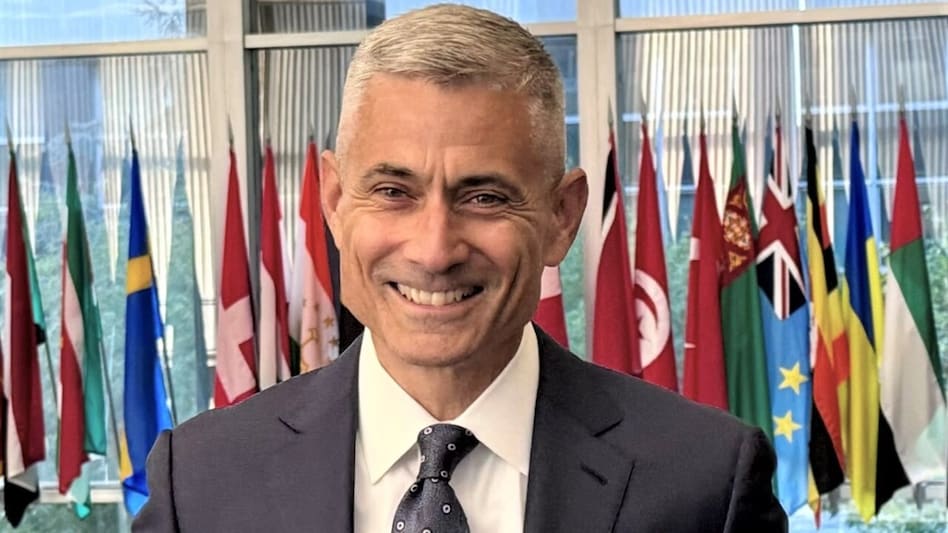
 Trump’s South Asia strategist to meet Indian officials on security, Indo-Pacific
As tensions continue to ripple across West Asia following the Iran–US-Israel conflict, President Donald Trump's senior South Asia official is in New Delhi for talks focused on regional security and Indo-Pacific priorities.
Also read: Stocks may drop further as West Asia's conflict hits Indian bottomlines, supply chains
Assistant Secretary of State for South and Central Asian Affairs S Paul Kapur is visiting India from March 1 to 3. During his time in New Delhi, Kapur will meet Indian officials to discuss regional security and shared priorities in the Indo-Pacific, according to the U.S. State Department.
The visit comes at a moment of heightened geopolitical strain, with ongoing conflict involving Iran, the United States, and Israel.
The State Department said Kapur's trip builds on recent momentum aimed at strengthening bilateral ties under President Trump's foreign policy approach.
"Assistant Secretary Kapur's visit builds upon recent momentum to advance President Trump’s vision for a robust and mutually beneficial U.S.-India partnership," the department said.
Kapur has consistently framed India as central to Washington's broader strategic outlook in the Indo-Pacific.
In February this year, speaking during a Foreign Affairs Subcommittee hearing on U.S. policy in South Asia, Kapur described India's strategic autonomy as an asset for Washington rather than a complication. "A strong and independent India is a strategic win for the United States," he said.
He expanded on that view, arguing that India's ability to chart its own course aligns with US interests in balancing China’s influence. "An India that can be independent and stand up for itself and preserve its freedom of action actually works to our strategic advantage and promotes our strategic interest," the diplomat said.
Paul said a strong India was important as the US was trying to not to keep China out of the region, "but to prevent China or any single hegemon from taking over or imposing coercive leverage on the region."
Kapur added that India's autonomy changes the balance of power across the Indo-Pacific. "So an India that is able to be independent and preserve its freedom of action takes a huge swath of the Indo-Pacific off of China's plate. And almost by definition, it prevents it from becoming the dominant power in the region."
During the same hearing, he addressed questions about China's naval reach. When asked whether Beijing possesses a true blue-water navy, Kapur offered a measured assessment. "They (Chinese) have blue-water capabilities."
A blue-water navy refers to a force capable of sustained operations far from its home shores, supported by global bases and logistics networks. Blue-water capabilities, by contrast, suggest the ability to operate in distant waters without necessarily maintaining a permanent global presence at scale.

 US-Iran pause attacks for second day; Trump 'giving talks some space' as Hormuz deal discussed
 New paper leak bill in Lok Sabha today, proposes harsher punishment; MPs given draft
 Which ITR form should NRIs use? Why filing ITR-1 could be a costly mistake
 Top stocks in news: NTPC, Jindal Steel, Bank of Baroda, NBCC, IDFC First, TCPL, SBI Cards, REC
 SIFs, mutual funds, PMS or AIFs: Which investment route deserves a place in your portfolio?
 AI Data Centers, Aerospace & Gas Turbines: What's Powering Indo-MIM's Future Growth?
 Best Healthcare Stocks: Gaurang Shah's Outlook On Apollo Hospitals, Fortis & The Manipal Health IPO
 Is Indo-MIM's IPO Valuation Justified? Here's Why The Company Sees Strong Growth Ahead
 Treasury Bills Explained: Why T-Bills Are One Of The Safest Short-Term Investment Options
 FDs vs Markets: Where Should You Keep Your Short-Term Money?
 YES Bank, Inox Wind, MCX: Top stocks to trade— Key levels, target price, stop loss & more
 BEL Q1 results today: What consensus estimates, target prices suggest
 Zen Technologies: High altitude anti-drone system's launch puts stock in focus
  Hindustan Zinc share price: HZL targets by Jefferies, HSBC, Citi & other stock brokerages
 Nifty, Sensex, Nifty Bank outlook for today: GIFT Nifty up 140 points; key levels to watchYES Bank, Inox Wind, MCX: Top stocks to trade— Key levels, target price, stop loss & moreBEL Q1 results today: What consensus estimates, target prices suggestZen Technologies: High altitude anti-drone system's launch puts stock in focus
  The $70-billion NRI bet: Can FCNR(B) deposits buy India enough time to defend the rupee?
 Petrol, diesel prices today, July 27: Prices slightly up in some cities; Check latest rates in Delhi, Mumbai, Chennai & more









