














After roti, kapda and makaan, healthcare is the next big aspiration for millions of Indians. Prime Minister Narendra Modi, too, stressed this point in a series of posts on X in the middle of June, stating that health remains the core agenda of the government, which he said runs the world’s largest healthcare scheme—Ayushman Bharat.
The remark came at a time the country’s private hospital industry is entering one of its biggest expansion drives. From Manipal and Apollo to Max Healthcare, Fortis Healthcare, Medanta, Paras Health, and Yashoda Hospitals, India’s leading hospital chains are adding beds, entering new markets, and raising fresh capital to fund growth—all at a frenetic pace.
Private equity is backing up with large investments, while wider insurance coverage is bringing more Indians into the formal healthcare system, giving hospital operators confidence to expand.
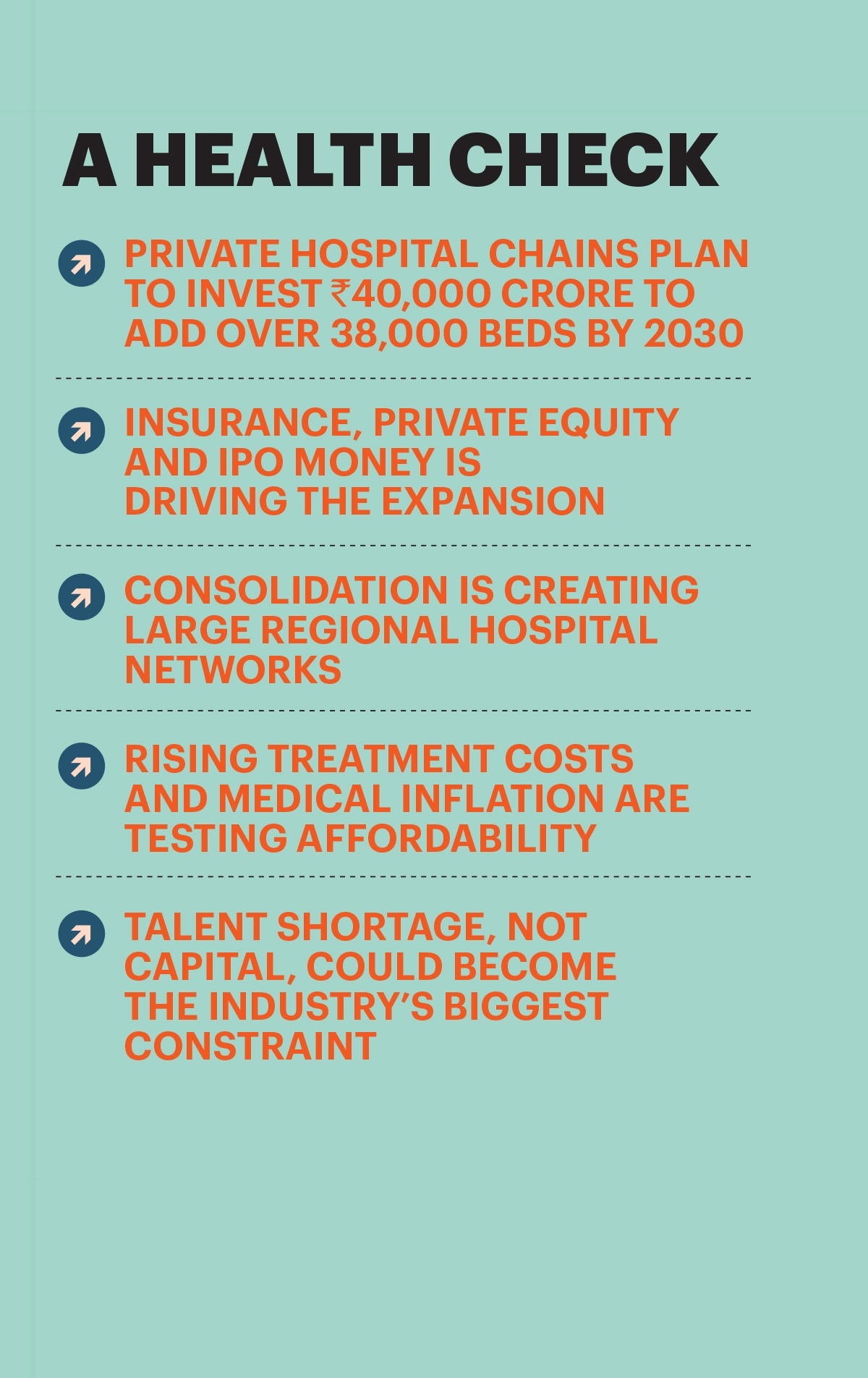
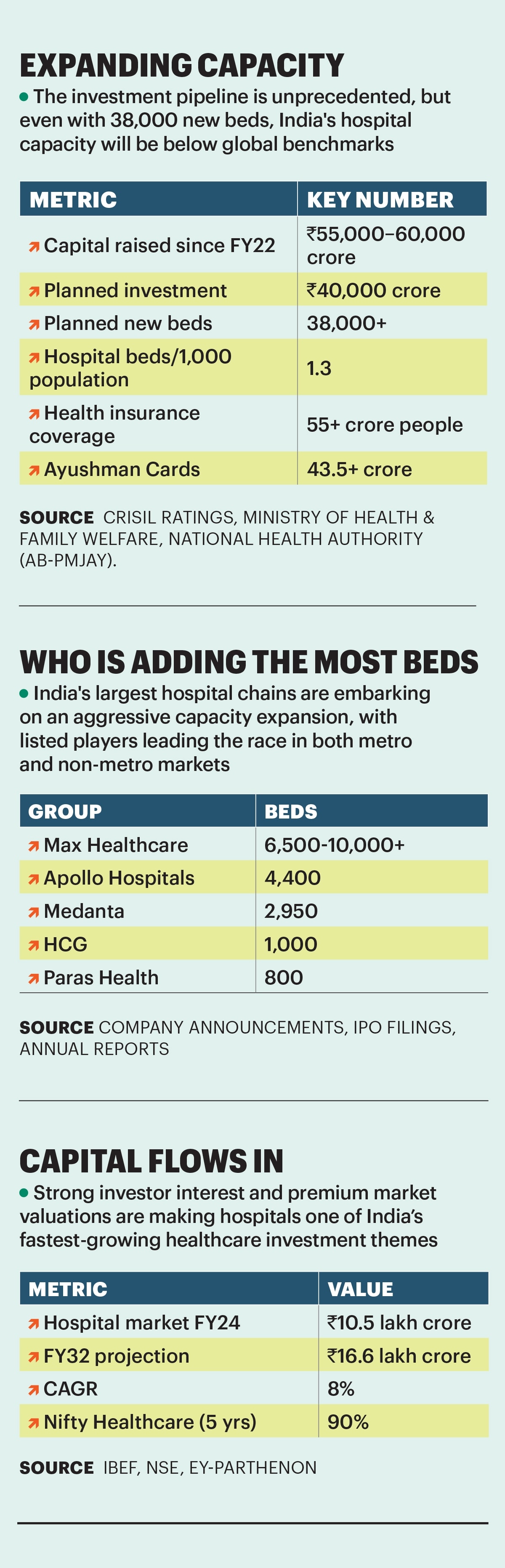
The numbers underline the scale of the effort. Crisil Ratings estimates hospitals have attracted Rs 55,000-60,000 crore through private equity and public markets since FY22, including nearly Rs 25,000 crore in FY25 and FY26. The country’s leading hospital chains are expected to invest another Rs 40,000 crore to add more than 38,000 beds by 2030.

Beds, Billions and Building Spree
The expansion is taking different forms. Some groups are building greenfield facilities, others are acquiring regional chains, while several are tapping public markets to strengthen balance sheets and finance future growth.
Temasek-backed Manipal Health Enterprises, India’s largest private hospital network by bed capacity, opened its Rs 9,275-crore initial public offering in July. A large share of the proceeds will be used to reduce debt from acquisitions, including Columbia Asia, Vikram Hospital, Medica and Sahyadri Hospitals. “Three factors will drive our growth—increasing occupancy from the current 65%, adding new beds and unlocking the potential of Sahyadri Hospitals,” says Managing Director and CEO Dilip Jose. Chief Financial Officer Samir Agarwal says the IPO will leave the company “practically” net debt free, giving it greater financial flexibility for future expansion.
Apollo Hospitals, by contrast, is relying largely on internal accruals. It plans to add nearly 4,400 beds over the next five years.
Medanta plans to add 2,950 beds through five greenfield projects, expanding into Delhi, Mumbai, Guwahati and Varanasi. The company recently scaled up its Guwahati project into a 650-bed super-speciality hospital. “With a strong balance sheet and deep clinical expertise, we are committed to expanding our network through a disciplined, quality-anchored approach that ensures sustainable growth for all our stakeholders,” says Pankaj Sahni, Group CEO and Director, Medanta
Max Healthcare is also pursuing an ambitious plan to take its network from around 6,500 beds to more than 10,000 over the next three-four years through projects in Gurugram, Lucknow, Pitampura (Delhi), Zirakpur (Punjab) and Bhubaneswar. Abhay Soi, Chairman and Managing Director, lists nearly 20 cities where he sees opportunities for growth.
Another important expansion route is acquisitions. Fortis Healthcare is strengthening its regional clusters through deals such as People Tree Hospital in Bengaluru and Shrimann Hospital in Jalandhar, while adding management contracts in Greater Noida and Lucknow.
Paras Health, which is preparing for a public listing, plans to add around 800 beds by March 2028 as it expands across North India.
“The opportunity in North India is enormous. Healthcare has to be delivered where people live,” says Dr Dharminder Nagar, Managing Director, Paras Hospitals. Rainbow Children’s Hospital is also expanding north, with Chairman Dr. Ramesh Kancharla citing the high concentration of births in Uttar Pradesh, Bihar, Rajasthan and Haryana.
The Yashoda Group, meanwhile, is investing close to Rs 2,400 crore in Yashoda Medicity in Greater Noida. “The hospital sector is seeing strong investor interest and consolidation, and we are closely observing these trends,” says Dr. Upasana Arora, Managing Director, Yashoda Group, which is also in discussions with the government on public-private partnership models.
Specialty chains are expanding alongside multispeciality operators. HealthCare Global Enterprises (HCG), which runs 25 oncology hospitals in 19 cities, plans to add 1,000 beds over the next five years.
“India recorded an estimated 1.56 milion new cancer cases in 2024. We are expanding to provide specialised cancer care to more patients,” says Dr. Manish Mattoo, CEO and Executive Director, HCG.
The Consolidation Wave
Consolidation is a key part of the growth strategy of the hospitals. Rather than building hospitals across scattered geographies, companies are creating regional clusters that improve referrals, optimise specialist resources and make better use of infrastructure.
Manipal Health says acquisitions are the starting point; value is created by integrating those assets into a single operating model. Over the past five years, it has integrated 31 hospitals into its network, creating regional clusters that, it says, have improved operational efficiency and clinical outcomes.
“Synergies allow you to share resources between hospitals and improve the understanding of the micro-market. It makes more sense to expand within the same geography rather than enter a new one,” says Max Healthcare’s Soi. This also strengthens referrals while making better use of doctors and equipment.
Fortis Healthcare, too, is building around regional clusters. “We continue to progress on our brownfield expansion plans and evaluate further inorganic growth opportunities within our focus geographic clusters,” says Dr. Ashutosh Raghuvanshi, Managing Director and CEO, Fortis Healthcare.
Apollo Hospitals is also redefining its portfolio. During the year, it merged Apollo Cradle and Fertility with Cloudnine to create an integrated mother-and-child care platform, while moving ahead with the proposed demerger of its pharmacy and digital health businesses.
The restructuring points at the group’s effort to emphasise core hospital operations while continuing to invest in capacity and specialised care.
Insurance Drives Demand
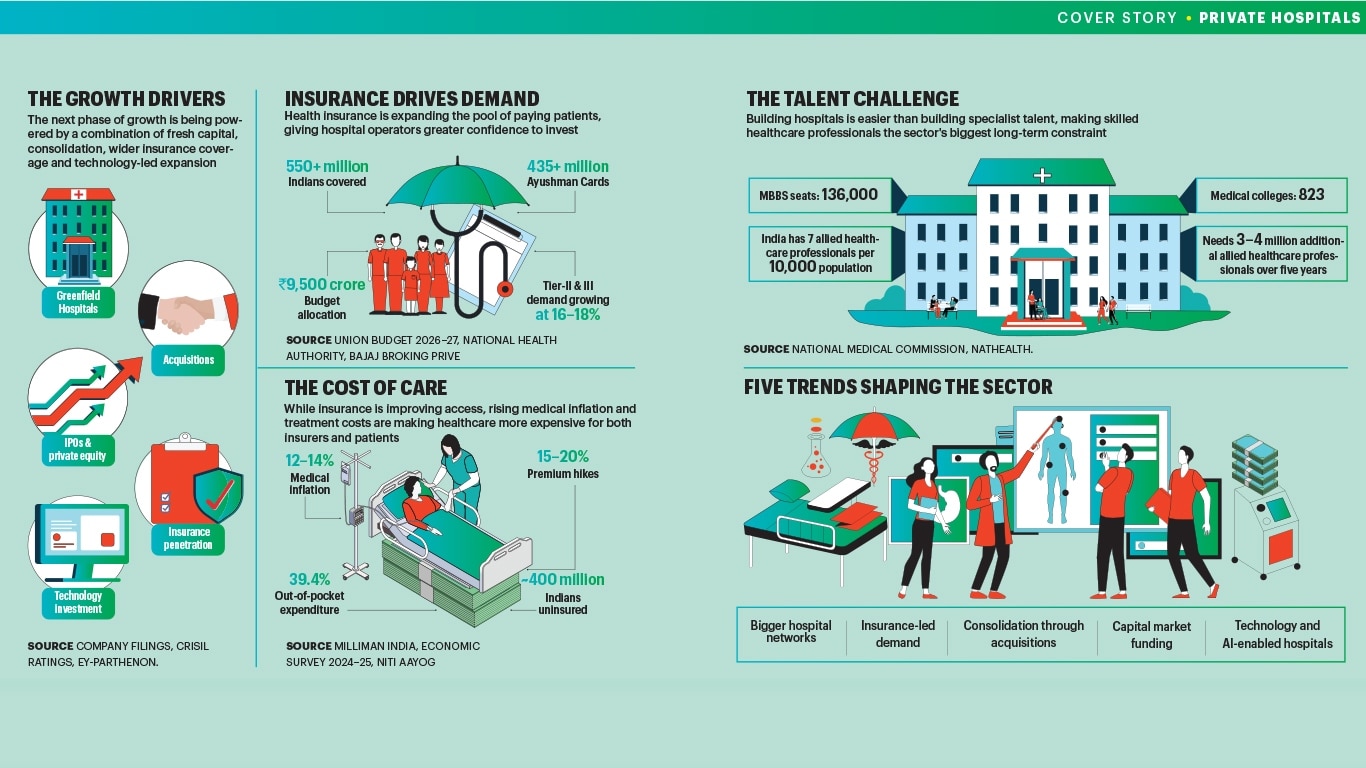
The rapid expansion of private hospitals is supported by a steady rise in health insurance coverage. More than 550 million Indians now have health insurance; the AB-PMJAY has issued over 435 million Ayushman Cards. The Union Budget for 2026-27 allocated Rs 9,500 crore to the flagship scheme. More than 70% hospitals empanelled under Ayushman Bharat are in Tier-II and Tier-III cities.
Bajaj Broking Prive has estimated that healthcare demand in these markets is growing at 16-18% annually compared with 12-14% in metros. As more patients can pay through insurance rather than out of pocket, hospitals are gaining confidence to expand into underserved markets.
A Deloitte India survey of hospital CXOs has found that 60% expect the sector to grow by 10-15% in FY27, driven by rising insurance penetration, demand for organised healthcare and continued capacity expansion, including in Tier-II and Tier-III markets.
Yet, the demand-supply gap remains wide. Soi estimates that the National Capital Region has only 6,000-8,000 tertiary care private beds for a population of roughly 45 million. Max Healthcare’s hospitals operate at 77-78% midnight occupancy, rising to more than 120% during the day once emergency admissions are included. “I don't see how these 6,000 or 8,000 beds in the National Capital Region are going to be enough,” he says.
The Cost of Care
Greater insurance coverage has widened access to healthcare but has coincided with a rise in treatment costs. According to Milliman India’s 2025 report, medical inflation is 12-14%, well above most Asian markets and roughly three times India’s general inflation. A procedure that cost Rs 1-1.5 lakh in 2018 now costs Rs 2-3 lakh. NSSO data shows average private inpatient expenditure rose 239% from Rs 12,546 in 2010 to Rs 42,600 in 2023. In fact, a parliamentary panel has proposed a cap on room rates in private hospitals in big cities.
The strain shows up in the insurance sector. Milliman India’s report shows the incurred claim ratio for public sector insurers reached 100.6% in FY25, meaning claims exceeded premium collections. Insurers have responded by raising premiums by 15-20%. Meanwhile, out-of-pocket spending still accounts for 39.4% of India’s total health expenditure, according to the Economic Survey 2024-25, while NITI Aayog says nearly 400 million Indians are uninsured.
“We are investing in faster claim processing, wider cashless network of healthcare providers, and greater transparency in waiting periods and exclusions, so that policyholders receive the care they deserve. We’re also deepening our presence & distribution in Tier II and III cities,” says Manish Dodeja, Executive Director & Chief Business Officer, Care Health Insurance.
Hospitals say rising treatment costs are only one part of the problem. They also point to delays in reimbursements from insurers and government health schemes. Dr Ashok Seth, Chairman of Fortis Escorts Heart Institute, says the next phase of health financing must move beyond expanding insurance coverage to ensuring that reimbursement supports quality care. Earlier this year, several private hospitals suspended cashless treatment for beneficiaries under the Central Government Health Scheme citing dues worth hundreds of crores.
Krishnan Ramachandran, Managing Director and CEO, Niva Bupa Health Insurance, says insurers are working on three initiatives to improve affordability and standardise care—awareness campaigns, a common empanelment framework and evidence-based treatment protocols. “The second important initiative, which we believe will make insurance more affordable, is a common empanelment initiative. The objective is to have common agreements as well as common tariff arrangements," he says. This is important as disputes over reimbursement rates, claim settlements and cashless treatment have become commonplace.
The disputes have exposed gaps in the regulatory framework. India’s private hospital sector continues to operate under a fragmented system, with licensing, quality standards, pricing and oversight divided among multiple authorities. While the Clinical Establishments (Registration and Regulation) Act, 2010, prescribes minimum standards, it has not been adopted uniformly across the country.
New Owners
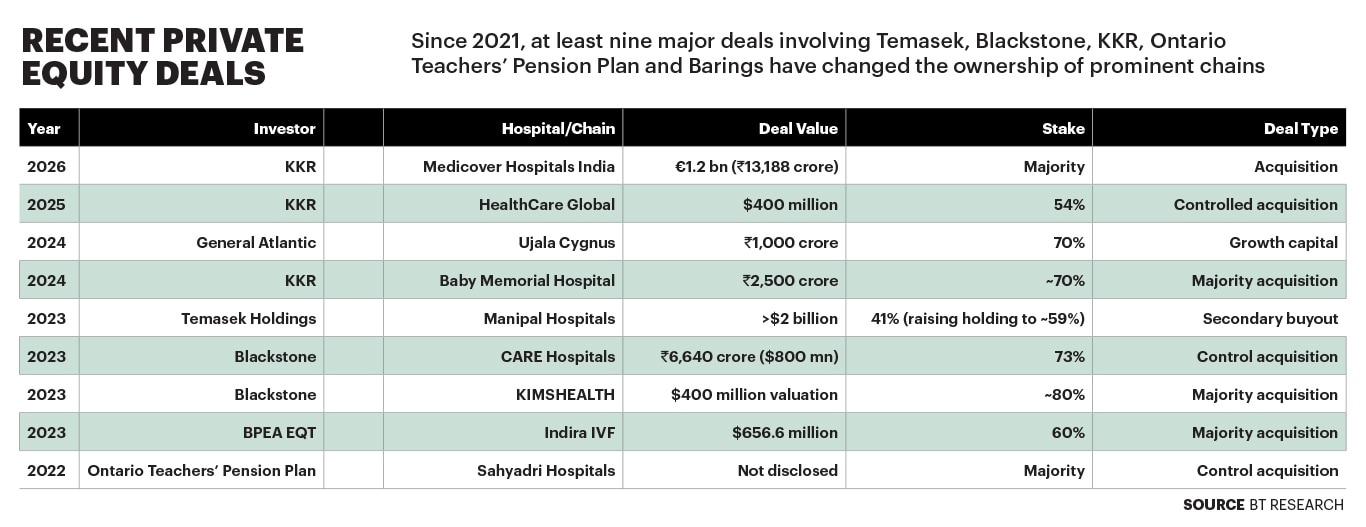
The ownership profile of India’s organised hospital sector has changed markedly in recent years as global investors have stepped up investments through acquisitions and majority stake purchases. Since 2021, at least nine major deals involving Temasek, Blackstone, KKR, General Atlantic, Ontario Teachers’ Pension Plan and Barings have changed the ownership of prominent hospital chains, including Manipal Hospitals, CARE Hospitals, KIMSHEALTH, Sahyadri Hospitals, HealthCare Global (HCG), Ujala Cygnus, Indira IVF and Medicover Hospitals India. While institutional capital is expected to support expansion and improve healthcare infrastructure, it has also sparked debate over affordability and patient care. A growing body of research suggests private equity ownership can accelerate the commercialisation of healthcare and may contribute to higher healthcare costs. “Healthcare has now gone from being a service into an asset class,” says Dr K. Srinath Reddy, Chancellor of the PHFI Institute of Public Health Sciences (Deemed to be University). He argues that investors seeking higher returns can increase the cost of care and encourage unnecessary procedures, highlighting the need for stronger regulatory oversight as private equity expands across hospitals, diagnostics, pharmaceuticals and insurance.
Capital Fuels Boom
The growth of the private healthcare industry explains why investors are willing to pay a premium for the sector. India’s hospital market, estimated around Rs 10.5 lakh crore in FY24, is projected to grow to nearly Rs 16.6 lakh crore by FY32 at a compound annual growth rate of 8%, according to the India Brand Equity Foundation.
Private equity continues to back acquisitions and consolidation, listed hospital companies are commanding premium valuations, and investors have shown a strong appetite for new public offerings. Together, they are providing hospital operators capital to expand. The Nifty Healthcare Index, which tracks companies across pharmaceuticals, hospitals and diagnostics, has gained about 90% in the past five years, compared with a 53% rise in the Nifty 50. Hospital companies have been among the biggest wealth creators during this period, with Artemis Medicare Services delivering a 640% return, followed by Aster DM Quality Care (400%), Indraprastha Medical Corporation (342%), Narayana Health (317%), Max Healthcare (304%) and Apollo Hospitals (116%). The strong listing day gains of Manipal Health Enterprises—it opened 11% higher than the issue price—reflects that confidence.
Listed hospital operators continue to report healthy revenue growth, improving margins and stable occupancy. According to EY-Parthenon, hospitals remained the primary growth engine within the healthcare sector in FY26, with major operators reporting revenue and EBITDA growth of more than 15%, supported by steady occupancy and high-acuity specialties such as cardiology and oncology.
“We are witnessing a structural shift with players focusing on disciplined expansion, strategic partnerships and selective acquisitions. Coupled with strong investor interest and a robust pipeline of public market activity, the healthcare sector remains well-positioned for sustained growth,” says Kaivaan Movdawalla, National Healthcare Leader, EY-Parthenon India.
Private equity investors continue to be optimistic. “Deal activity in healthcare remains buoyant. The trend of PE-backed strategic buyouts in the hospital segment has strengthened as investors look to build regional clusters. As sector consolidation accelerates and balance sheets improve, transaction momentum is expected to sustain through FY27,” says Amit Gupta, Partner, Healthcare and Life Sciences Investment Banking, EY India.


The Race for Talent
While India’s leading hospital chains are investing billions to expand capacity, finding experienced doctors, nurses and allied healthcare professionals remains a challenge. India, though, has made progress in expanding medical education over the past decade. The number of medical colleges has doubled, and MBBS seats have crossed 136,000 across 823 medical colleges, according to the National Medical Commission.
“Hospital infrastructure can be built in three-four years but it takes years of training to develop experienced oncologists, intensivists, cardiac surgeons, anaesthetists and critical care nurses. The industry’s ability to sustain expansion will depend as much on human capital as on financial capital,” says Arup Mitra, Professor of Economics at South Asian University (SAU) in New Delhi.
“Demand for diagnostic and therapeutic services is rising rapidly, with pathology test volumes expected to double between 2022 and 2027, and radiology imaging volumes projected to grow by nearly 90%. To meet this demand, India will require an additional three-four million allied healthcare professionals over the next five years,” he says.
“Talent acquisition is one of the most critical priorities in healthcare today, especially with increasing demand for experienced clinicians and specialists,” says Arora of Yashoda Medicity.
Private hospital chains are adding thousands of beds across the country. Evidence on whether those investments are translating into consistently better clinical care remains limited.
India’s principal hospital accreditation body, the National Accreditation Board for Hospitals & Healthcare Providers (NABH), accredits both public and private hospitals; some also hold Joint Commission International accreditation, an internationally recognised quality benchmark. Accredited facilities account for a small share of capacity. That share is even smaller in Tier-II and Tier-III markets where private hospital chains are expanding most aggressively.
Hospital executives say scale can improve quality rather than dilute it. Jose points to Manipal’s integration of 31 acquired hospitals under a common clinical and operating framework as evidence that large networks can standardise care.
Dr. Seth says expanding into Tier-II and Tier-III cities will improve India’s healthcare landscape if quality travels with infrastructure. “The encouraging part is that small towns, where I never imagined a cath lab could exist, now have well-equipped facilities run by well-trained DM cardiologists,” he says.

“India’s healthcare landscape stands at an inflection point. Rising incomes, health awareness, demographic shifts, insurance penetration and the burden of chronic disease are reshaping demand and expectations. In this context, hospitals are no longer merely centres of treatment; they are essential social and economic infrastructure, shaping productivity, dignity and quality of life of a nation,” says Suneeta Reddy, Managing Director, Apollo Hospitals.
For Dr Seth, profits are necessary, but the defining measure is the value hospitals create for patients. “Profit is necessary because healthcare requires investment. Profiteering is what is wrong,” he says. He argues that India needs stricter audits, outcome-based reimbursement and greater emphasis on hospital readmissions as measures of care.
Doctor Entrepreneurs
India’s hospital boom is not being driven by capital alone. Behind many of the country’s largest healthcare institutions are doctors who stepped beyond clinical practice to build some of India’s most successful hospital enterprises.
From Dr. Prathap C. Reddy of Apollo Hospitals and Dr Naresh Trehan of Medanta to Dr. Devi Shetty of Narayana Health, these physician-entrepreneurs have helped redefine organised healthcare in India. They built institutions that have expanded access to specialised care, attracted global investment and transformed healthcare into one of the country’s fastest-growing industries.
Read the next story, “The Doctorpreneurs,” to find out how these doctorprenuers turned medical expertise into enduring healthcare businesses.
@neetu_csharma


