













In 1991-92, when Dhirubhai Ambani became India’s first self-made dollar billionaire, he was nearly 60. The journey involved decades of licence-raj navigation and running textile mills and refineries.
Eight years later, Azim Premji joined the club when Wipro’s IT valuation exploded during the dot-com boom. He was in his mid-50s.
Different decades, different sectors, same math—a billion-dollar net worth took almost a lifetime.
The New Clock
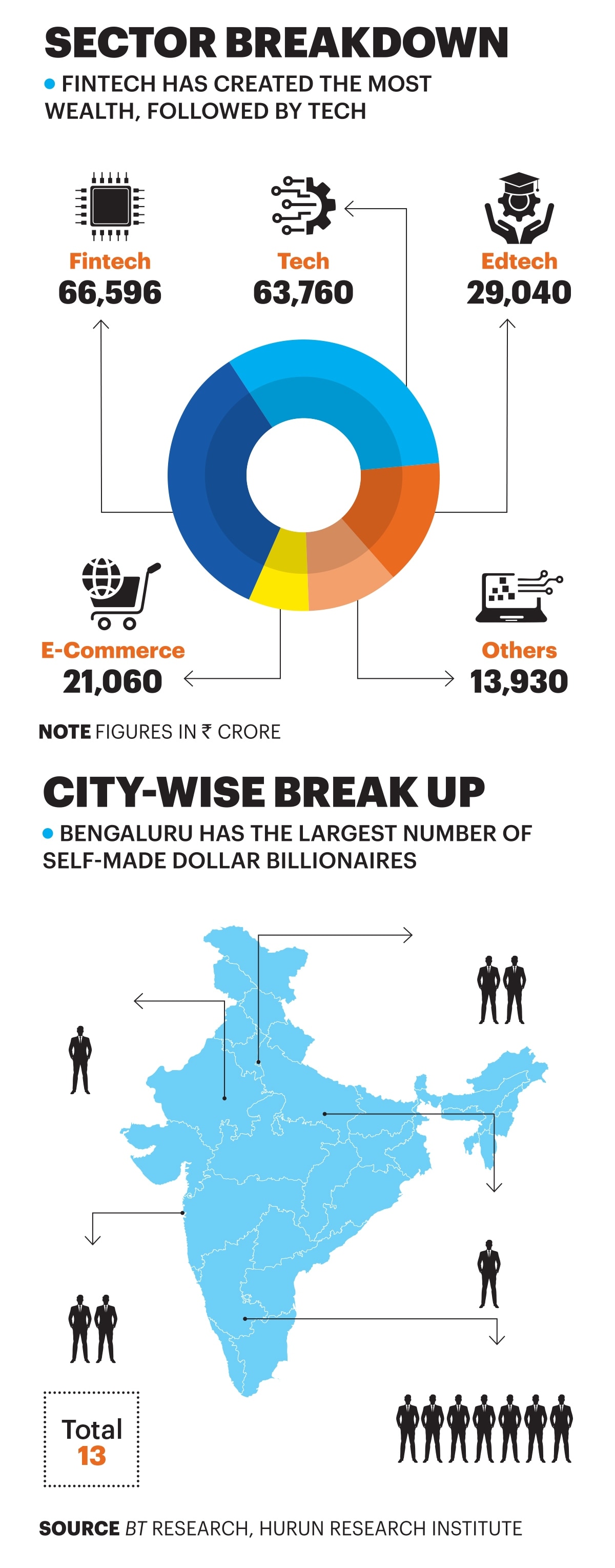
The median age of India’s newest crop of self-made billionaires is 33. That’s less than half the 67-year median age of the country’s billionaire population overall. These entrepreneurs are not only young but have also built their empires from scratch, without the support of inherited wealth or family businesses.
That distinction matters more than it might seem. Look at the rest of India’s rich list and a different pattern dominates—at the second generation, sons, daughters and nephews who took over conglomerates their previous generation built in steel, cement, pharmaceuticals or FMCG. Their wealth compounds through inherited market share, existing distribution networks, banking relationships built over decades, and boards populated by family loyalists. The job, for many of them, is stewardship: protecting and expanding a fortress that has already been built.
The founders in this story—all below 45—inherited none of that. No factory, no distribution network, no line of credit with a nationalised bank built on a grandfather’s reputation. What they inherited instead was public and digital: a smartphone-owning population, a payments infrastructure anyone could plug into, an identity system that let a fintech company onboard a customer in minutes. Where a second-generation heir spends years learning to run what already exists, a self-made founder in this cohort had to first prove something existed at all—a market, a business model, a reason hundreds of millions of people would trust an app with their money. That is a fundamentally different apprenticeship, and it explains why their timelines look nothing alike even when their bank balances eventually do.
The question worth asking isn’t who they are. It’s what changed underneath them.
Three shifts converged to compress almost a lifetime journey into a decade or two—infrastructure (UPI, Aadhaar, cheap data), capital (a venture ecosystem that finally matured), and technology.
The Smartphone Boom
Before UPI, before cheap data, there was the handset. Android phones flooded India as cheap as Rs 5,000, and a population that had never owned a PC leapfrogged straight to mobile.
Two IIT graduates had already made their bet a couple of years earlier. Sachin Bansal and Binny Bansal started Flipkart as an online bookstore. The smartphone wave turned it into India’s answer to Amazon. Cash on delivery for a cash economy, easy returns for a market that didn’t trust buying the unseen.
Later, Walmart bought a majority stake in 2018 for roughly $16 billion. The Bansals were still in their thirties. The playbook was written—find a fragmented offline market and digitise it with the help of venture capital faster than any incumbent could react.
Jio moment and UPI
In 2016, Reliance Jio launched near-free data and shrunk the cost of a gigabyte to the world’s cheapest. Millions of Indians came online for the first time.
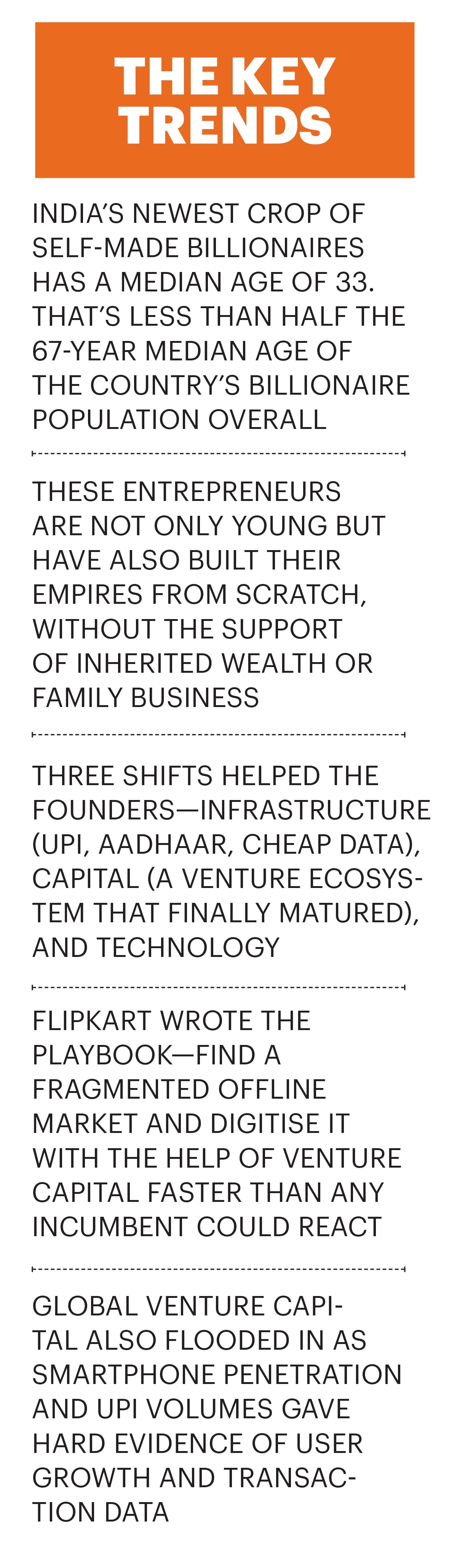
Around the same time, the National Payments Corporation of India launched UPI, which enabled instant transfers between two bank accounts with a phone number or a QR code. By the mid-2020s, UPI was clearing tens of billions of transactions a month, more than most other payment systems combined. Cheap data, plus instant payments clubbed with Aadhaar, became India’s digital public infrastructure.
Venture Capital turns bullish
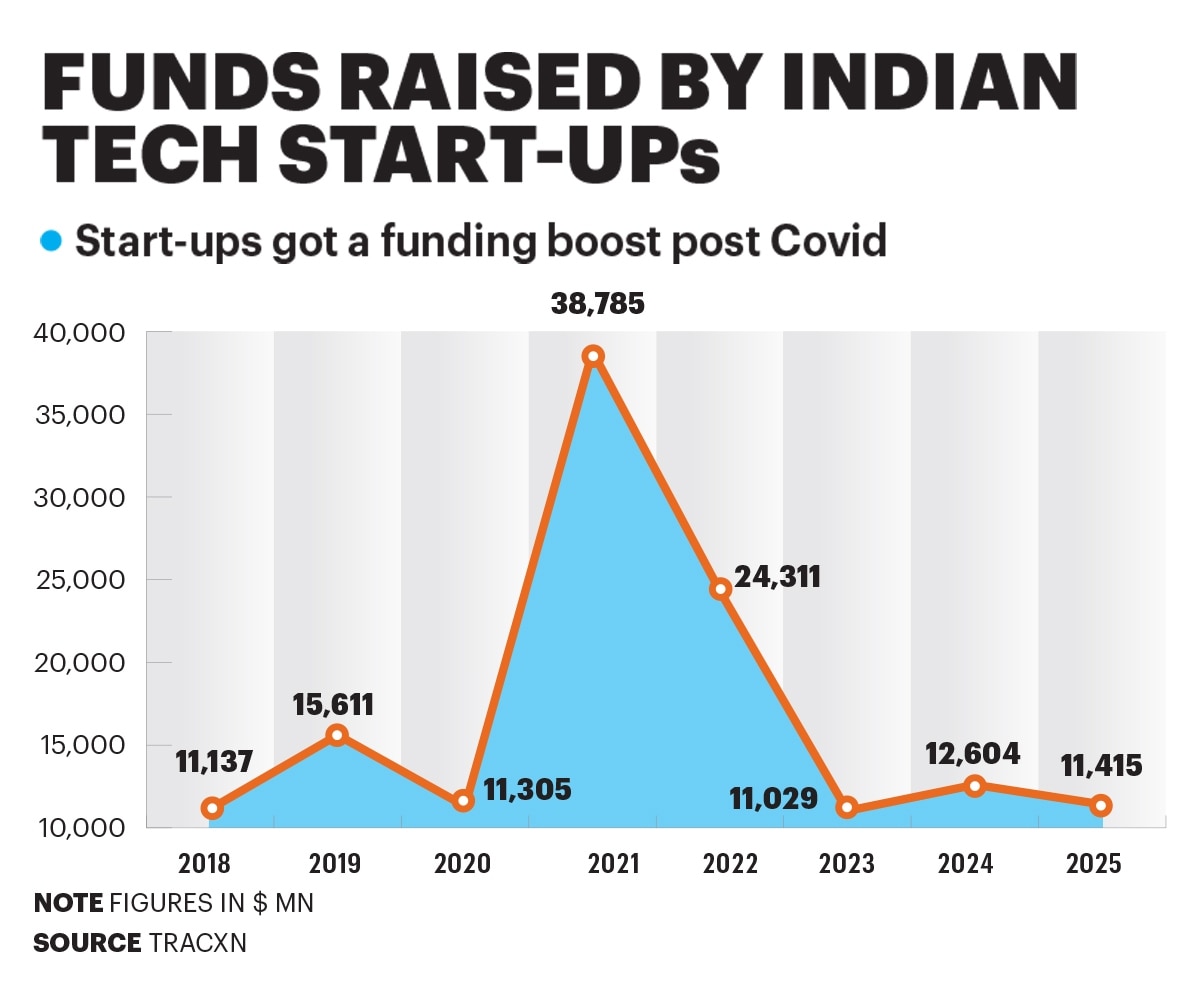
None of this would have compounded into billionaire fortunes without a fourth shift, quieter than the others but just as decisive—global venture capital deciding, almost all at once, that India was investable. That changed as smartphone penetration and UPI volumes gave investors hard evidence of user growth and transaction data.
SoftBankVision Fund, Tiger Global, Sequoia’s India arm, Accel and a wave of sovereign and pension funds moved in through the mid-to-late 2010s, writing cheques that let founders scale user bases years before worrying about profit. Unlike the patient family capital that financed India’s older conglomerates, this money rewarded speed over caution: market share now, monetisation later.
This capital, more than any single app or algorithm, lets founders compress a fund-raising and scaling journey that once took public listing and decades of retained earnings into a handful of funding rounds.
Fintech Cashes In
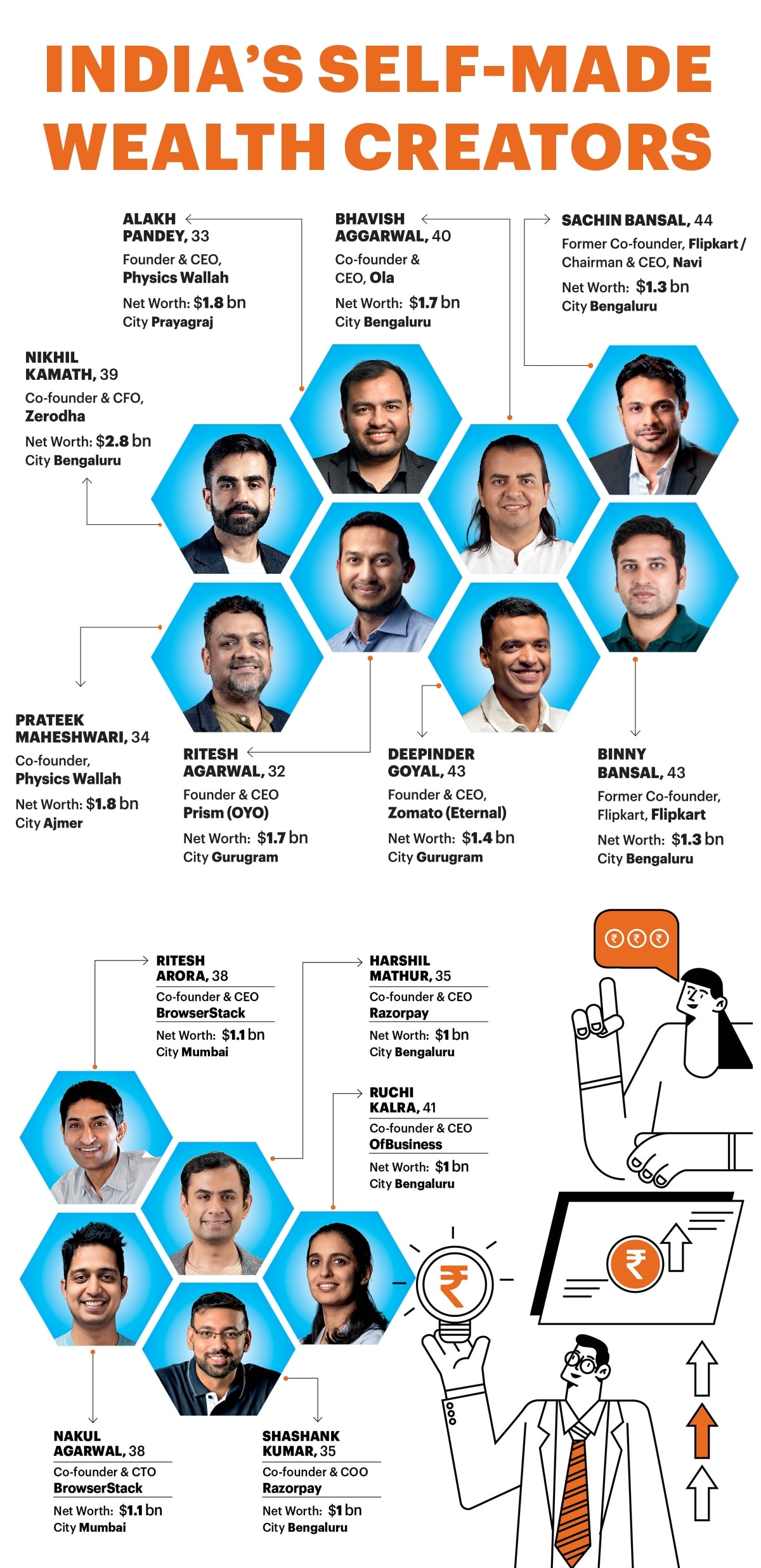
Nikhil Kamath, along with his brother Nithin, had started Zerodha back in 2010, but it was the post-2016 wave of newly connected, UPI-comfortable retail investors that turned it into India’s largest stockbroker, without a single physical branch. It revolutionised the Indian stockbroking industry by introducing flat-fee pricing, zero brokerage on equity delivery, and an entirely web-based, tech-first platform. They built a fast, lightweight web/mobile trading interface easy to access on a smartphone.
Harshil Mathur and Shashank Kumar built Razorpay in 2014 to solve one unglamorous problem: helping businesses accept digital payments. The UPI boom made it essential for hundreds of thousands of merchants. It disrupted the market by replacing slow, legacy banking integration with a developer-first, frictionless payment gateway that slashed high transaction failure rates. Mathur says they started by building for businesses to serve the consumers better.
Consumer India Goes Digital
Deepinder Goyal started Zomato in 2008 as a plain restaurant directory. The post-2016 flood of smartphone-owning, UPI-paying urban Indians turned it into daily infrastructure for millions. The company’s biggest strategic bet came in 2022 with the acquisition of Blinkit, a move that was questioned at the time, but reflected Goyal’s conviction that quick commerce would become a much larger opportunity. “Our logic was if someone else did it three years later, it would have hurt,” Goyal had said while explaining the acquisition to BT. That conviction has paid off, with Blinkit emerging as the faster-growing engine within Eternal, validating a founder’s willingness to bet ahead of the market.
Bhavish Aggarwal founded Ola in 2010 to organise India’s chaotic taxi trade using GPS and digital payments to do for transport what Flipkart had done for retail. The ambition, however, extended beyond ride-hailing. As Ola Electric became his next act, Aggarwal repeatedly argued that the goal was never just chasing valuations. “The focus is on value creation and not valuation... We are in the business of building for a sustainable future,” he told BT, framing the company’s larger ambition as helping build India into a global EV hub. The shift also reflects how this generation of founders increasingly sees itself not merely as building consumer apps, but creating globally competitive manufacturing and technology businesses.
Ritesh Agarwal, barely out of his teens, founded OYO in 2013 to standardise India’s fragmented budget-hotel market, later restructuring parts of it under the Prism umbrella, one of the fastest founder-to-billionaire timelines in Indian history.
Both Ola and OYO disrupted traditional transportation and hospitality markets by digitising fragmented inventory, aggressive price discounting, and implementing mobile-first booking systems.
Not every disruption was a consumer app. Alakh Pandey and Prateek Maheshwari built Physics Wallah out of a YouTube channel, betting correctly that cheap data had created a market of small-town students who owned a phone but couldn’t afford traditional coaching. Their low-cost video model turned the two teachers into billionaires by undercutting an entire industry.
Despite that scale, Pandey says the company’s operating philosophy has barely changed. “Physics Wallah may look like it has grown tremendously, but inside our way of working remains the same,” he had said earlier.
With BrowserStack, Ritesh Arora and Nakul Aggarwal took a different route. Building a cross-browser testing tool sold to developers globally is a proof that this generation wasn’t only digitising Indian problems but exporting infrastructure to the world.
Ruchi Kalra co-founded Ofbusiness, applying the same digital-first playbook to something as unglamorous as B2B raw-material procurement.
Many names, one underlying story
Each of these founders inherited infrastructure rather than having to build it. Cheap smartphones to reach users. Cheap data to keep them online. UPI to move money between them without friction. On top of that sat global venture capital, patient enough to fund years of losses for a shot at scale, and a cultural confidence that hadn’t existed a generation earlier.
India’s rich list still tilts heavily towards inherited wealth, business houses now on their second or third generation of leadership, growing what was handed to them rather than building from zero. Both paths produce billionaires. But only one of them had to invent its own market before it could conquer it.
The structural shift is real. Where Ambani needed 60 years and Premji needed 55, this generation needed a connected population, a payment rail that worked, and investors willing to bet on the gap between an idea and its scale. The clock has been reset, and it’s ticking a lot faster now.
@nindakbaba


