












India’s shipping has a chequered past. The country is home to the world’s oldest known dockyard—likely built during the Indus Valley civilisation era—in Lothal in the Bhal region of Gujarat. The memory of its glorious maritime past lives on in festivals such as Boita Bandna in Orissa which celebrates past voyages to Southeast Asian countries.
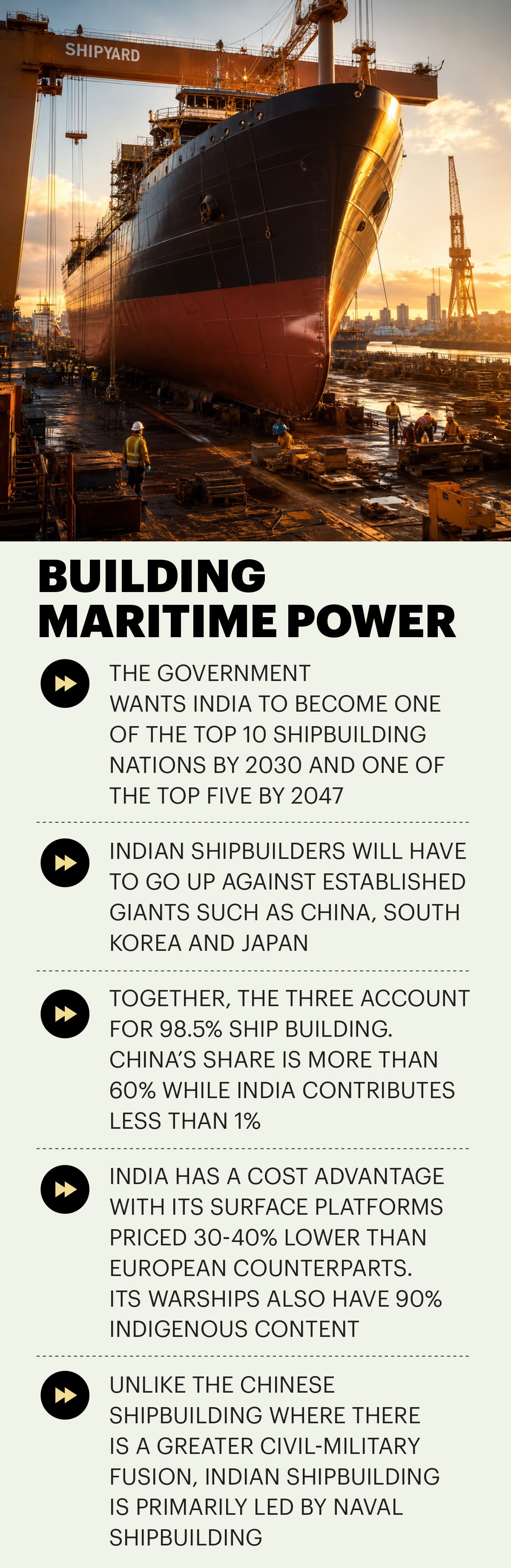
But that is history, most it is forgotten. At present, India accounts for less than 1% of the world’s ship-building capacity. China, South Korea and Japan together account for 98.5% of global ship building. China’s share is 60%.
India aspires to join that exalted club.
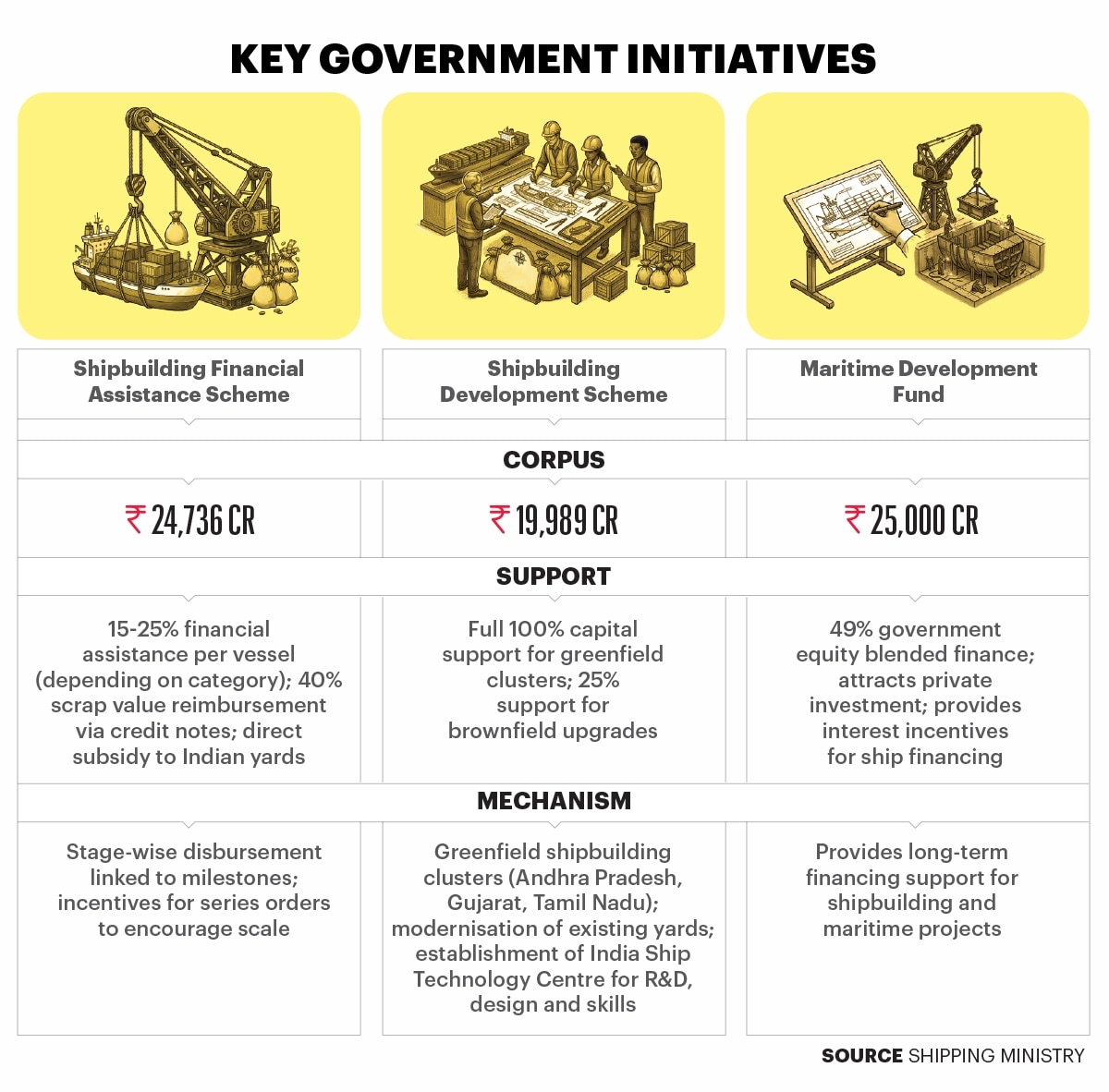
The government has approved a Rs 69,725-crore package to make the country one of the top 10 ship-building nations by 2030 and one of the top five by 2047. Indian shipyards, driven by demand from the Navy, have been focused on domestic waters. The government is nudging them to target exports. Mazagon Dockyard Ltd (MDL), Garden Reach Shipbuilders and Engineers Ltd (GRSE), Goa Shipyards Ltd (GSL) and Cochin Shipyard Ltd (CSL) have been asked to transform India from a regional manufacturer of patrol corvettes and small ships to a global builder of frigates, cadet training ships and modular warships for Southeast Asia, Latin America and Africa.
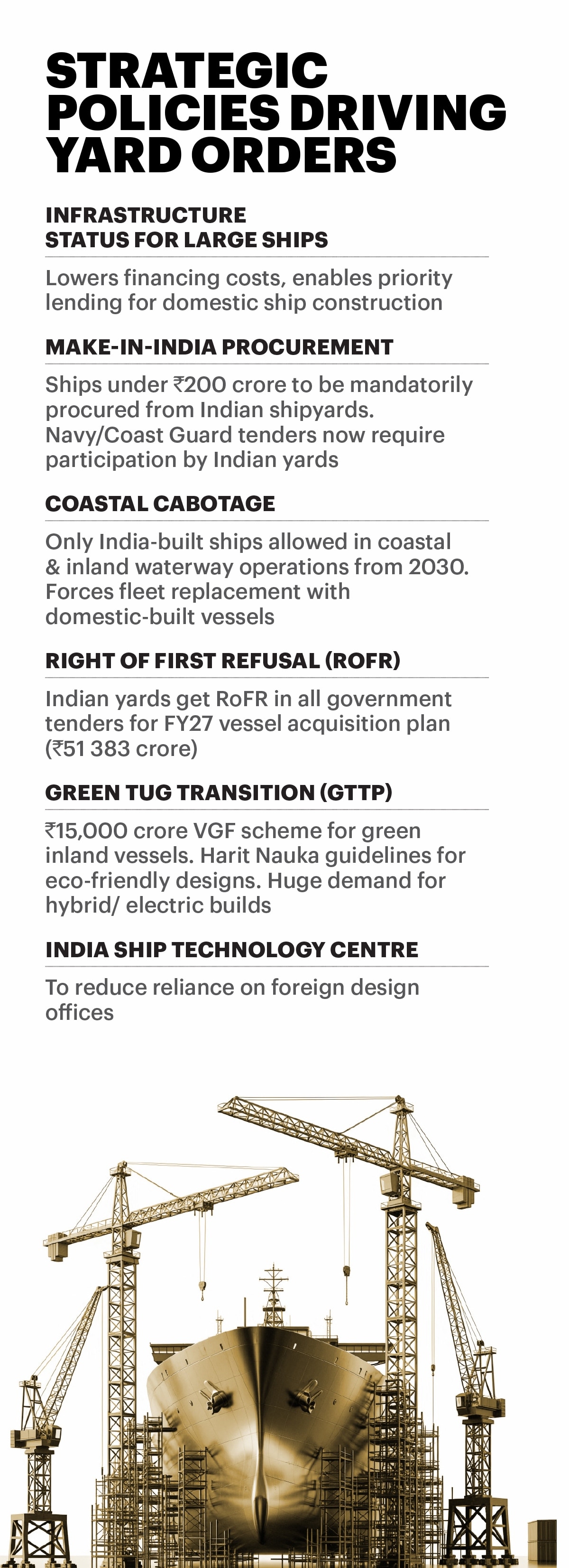
The players will need all hands on deck as they take on established giants China, South Korea and Japan, but they have a few things going for them. The foremost among them is the experience of building for the Insian Navy, followed by government incentives such as infrastructure status to builders of large ships (it will lower the cost of capital) and mandatory local sourcing norms (see Strategic Policies Driving Yard Orders).
Competitive Landscape
India’s surface platforms are priced 30-40% lower than the European counterparts. Against the East Asian competitors India doesn’t have a clean 30-40% cost advantage. It has lower labour costs than China, South Korea and Japan; but it has higher material and financing expenses. The Indian warships also have a high (90%) indigenous content. China, however, is far ahead in speed of manufacturing; South Korea’s advantage lies in integrating cutting-edge sensors and propulsion; and Japan has a legacy of maritime craftsmanship.
India is relying on modular construction, diplomatic goodwill under the Security and Growth for All in the Region (SAGAR) framework for maritime cooperation in the Indian Ocean Region and competitive pricing to carve out a place for itself in the global market. The government has laid out a plan to buy more than 400 vessels to provide order continuity for the shipyards.
The Indian government sees shipbuilding as a strategic industry with significant economic multipliers. Shipbuilding has strong linkages to steel, engineering, manufacturing, logistics, electronics, defence production and maritime services. The sector has an employment multiplier of 6.4 and an investment multiplier of 1.82, according to government estimates.
Another major factor is India’s trade flows. By 2047, India’s export-import cargo is expected to reach nearly 5.7 billion tonnes compared to 1.2 billion tonnes at persent. Currently, a large portion, 90-95%, is carried by foreign-owned vessels. Increasing the share of cargo transported by Indian-owned and Indian-built ships will lower geopolitical risks as well.
The Navy Connection
Unlike the Chinese shipbuilding where there is a greater civil-military fusion, Indian shipbuilding is primarily led by naval shipbuilding, says Captain (retd) K.K. Agnihotri. “Naval shipbuilding is our strong suit. The commercial ship building has not kept pace. That is where the potential resides,” says Agnihotri, a Senior Fellow at the National Maritime Foundation. Only 7% India-owned commercial ships are built domestically.
Indian shipbuilding faces the twin challenge of scaling up and diversifying. In 2026, the Navy plans to commission a record 19 domestically built warships. It has been a leading buyer of ships built in India and inducted its last imported warship in 2025. It plans to field a fleet of 200 warships and submarines by 2035.
The Indian shipyards will have to rise to the challenge by absorbing the latest technologies and scaling up capabilities. At the same time, the government will have to hasten policy decisions and allocate sufficient funds to prevent the withering away of assembly lines. This had happened with MDL, now the largest Indian shipyard, after it did not get follow-on submarine orders for two decades after building HDW submarines. The manufacturing line for Indigenous Aircraft Carrier (IAC) at Cochin Shipyard Ltd has been idle after the induction of IAC-1 in 2022. The nod for the second indigenous aircraft carrier is still awaited. Captain Agnihotri says it is not feasible for CSL to keep the assembly line and human skills ready in perpetuity. “Once the line is utilised somewhere else, we will not be able to find space or time to start the IAC-2.”
The last aircraft carrier took more than 12 years to build. The next will take eight-nine years. Construction will start three-four years after the government’s nod.
Policy Push
The Navy has been working with public sector shipyards since the 1970s. The service has a ship design bureau and recently brought out the Swavlamban document to codify the future tech and platforms required to be indigenised.
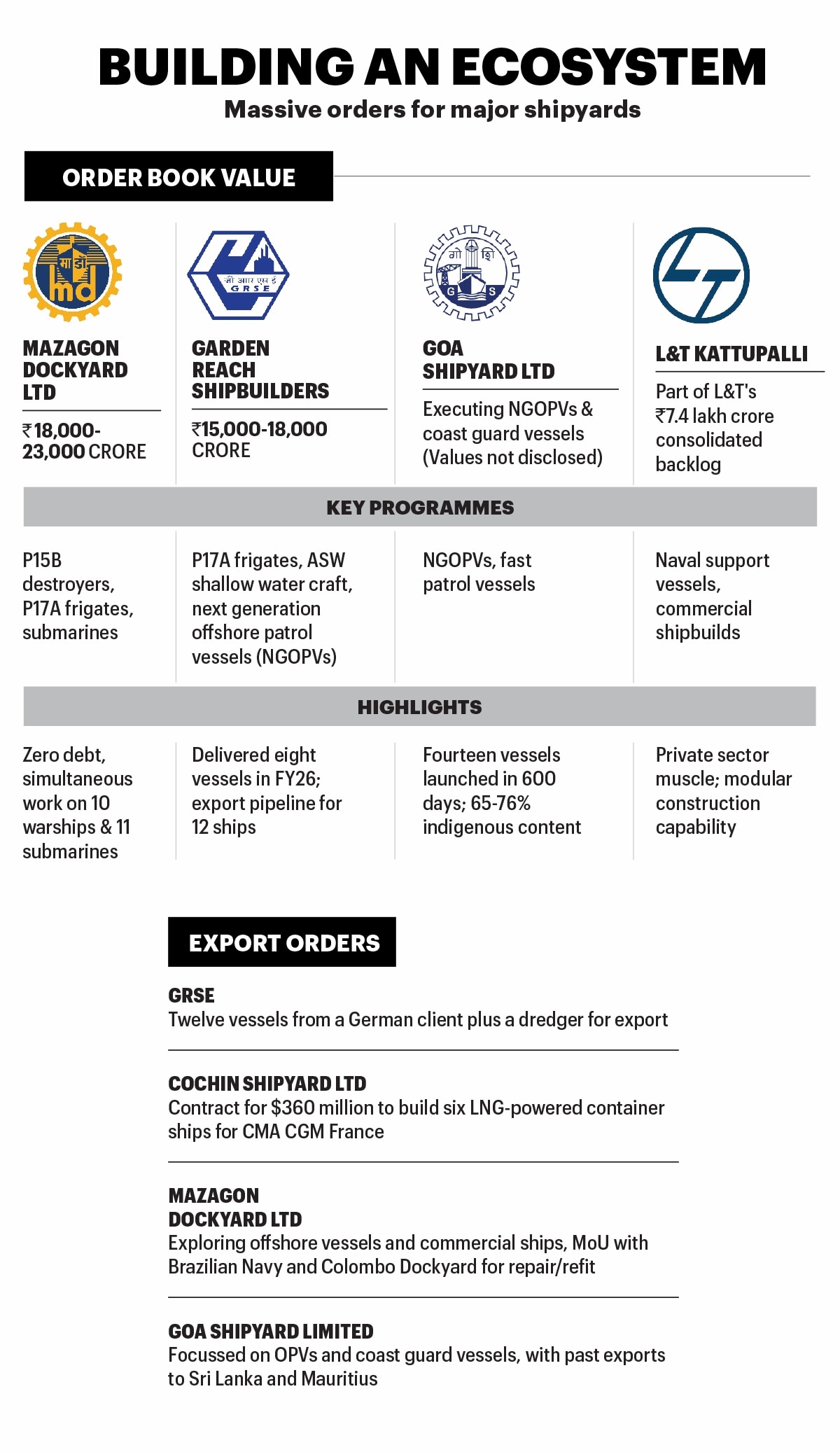
Former CMD of Goa Shipyard Ltd Rear Admiral Shekhar Mittal (retd) is hopeful and says the Indian government has been strategically building capabilities of Indian shipyards by farming out orders to two-three shipyards. “MDL designed the Khukri class corvettes. The designs were passed to GRSE, and with a little bit of handholding, GRSE built the corvettes (an anti-submarine warfare corvette of the same class, INS Kirpan, was gifted to the Vietnamese Navy in 2023). We built the capability,” says Rear Admiral Mittal, who has served as the Director of Indian Navy’s Warship Design Bureau and is working for Rekise Marine, which is building autonomous (unmanned) submarines and surface vessels. Following the same template, Goa Shipyard Ltd is building frigates designed for surface, sub-surface and air combat operations. The frigates, built with Russian collaboration under the ‘Make in India’ scheme, are equipped with Brahmos missile system, torpedo launchers, and auxiliary control systems.
Even Larsen & Toubro, which started as a commercial shipyard, wants to get a piece of the burgeoning Indian warship industry. It has proposed a Rs 1,100-crore expansion at its Kattupalli shipyard and a modular fabrication facility near Chennai to increase utilisation of the existing infrastructure and strengthen shipbuilding and repair capabilities. The Tatas are also entering the shipbuilding industry with their first yard in Kerala.
Going Modular
The biggest hindrance for Indian shipyards in securing large global orders is the low tonnage capability. India’s capacity is just 0.072 million GT (gross tonnage, a standard measure of the overall internal volume), against South Korea’s 20 million and Japan’s nine million.
China’s mega yards can build bulk carriers, LNG tankers and container ships simultaneously. South Korea specialises in high-value LNG carriers and ultra-large container ships, commanding 25-30% global share. Japan focuses on precision engineering, eco‑friendly vessels, and niche segments.
In India, instead of one yard building large surface vessels at one go, several smaller shipyards like Chowgule shipyard have emerged. These build blocks of a bigger vessel that are integrated at the main shipyard later.
The government taking a leaf out of the South Korean model and establishing greenfield mega shipbuilding clusters across the country. These will be equipped with common dry docks, breakwaters, dredged channels, outfitting berths, utilities, shared logistics infrastructure, and ancillary manufacturing ecosystems.
The first cluster is planned in Tamil Nadu through a collaboration between V.O. Chidambaranar Port and SIPCOT. Additional locations under consideration include Andhra Pradesh, Odisha, Gujarat and Maharashtra. Each cluster may involve an investment of Rs 10,000-20,000 crore.
Riding the shipbuilding boom, Gujarat has already come out with Shipbuilding and Repair Policy 2026 and is eyeing an investment of more than Rs 27,000 crore. The Gujarat government will set up two Integrated Mega Shipbuilding Parks.
Repair, the Bigger Prize?
The global ship repair and maintenance market in 2026 is valued at $32-41 billion and projected to grow to $55-60 billion by 2030-2036, according to the Ship Repairing Global Market Report 2026 published by the Business Research Company. Though India’s share is less than 2%, it is emerging as cost‑competitive alternative. Its location in the Indo-Pacific and the 7,500-km coastline mean potential for emerging as a regional ship maintenance, repair and overhaul hub. The L&T shipyard in Chennai has repaired USNS Salvor and two British vessels, the Royal Fleet Auxiliary Argus and RFA Lyme Bay. This was the first time a Royal Navy vessel underwent maintenance at an Indian shipyard. Besides L&T Shipyard, the US Navy has entered into an tie-up with CSL.
In a strategic acquisition to position it as a global player, the government has given a nod to MDL to acquire a controlling stake in Sri Lanka’s largest shipbuilding and repair facility, Colombo Dockyard, for $52.96 million. The yard is close to some of the busiest shipping lanes in the world.
MDL is constructing a large floating dry dock at its Nhava (Nava Sheva) yard near Mumbai. It was cleared in 2025. This floating dock will significantly expand India’s naval and commercial shipbuilding and repair capacity. This will relieve congestion at MDL’s land‑based Mumbai dockyards and enable construction and repair of next‑generation destroyers, landing helicopter docks, aircraft carriers, and submarines in synergy with the Colombo Dockyard.
Other companies have also announced plans to set up MRO operations and shipbuilding clusters. “MRO cash flow cycles are fast, unlike shipbuilding, where it takes three-five years depending on the size of the ship. Refits have a much shorter duration. The money is not blocked,” says Rear Admiral Mittal.
India’s shipyards are standing at the crossroads. Government initiatives like Sagarmala Make in India and Shipbuilding Financial Assistance Policy might take them closer to making India a shipping power.


