














Where there’s a will, there will be a dispute. And when there’s no will, complications inevitably arise.
These maxims, popular among lawyers and estate planners, illustrate how difficult it is to ensure a smooth corporate succession or leave behind an inheritance for one’s family.

In any case, you can’t do without a will. You can counter the risks with some care and effort, say experts. The risk of a will being contested can be significantly reduced by ensuring it is professionally drafted and periodically reviewed, says Sneha Makhija, Head of Wealth Planning at Sanctum Wealth. The document should be “aligned with ownership structure, nominations and legal documentation governing the underlying assets,” says Makhija.
There are hundreds of examples of inheritance disputes rocking the world of business. In July 2026, the late Ratan Tata’s will faced hurdles over transfer of 3,368 Tata Sons shares he had willed to two charitable trusts. The issue is being probed by the Maharashtra charity commissioner, delaying the transfer of Rs 1,684 crore worth of shares he had held in the Tata Group holding company. Ratan Tata died in 2024.
Other high-profile cases include a dispute over the Rs 30,000 crore estate of Sunjay Kapur, chairman of automobile component maker Sona Comstar, between his mother Rani and widow Priya Sachdev. Kapur died in 2025 after collapsing at a polo match in England.
Octogenarian Bina Modi and her sons Lalit and Samir Modi have been engaged in a legal battle over the Rs 11,000 crore business empire of the late K. K. Modi and its flagship Godfrey Phillips India.
Over past years, succession disputes have roiled many other businesses—including the MP Birla Group, Kalyani Group and the Oberoi Group—as well.
Time-Consuming
Some of the disputes are in the process of getting resolved. Some continue to fester. Almost all have big money riding on them.
Roughly Rs 18.5 lakh crore worth of real estate and family wealth is stuck in often time-consuming litigation in Indian courts, according to a paper by the Centre for Policy Research. Inheritance and partition suits take between three and 20 years to get resolved.
Around 66% civil litigation in India pertains to land or property disputes. For perspective, 11.3 million civil cases are pending in courts, according to the National Judicial Data Grid.
Yet, a survey in 20 cities conducted by personal finance periodical 1 Finance Magazine found that only 15.2% respondents have a will to ensure their assets go to beneficiaries of their choice.
Writing a Sound Will
Taken together, these facts indicate the importance of a well-thought-out succession plan, as much in ordinary households as in corporate boardrooms. A sound will can go a long away in bequeathing assets in a smooth manner and reducing the possibility of lengthy disputes.
What goes into writing a legally sound and functionally smart will? What could happen in its absence? Where could things go wrong and lead to feuds? And when do additional documents become necessary to prove one’s right to an inherited asset?
Wills are governed by the Indian Succession Act, 1925. Sections of the Act define a will, a person’s capacity to write one, procedures for defence, how a will can be revoked, and so on.
A person making a will, or Testator/Testatrix (a man or woman, respectively, who leaves behind a valid will) has to clearly mention his/her name, age, place of writing the document, and indicate it was made with a sound mind. It lists the person’s assets and their beneficiaries to the last detail as to who gets how much. It also names the executor so that the person’s directions can be carried out after he or she passes on. Finally, the will has to be signed by at least two witnesses.
Only those assets that are self-acquired, without joint ownership or where the testator/testatrix is the sole owner in case they are inherited, can be bequeathed though a will.

Some Dos and Don’ts
“To avoid the will being challenged on medical grounds or due to claims of mental incapacity, it is recommended that a medical fitness certificate be attached. A video recording of the will being read and signed can also help in case of any challenges or disputes,” says Haigreve Khaitan, managing partner of law firm Khaitan & Co.
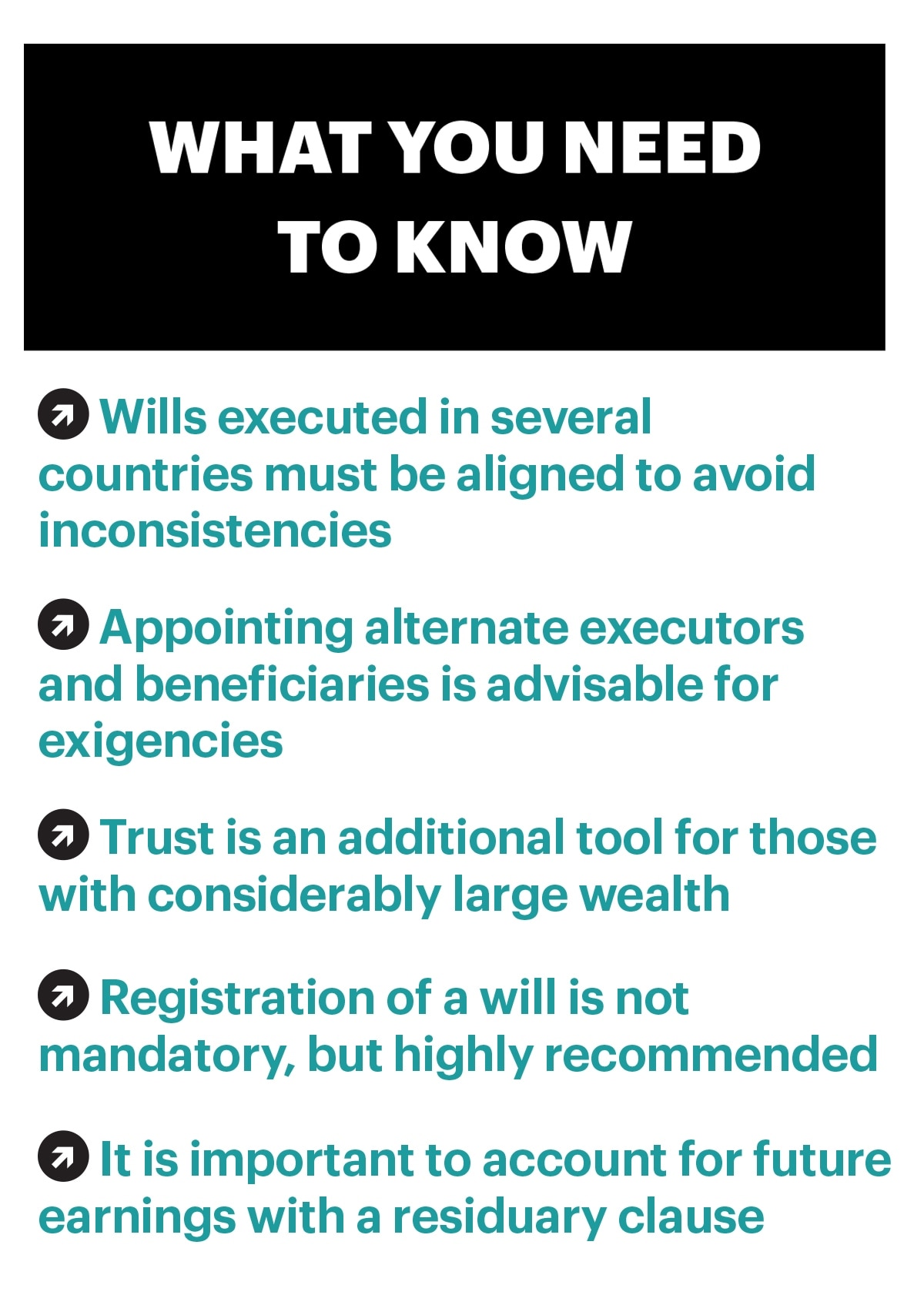
To ensure that a will is executed and even future earnings (of the testator/testatrix after the will is made) are accounted for, Tanmay Patnaik, partner in the Private Client Practice at Trilegal, offers an important suggestion. “It is advisable to include alternative executors and alternative beneficiaries in case the primary persons named are unable to act or predecease the testator,” says Patnaik. “A sound will should also contain a residuary clause dealing with assets that may not have been specifically listed or that may be acquired in the future, so that no part of the estate is left to devolve by intestacy” or not being covered by a valid will.
In India, it is not mandatory to register a will, but experts suggest doing so nonetheless.
“Registration is optional but can be beneficial as it provides documentary evidence of the will’s existence, confirms that the testator or testatrix personally appeared before the registering authority and acknowledged the document, and ensures its safe custody with the registrar,” says Patnaik.
Intestate Issues
In the absence of a will, after a person’s death, the assets are bequeathed on the basis of applicable succession laws.
The Hindu succession law specifies heirs under classes (Class 1, Class 2 and so on in order of precedence). Most of the sections are applicable to Buddhists, Jains, and Sikhs as well.
For Christians, the Indian Succession Act is applicable, with provisions that specify how much to allocate to the spouse, children, parents and so on.
The Muslim Personal Law allows only one-third of the value of the assets to be passed on via a will. The rest go to legal heirs on the basis of Sharia laws.
“A will allows one to override the application of personal laws which govern intestate succession and ensure that an individual’s assets are distributed according to their wishes and not as per a statutory formula,” says Khaitan.
“For instance, under Hindu law, if a male dies intestate (without leaving a valid will), his mother is also a heir alongside the spouse and children, which tends to be a surprise for many people,” he adds.

Nomination Issues
Nominating someone may not be enough to bequeath assets. Patnaik of Trilegal makes an important distinction here. “A nominee is essentially a trustee who is authorised to collect funds from the bank / financial institution after the account holder’s death, but the underlying ownership remains with the legatee named in a valid will, or in the absence of a valid will, the legal heirs as per the applicable law of intestate succession,” he says.
In the case of insurance, however, nomination allows relatively easy passage of benefits to nominees. “Under the Insurance Act, 1938, where a life insurance policyholder nominates specified close family members, such as a parent, spouse or a child, the nominee may, subject to the applicable provisions and exceptions, be regarded as beneficially entitled to the insurance proceeds,” says Patnaik.
Other documents commonly sought include letters of administration, succession certificate, indemnity bonds and affidavits.
Makhija of Sanctum Wealth breaks down the details.
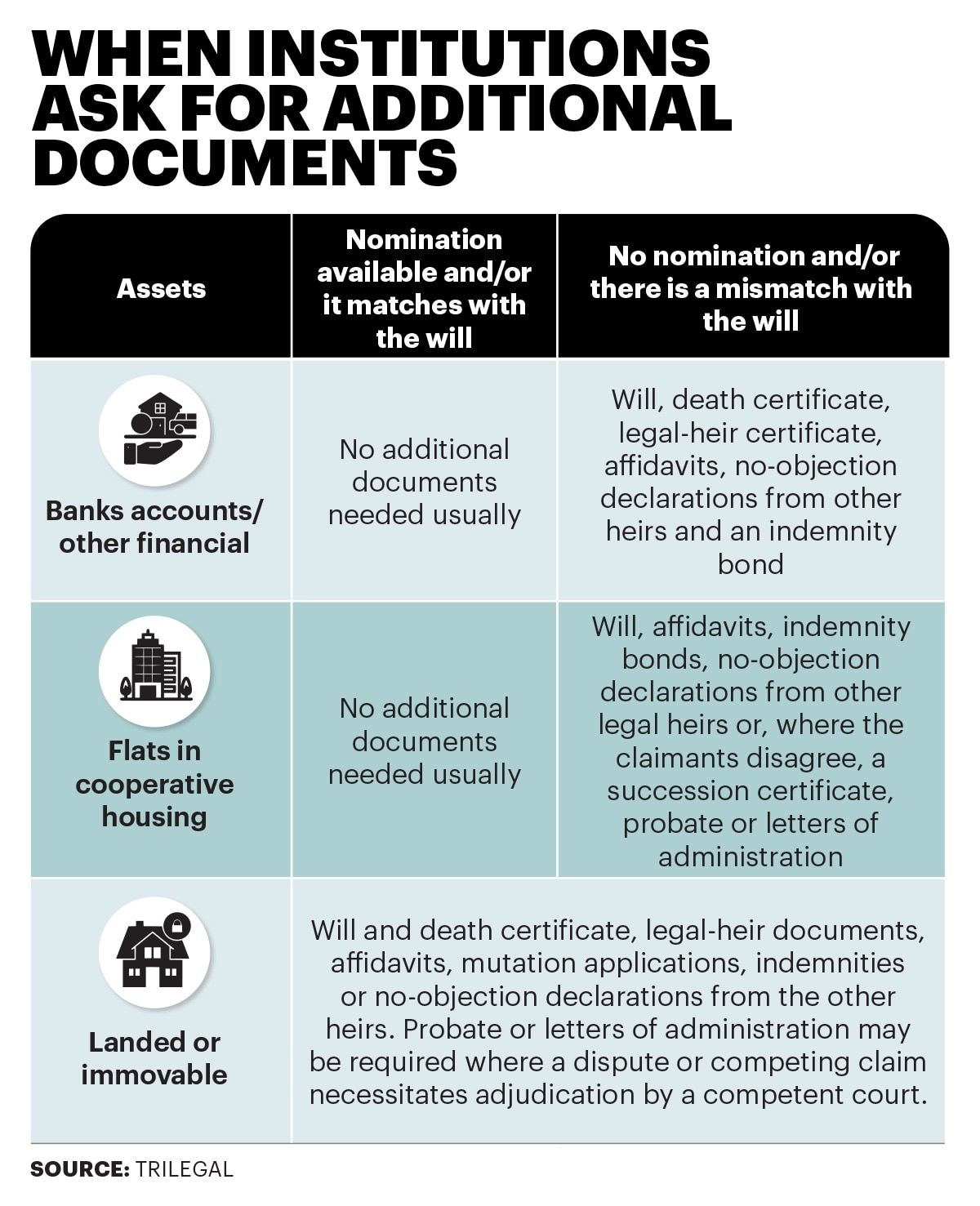
“Letters of administration are generally required where a person dies without a will or no executor has been appointed,” she says. “A Succession Certificate is typically required where a person dies intestate and the estate comprises only movable financial assets… Indemnity bonds, affidavits and similar documents are commonly sought as procedural safeguards to protect institutions against competing claims or future litigation,” she explains.
Problematic Wills
Despite the best intentions of a testator, things can go haywire and a will can be challenged for multiple reasons.
“Allegations of undue influence, lack of testamentary capacity, forgery or suspicious circumstances surrounding the execution of the will are also common grounds for a challenge,” says Makhija.
A will lacking rigour in itself can lead to problems and legal challenges. “A will may be poorly structured if it fails to provide for substitute beneficiaries in the event of predeceasing legatees, omits a residuary clause, attempts to cover overseas assets without proper planning, or contains handwritten changes or annexures that are not properly executed through a codicil,” Khaitan says.
Opting for Trust
A will is useful for most income groups with moderate assets. Those with an extensive list of properties, businesses, overseas assets and a list of beneficiaries with complicated requirements often float a trust.
A trust is a legal arrangement and comprises a settler (or grantor), trustee or trustees and beneficiaries. Private trusts are governed by the Indian Trusts Act, 1882. The settler is the one transferring the assets to the trust he/she has created. The trustees appointed by the grantor take care of the assets and ensure they go to the intended beneficiaries.
“For families with complex asset holdings, business interests, cross-border assets, blended families, or specific succession objectives, a will alone may not be sufficient. In such cases, it should form part of a broader estate planning framework, complemented by structures such as private family trusts and other succession planning tools,” says Makhija.
“Trusts can be named as legatees under a will, allowing assets to flow into a trust structure upon the testator’s demise. This is particularly useful for protecting minor or special-needs beneficiaries, ensuring professional management of assets, facilitating smooth inter-generational transfer and protecting assets from creditors or matrimonial disharmony,” says Khaitan.


