













india’s largest car maker Maruti Suzuki started commercial production from the fourth plant at its Hansalpur manufacturing facility in Gujarat in July this year. The plant has a capacity of 250,000 units per year, taking the overall capacity in Hansalpur to one million units per year.
The company has invested Rs 25,289 crore in Hansalpur over he years. It is the first Suzuki facility anywhere with an annual capacity of one million. It is also India’s largest single-location passenger vehicle plant.
Maruti Suzuki is one of many companies that have contributed to Gujarat building a large manufacturing base. In May 2026, Japanese auto giant Honda’s Indian two-wheeler arm announced an investment of Rs 920 crore to set up a fourth production line at its manufacturing plant in Vithalapur, also in Gujarat. The state has topped the BT study on India’s top manufacturing states.
The new line, which will begin operation in 2027, will have a production capacity of 650,000 units per year, and will take the total annual capacity in Vithalapur to 2.6 million units, making it the largest assembly plant for Honda motorcycles globally. Honda’s local rival Hero MotoCorp already operates a large plant in Gujarat’s Halol.
Automobile is not the only area bringing huge investments in Gujarat. Tata Electronics is building a mega semiconductor fabrication facility in Dholera, with the total investment likely to be up to Rs 91,000 crore. Murugappa Group-owned CG Power’s arm recently started commercial production at its G1 Outsourced Semiconductor Assembly and Test (OSAT) facility in Sanand. CG Semi is investing over Rs 7,600 crore over five years to develop two OSAT facilities there.
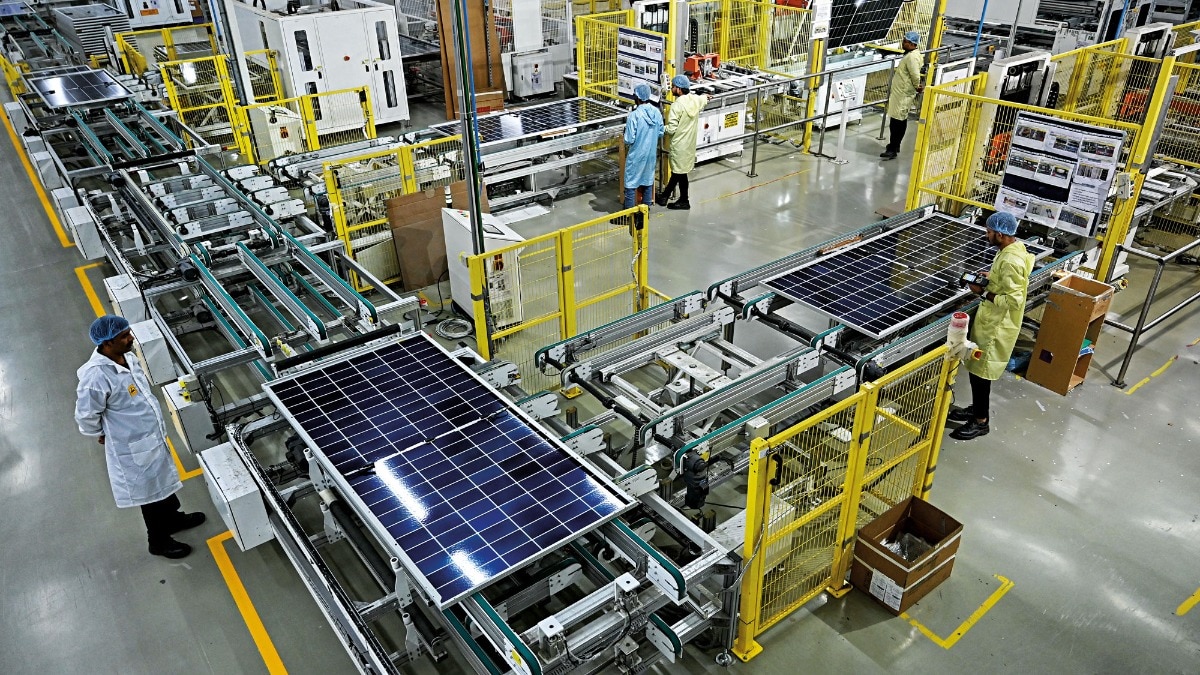
In Sanand, US consumer goods giant Procter & Gamble set up a new personal care manufacturing facility with a Rs 2,000 crore investment. At the Vibrant Gujarat Regional Summit this year, Reliance Industries Chairman Mukesh Ambani announced plans to invest Rs 7 lakh crore in Gujarat over five years, double the Rs 3.5 lakh crore it had invested since 2021. Reliance already operates its largest refinery in Jamnagar and is building gigafactories for green hydrogen, photovoltaic panels and energy storage batteries, among others. Jamnagar will also house India’s largest AI-ready data centre.
Gujarat has already had a strong manufacturing base in areas like chemicals, pharmaceuticals, oil refining and tiles. Now, it is attracting massive investments in areas like automobiles, electronics, renewable energy, ports and even ship building. Aided by supportive policies, the state has in recent years emerged as India’s largest manufacturing hub.
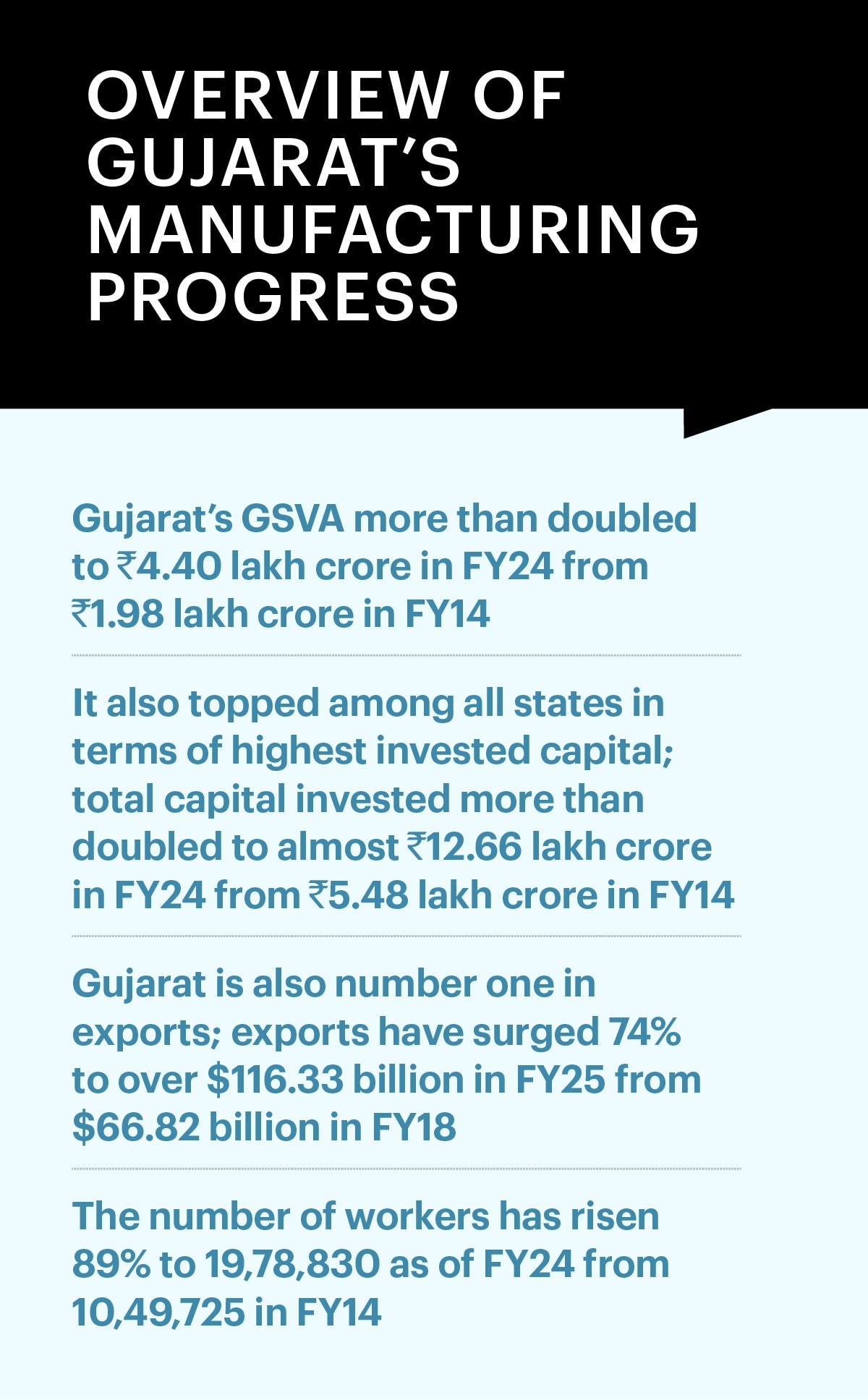
Based on the BT-Deloitte 2022-23 data, Gujarat ranked number one in the country in terms of manufacturing gross state value added (GSVA) growth over both five-year and ten-year periods. GSVA essentially measures the net output of the manufacturing sector after deducting the cost of raw materials and other inputs from the total output of manufactured goods.
Not only that. Gujarat has also emerged as an investment ace, getting the top rank in terms of capital invested. Not surprisingly, the state is also the numero uno in exports.
Emergence of mega ports like Gujarat Pipavav Port, in which Denmark’s APM Terminals holds a majority stake, and the Adani Group-owned Mundra Port, along with its proximity to West Asia, have helped Gujarat become a major exporter.
“With India’s longest coastline of about 2,340 km, 49 ports and nearly 39% of the country’s cargo handled through Gujarat, the state has established itself as India’s gateway to global trade,” says Gujarat Chief Minister Bhupendra Patel.
In July, the Gujarat government announced its shipbuilding and ship repair policy. The state wants to develop an integrated mega shipbuilding park under the policy.
The Union government has already approved the establishment of a mega shipbuilding cluster at Kuchhadi in Porbandar district. The cluster will house two-three shipyards along with a network of ancillary industries. According to officials, this development is expected to attract private investment of about Rs 23,700 crore.
Further, to support this large-scale industrial ecosystem, common marine and land-based infrastructure worth around Rs 3,300 crore will be developed.
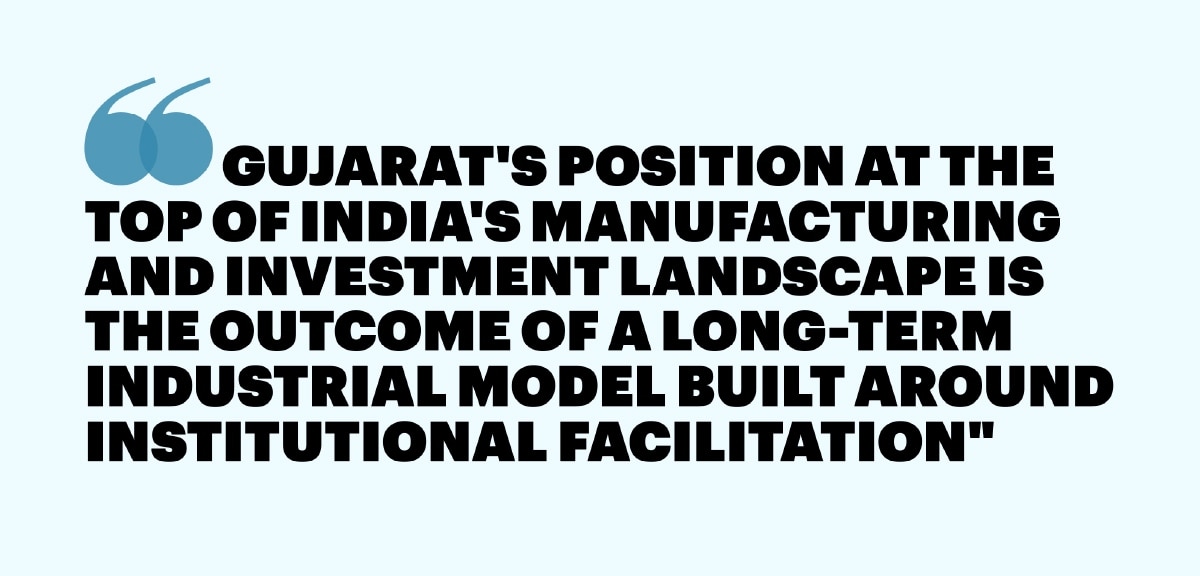
According to industry body ASSOCHAM, Gujarat’s position at the top of India's manufacturing and investment landscape is not the result of a single policy or one mega investment, but is the outcome of a long-term industrial model built around infrastructure, policy continuity, institutional facilitation and execution.
“Gujarat's ability to pre-develop industrial infrastructure such as the Special Investment Regions in Sanand, Dholera and GIFT City removes the friction of land acquisition and utility set-up for large-scale manufacturers,” says Milan Thakkar, chairman, policy advocacy and ease of doing business committee, ASSOCHAM Gujarat Council.
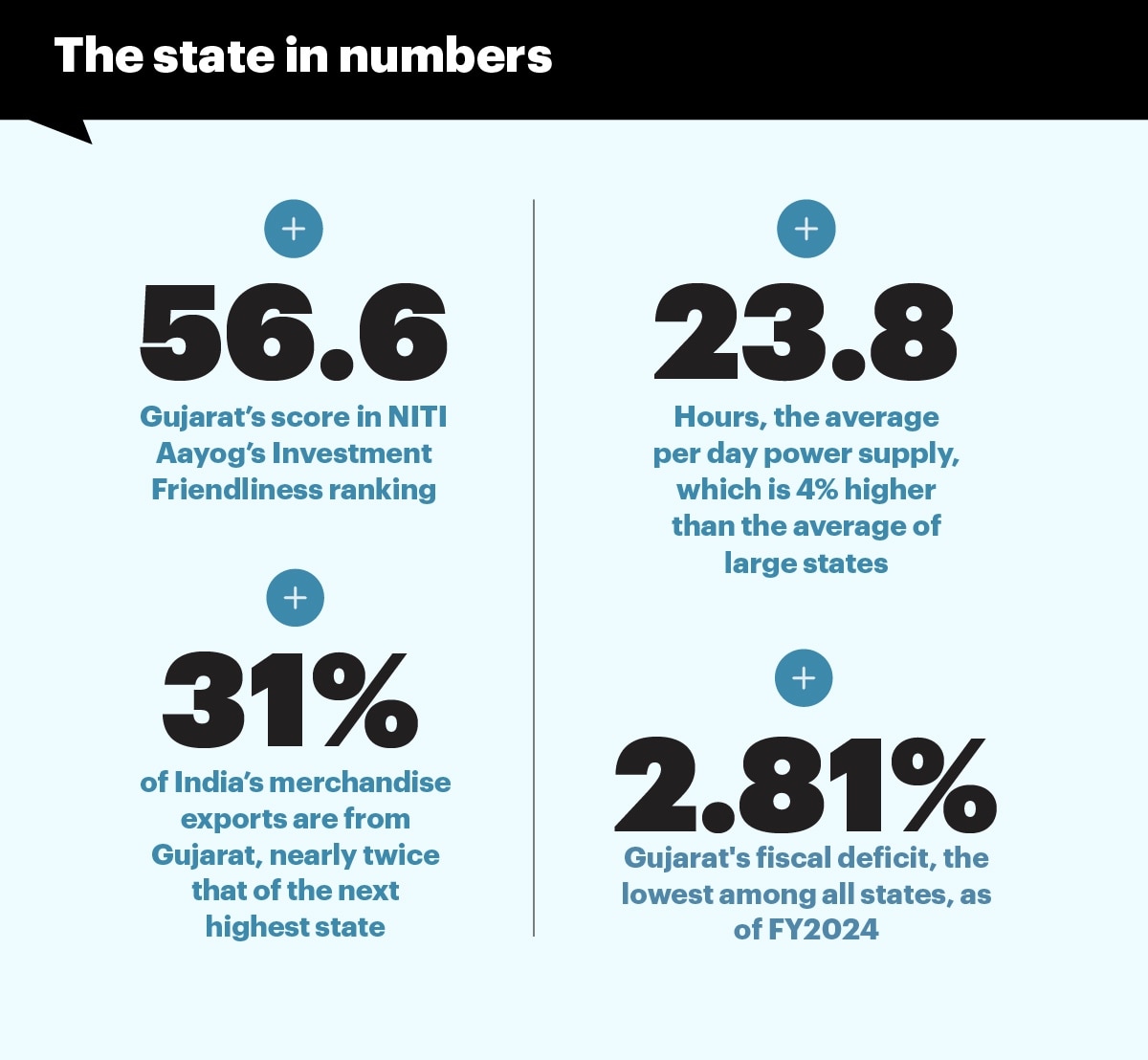
The NITI Aayog’s first Investment Friendliness Index released in 2026 uses a 100-point scale and serves as a benchmark for states to improve their investment environment. Five states—Gujarat, Maharashtra, Tamil Nadu, Goa and Odisha—were identified as the top performers based on the scores. Among large states, Gujarat was identified as the best performer with a score of 56.6.
“The state’s score is driven by its strong performance across infrastructure, business climate, financial health, regulatory ease and government policy pillars, with areas of improvement in resources, institutional environment and environment resilience pillars,” according to NITI Aayog.
It pointed out that Gujarat’s high rank in infrastructure was the result of its efficient port operations; the turnaround time weighted by capacity for major and non-major ports was the lowest.
It also noted that Gujarat offered power to industrial users at prices 29% below the pan-India average. “Electricity downtime in the state is also low, with an average power supply of 23.8 hours a day (4% higher than the large state average), thus providing reliable and uninterrupted power supply to businesses.”
Importantly, Gujarat also scored well on the financial health pillar. At 2.81%, it had the lowest fiscal deficit as a percentage of GSDP among the states, as of financial year 2024. Also, its outstanding liabilities as a percentage of GSDP remained sustainable at 18%, 40% below the average for the large states, it said.
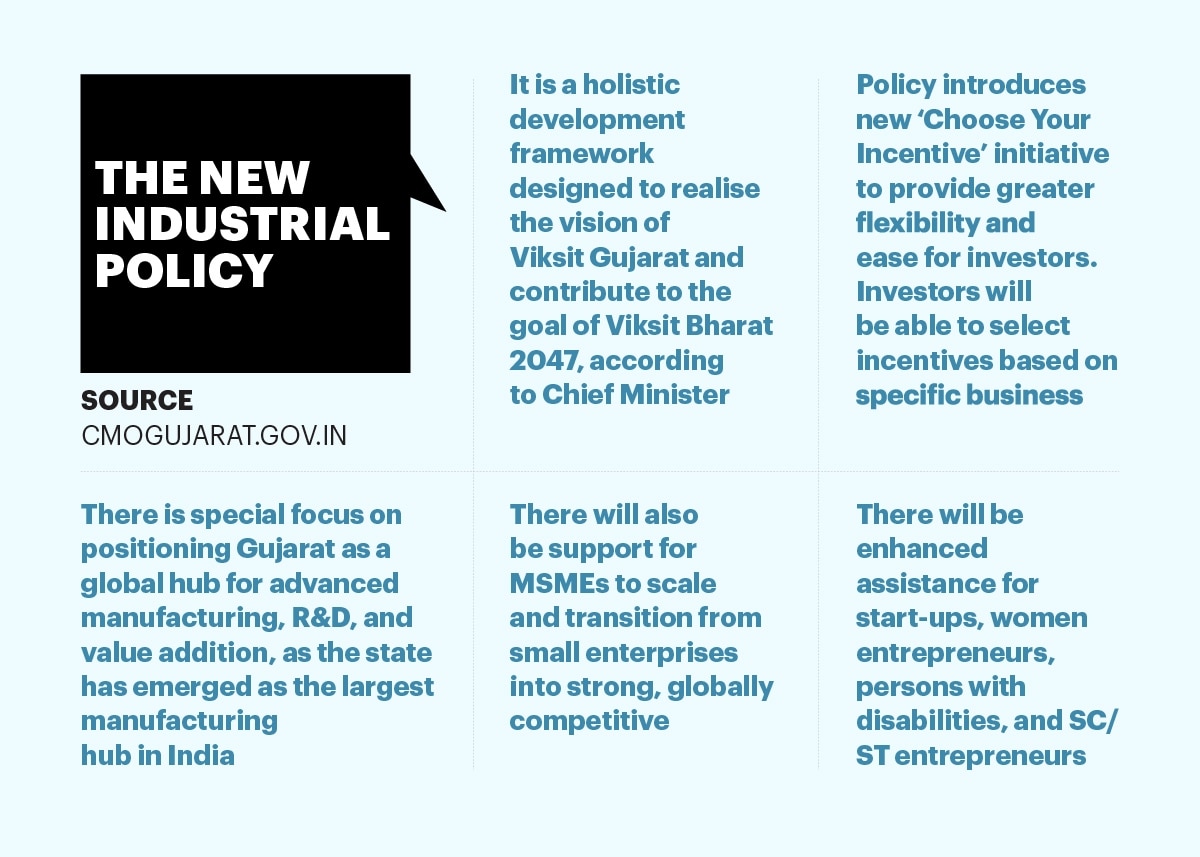
In June 2026, the Gujarat government announced its new industrial policy. It’s a holistic framework aimed at driving the next phase of growth. According to Chief Minister Patel, the policy has been designed with a future-oriented approach by incorporating the aspirations of industries, at a time when the rapidly evolving global economy, technological advancements, artificial intelligence, green energy, and the restructuring of global supply chains are transforming the industrial landscape.
The government wants to position Gujarat as a global hub for advanced manufacturing, research and development and value addition. It will provide support for micro, small and medium enterprises (MSMEs) to scale rapidly and transition from small enterprises into strong, globally competitive businesses. There will also be enhanced assistance for start-ups and women entrepreneurs.
A notable feature of this policy is the introduction of a new choose-your-incentive initiative that aims to provide greater flexibility and ease for investors. Under this initiative, investors will be able to select incentives based on their specific business requirements, the policy states.
Patel sees the new industrial policy as a roadmap to transform the state into a global industrial powerhouse. Between January 2000 and March 2026, Gujarat attracted cumulative foreign direct investment worth $74.6 billion, according to him.
“We have strengthened ease of doing business through single-window clearance mechanisms, simplified regulatory processes and decriminalisation of more than 500 provisions under the Gujarat Jan Vishwas (Amendment of Provisions) Act, 2025,” Patel told Business Today.
Gujarat’s manufacturing GVA rose to Rs 4.4 lakh crore in 2024-25, from nearly Rs 2 lakh crore in 2013-14. Chief Minister Patel says it is the result of a long-term strategy built on three key pillars of industrial diversification, large-scale investments and cluster-based development.
“Investors choose Gujarat for its efficient administration, skilled workforce and integrated industrial ecosystem. Going forward, the Regional Economic Master Plans and Viksit Gujarat@2047 roadmap will further enhance export competitiveness through multi-sector export hubs and next-generation industrial corridors,” he stressed.
Industry body ASSOCHAM representatives say Gujarat’s industrial success offers broader lessons to India’s states. “When infrastructure works, power is reliable, approvals are responsive, policies are predictable and global connectivity is strong, investors are more willing to commit capital and, importantly, to reinvest. That is the model Gujarat has built over time,” says Thakkar.
According to a Rajkot-based businessman, Gujarat once faced the same typical problems that used to be visible in other parts of India, such as acquisition of land, provision of utilities and availability of logistics. However, the state fixed those problems at scale, and that is why it’s a manufacturing hub today.
As per Gujarat Industrial Development Corp (GIDC), there are over 28,000 factories in the state. Around 239 industrial estates have been developed in strategic locations with adequate infrastructure like roads, water and drainage, gas and power infrastructure among other things in place.
However, the state is not without its challenges. NITI Aayog notes that Gujarat’s workforce productivity and satisfaction with technical skills remain moderate, with scope for improvement through better alignment of training with real-time industry needs, to enhance the overall quality of the workforce.
“There is a noticeable disparity in the maintenance and management of state-run Gujarat Maritime Board ports, reflecting scope for improvement to ensure seamless cargo handling and transportation,” the report said.
ASSOCHAM notes that advanced manufacturing will require technicians and engineers with highly specific skills. Gujarat will need stronger industry-academia partnerships, modernised ITIs, sector-specific training centres and apprenticeship programmes linked directly to factory requirements, it said.
Further, while Gujarat has strong national highways and efficient private ports, investor feedback points to gaps in municipal and internal roads, ASSOCHAM highlighted. These may appear to be civic issues, but for industry they directly affect logistics costs, worker mobility and supply-chain reliability, it said.
The industry body also called for strengthening social infrastructure as worker housing, healthcare, urban mobility and other public services will increasingly influence the ability of companies to attract and retain skilled talent.
The Chief Minister noted that Gujarat’s Industrial Policy 2026 does support anchor institutes, specialised skill development centres, training facilities in GIDC estates and skill development initiatives for MSMEs.
With inputs from Chetan Bhutani
@thenachiket


