













Just what does a B-school do differently each year to stand apart? Ask Varun Nagaraj that question, and the dean of S.P. Jain Institute of Management & Research (SPJIMR) takes a few seconds to gather his thoughts. With a slight grin, he points out that nobody wants to see another PPT slide. “It’s all about building something where our students work on real-life challenges and develop solutions.” He has been at the helm for five years and has steered the B-school into a strong position.
Nagaraj is not your classic academic. After earning a degree in electrical engineering from IIT Bombay, he moved to the US in 1986 for his master’s, followed by an MBA and then a PhD. He spent decades in the tech world before returning to India in 2021. In more ways than one, that grounding helps him understand areas such as AI, while also bringing a cogent view to career planning.
The right experience
Last year, when BT met him for the Best B-schools issue, much of the discussion centred on AI. Quite candidly, he outlined in some detail how the internet and social media had changed the landscape. The difference with AI, for him, lies not only in its disruptive impact on education but also in the pace at which that disruption has unfolded. Now, Nagaraj is ready to explain what SPJIMR is doing to make the most of it.
Three areas, according to him, stand out as major achievements for the B-school. In a moment, he moves to the softboard and elaborates on each. The first is the immersive experience offered to students, which gives them exposure to family businesses and SMEs. “It gives them a better understanding of different businesses that they otherwise may not have got,” says Nagaraj.
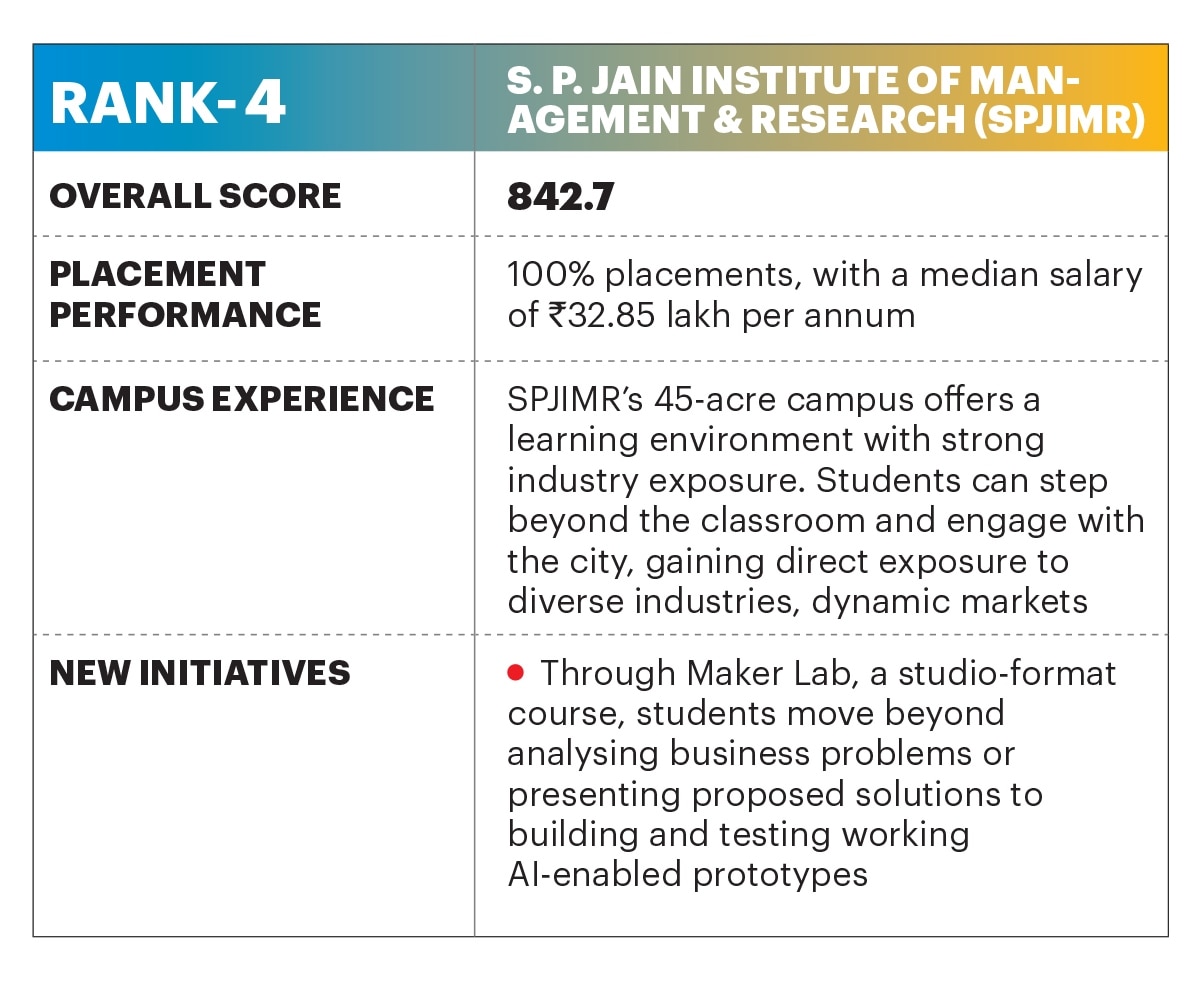
This is where the overall experience comes face-to-face with AI. Through Maker Lab, a studio-format course in the third term of its flagship two-year MBA, students are required to move beyond merely analysing problems or presenting proposed solutions. “Now, they build and test AI-enabled prototypes,” he says.
The exercise involves using technologies such as large language models (LLMs), retrieval-augmented generation, workflow automation and low-code platforms to build functional prototypes.
All this aligns well with SPJIMR’s focus on innovation—here, it goes by the name “wise innovation”, or innovation that is purposeful and done for the right reasons. “Wise innovation is now being operationalised,” adds Nagaraj.
Going global and even beyond
Nagaraj spends some time on SPJIMR’s internationalisation, and not without reason. One key element is the student exchange programme under which aspiring MBAs spend a semester with partner schools across Europe and Asia. The journey has not been easy, but the numbers now speak for themselves—in 2021, 10% of the class went overseas; today, the proportion is 40%, marking a fourfold increase. “We have worked very hard on this, and it helps our students get valuable exposure in a different environment,” he says.
The programme lasts eight to 10 weeks, with SPJIMR’s students sharing classrooms with peers from multiple countries and working on projects in diverse academic groups. Earlier this year, Nagaraj was elected to the AACSB (Association to Advance Collegiate Schools of Business) Board of Directors, making SPJIMR the first Indian B-school to be represented on the board in AACSB’s 110-year history.
AACSB is a global, nonprofit membership organisation of educational institutions, businesses and other entities devoted to advancing management education.
For Nagaraj, the last piece that keeps him occupied is research. “More than anything else, it must have impact,” he says categorically.
The concept of thought leadership is critical here, and SPJIMR’s faculty are encouraged to publish in journals and make their presence felt at conferences.
The idea is to build a knowledge base that can address challenges—both managerial and social—at many levels.
@krishnagopalan


