












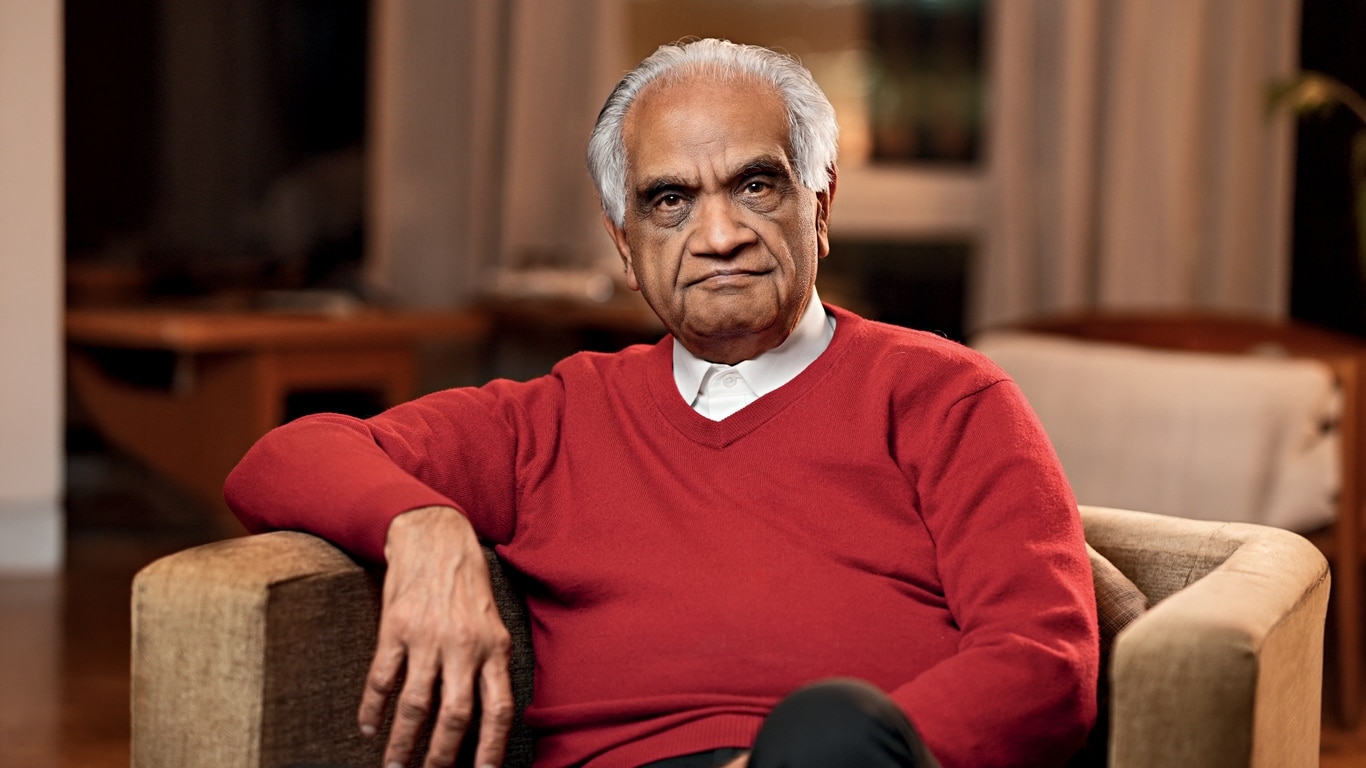
Ram Charan is a world-renowned business advisor, bestselling author, and speaker, who has spent six decades working with some of the most prominent companies and CEOs. He has advised CEOs and boards of Fortune 100 companies in every major industry—from manufacturing and financial services to technology and pharma, as well as leading Indian conglomerates, over the last few decades.
Therefore, at a time when the Indian economy and corporations, especially family business firms, are facing a number of threats as well as opportunities, BT asked him about the impact of artificial intelligence (AI), why it is imperative for the country to focus on manufacturing, and how boards can enable fool-proof succession-planning.
Born in 1939 in Uttar Pradesh, India, Charan learnt his first business lessons at his family’s shoe shop, where he developed an instinct for cash flow, people, and the fundamentals of commerce that still anchors his work today. Later, he earned an engineering degree in India, then an MBA and Doctorate from Harvard Business School, where he graduated with high distinction as a Baker Scholar.
His latest book, China’s 90% Model: China Has America by the Throat. Here’s How to Fight Back and Win, exposes how China systematically dominates global industries by building overcapacity to meet 90% of world demand, then flooding markets by pricing at or below the marginal cost to destroy competition. He talks about the criticality of policy reforms for Indian manufacturing and MSMEs, the impact of the coming AI revolution, and overcoming thorny management issues. Edited excerpts:
Over the years, manufacturing as a share of GDP has been coming down in India. Given that our focus is on services, how will it impact the growth of Indian industries and the economy?
India cannot prosper and improve its GDP per capita without growing manufacturing. Period. Second, a nation is built by its medium, small and micro enterprises.
Most of them have land, they know how to execute, and the time has come to scale them up. For example, they can manufacture textiles and furniture for internal consumption. This will reduce India’s trade deficit by half.
What will be the impact of AI on Indian companies?
AI is not a technology question. It is a leadership one. Every CEO and every board in India must understand this.
AI is the most powerful tool of instant learning that has ever existed. It puts the world’s data at your feet. It changes how you think, how fast you learn, and how quickly you turn ideas into action.
For Indian companies, the opportunity is enormous. AI expands the imagination of executives. It allows them to sense opportunities that did not exist before. Companies are already imagining and building systems for preventive maintenance, customer intelligence, supply chain optimisation, and much more. The speed of execution is increasing dramatically.
But here is the danger. If Indian CEOs leave AI to their technology teams, they will fall behind. This is not a technology project. It is business transformation one. Leaders must become coaches. You can no longer lead with instinct alone. You must lead with data. That requires every senior leader to invest in learning.
India has the talent. India has the ambition. What is needed now is leadership that acts with urgency. The companies that master AI will define the next decade. The ones that wait will be defined by it.
From your experience with global companies on succession planning, are there any lessons for Indian corporates?
The selection of a CEO is still, at the end of the day, a matter of judgement. Most people will tell you that Jaguar has made a mistake in the selection of its CEO even though it has one of the most rigorous selection processes. This has happened to Ford Motors too. What is important for the new leader is a rigorous understanding of what needs to be tackled in the first two years. People think that if a business leader can do well in the long term, that is sufficient. My view is that if he or she does not get the first two years right, they will never make it. That is where the selectors need to focus. I am not using the word board because in many cases boards are advised by headhunters. And these headhunters are really the selectors. The rest of the hiring is just a process.
Second, most companies rely on psychometrics because it can flag something, and then you have to assess what the selected person can tackle in the first two years. His track record will then convince the selectors he can learn to manage the first two years. Even if he does not have this skill, he can hire people to get the task done. There is no way to forecast what will be needed in 10 years.
You have been a consultant to many powerful global CEOs and companies. What is it that makes you so unique that one of the business magazines has called you, ‘the most influential advisor living in the world’?
I fail too. The old rule exists. You have value when you are wanted. You don’t go to the CEO and say I am the solution to your problem. You go to a CEO who has a problem, and you must say, “Maybe I can help, maybe I cannot. But I should do everything to deliver.” Recently, I solved a problem for a Chinese company on whose board I used to sit. It had a $3 billion business but was making huge losses. It took me about nine months to understand the problem. Now, it has a one billion Renminbi profit.
You have written about 10 industries in the US which will get obliterated. Which do you think are the main sectors in India that could be affected by the 90% model of China?
Every industry. Bar none. There is the 3:1 ratio. You buy something for three dollars in India that you can buy for one dollar in China. It is a fact.
Therefore, so long as the above continues, there is no way that India can compete with China. What do we export to China? Very little: processed foods, raw materials and things of that kind. That is not industrialisation. That is reduction of industrialisation.
Can you tell me a little bit about your early life and family?
In the 1920s, my father and uncle got together to start a cloth business. My father could write a bit, but my uncle was illiterate. They used to buy, for example, 20 yards of cloth from the market and make shirts for the villagers. They also used to sell sarees.
In 1947, during the Partition riots, their shop got burnt. My brother started a shoe shop, and it did well. When I was in school, my teachers came and told my father that this kid is bright and needs to go to an engineering college. I applied and I was admitted within 24 hours. That is how I began.


