













In April this year, industrial belts across Delhi-NCR witnessed a wave of worker protests that disrupted operations and prompted several states to revise minimum wages. The demonstrations, driven by long working hours, low pay, and poor working conditions, were intensified by workers’ anger over persistently high inflation and a sharp rise in cooking gas prices, which further eroded the purchasing power of already meagre wages.
With the West Asia war impacting energy and fuel supplies, prices of cooking gas had surged to over Rs 500 a kg and the cost of a cylinder was running into thousands in the black market.
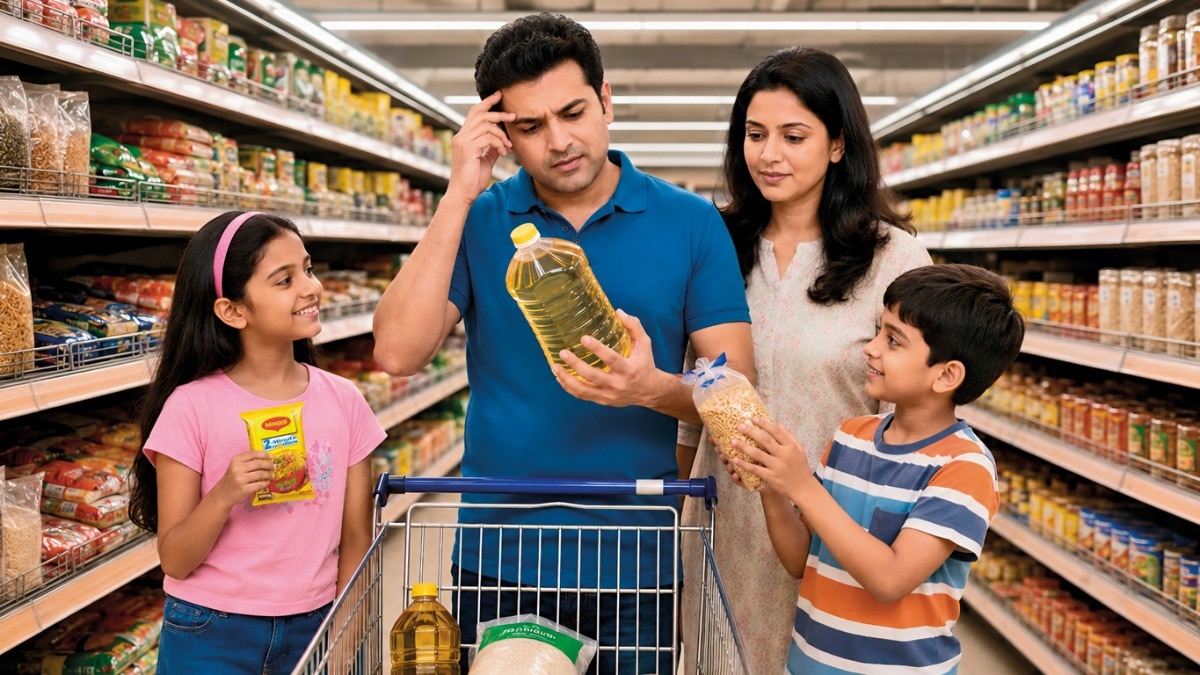
While this was seen as a one-off issue, over the last few months, the cost of the war in West Asia has begun trickling into household budgets. Not just cooking gas, prices of a bevy of household items, from fuel and staples like milk, dairy products, and biscuits to detergents and consumer goods like air conditioners have risen. Milk prices have increased by Rs 2 per litre. HUL has increased detergent prices by 5–11%. Britannia has flagged imminent price hikes to offset a 20% spike in fuel and packaging costs, while Dabur has raised prices within its oral care and haircare portfolios. These are just a few examples.
Far from Delhi-NCR, in Mumbai, retired homemaker Rupali Sheth notes that prices of daily household staples have risen in the last few months. The 70-year-old, however, says the prices haven’t affected her significantly and is not looking to
cut down the spends.
Back to the capital, in Delhi, Pooja, 42, who works as a cook, says that the biggest impact on her monthly budget has come from the price of cooking gas—a 14.2 kg cylinder is priced at Rs 942. “Prices of almost everything has risen in the last few months but there is no option. We used to save a few thousand rupees every month, but now we don’t save much,” she says.
Back home, people in her village in Western UP are more cautious about unnecessary expenditure. “It’s been raining on and off, but everyone has heard that the rains may not be too good this year. So, they have to be watchful on spending. If the crops fail, their entire investment (in farms) and earnings will be wiped off for the year,” she says.
Consumers, across income levels, seem to be feeling the pinch. This may continue at least for the next few months as a combination of the West Asia crisis and below average rains along with job cuts and uncertainty about salary hikes are making them wary of too much spending. This holds for both urban and rural households.

But the impact varies from income to income. Suresh Sadagopan, Founder of Ladder7 Financial Advisories explains this and says that typically in upper middle-class households, groceries and fruits and vegetables take up less than 20% of the monthly bill. “In times of high inflation or a sudden increase in prices of some food items, the impact on these households is usually minimal. However, for lower to middle income households, groceries and fruits and vegetables take up between 35 and 60% of the monthly budget for whom such price rise tends to have a significant impact,” he says.
While people in general tend to complain about prices going up, Sadagopan says that in recent months, there have been situations where clients are uncertain whether they will continue to have a job in the next three to six months due to issues like technology changes and AI. “Job losses are definitely happening,” he notes.
This was also flagged by Manish Tiwary, Chairman and Managing Director of Nestlé India at the Citi India Conference 2026 in early June, where he noted that while India’s consumption growth remains intact, the urban middle class is facing inflationary pressures while real earnings have not kept pace.
Prices Going Up
Recent commentary and data also show that prices have been increasing even though energy costs are now cooling due to the interim peace deal in West Asia.
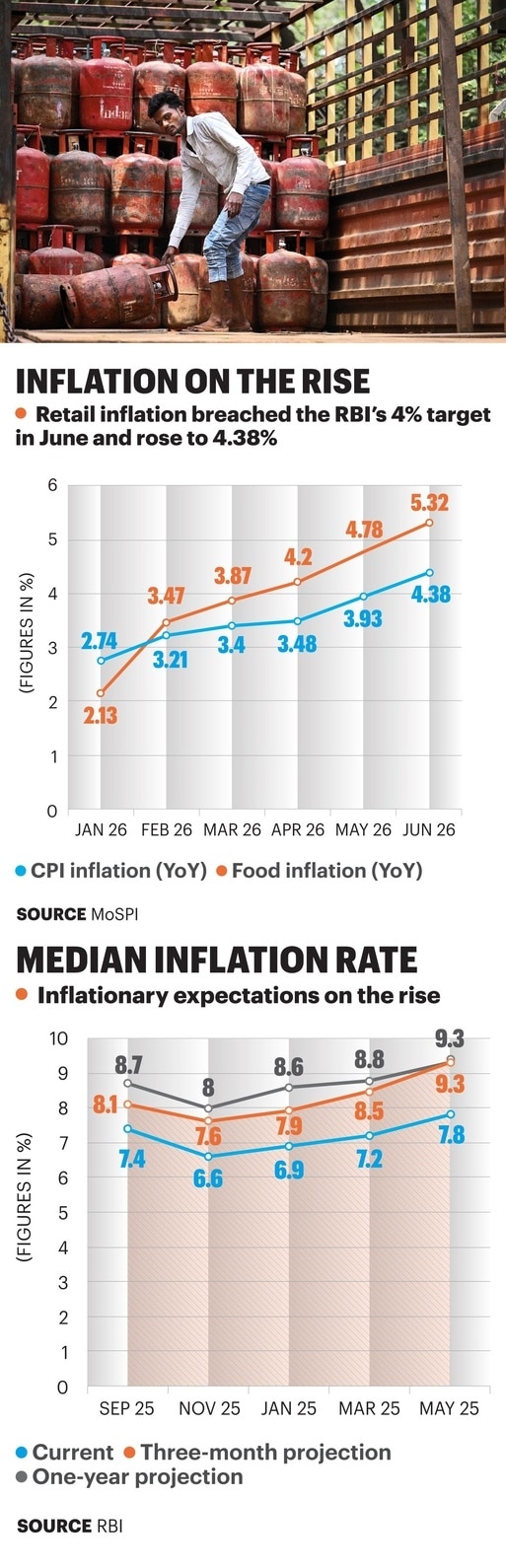
Retail inflation as measured by the Consumer Price Index breached the RBI’s 4% target in June and rose to 4.38% with inflation in the food and beverage basket rising to 5.05%.
The Centre had begun passing higher global energy prices to consumers. Heatwaves and then the monsoons have also led to a spike in prices of certain commodities. For instance, ginger and tomatoes were amongst the top five items that saw the highest inflation in June.
Forward looking surveys by the RBI are also showing a weakness in consumer sentiments and an uptick in inflationary expectations. In the latest surveys undertaken in May, both urban and rural consumer confidence weakened while inflation expectations of households edged up for the next three months as well as the one-year period.
Reports note mixed trends in terms of pricing. “Input cost trends remain mixed, with agri commodities largely stable, beverage inputs witnessing divergent trends, edible oils remaining elevated, and crude-linked packaging costs easing sequentially,” said a recent report by brokerage firm Equirus Securities on raw material input prices for FMCGs.
Food and beverage players remain relatively better placed, supported by stable cereal prices, lower coffee and cocoa costs, and softer copra, although elevated soymeal, edible oils, and dairy inputs remain key monitorable, the report said. Home and personal care players continue to face input cost pressures.
With crude oil prices softening in between, prices of a key input—plastic packaging—had also started easing.
“During the onset of the war, crude oil prices surged significantly, leading to a sharp increase not only in packaging raw material costs but also in several other input costs across the value chain. This resulted in an overall cost escalation for FMCG companies. However, with the situation stabilising and crude prices softening in recent weeks, input costs are beginning to ease,” explains Thimmaiah Napanda P, CEO & MD, Alternicq, a rigid plastic packaging company.
The government has now reduced prices of commercial LPG and aviation turbine fuel, but when the effect would pass on to retail consumers of diesel, petrol as well as domestic LPG cylinders is uncertain.
Most analysts expect inflation to average around 5%-5.2% this fiscal year, in line with the Reserve Bank of India’s projection of 5.1% but expect some favourable impact from the cooling energy prices. However, they warn that the impact of the rains on food prices will have to be monitored.
Upasna Bhardwaj, Chief Economist, Kotak Mahindra Bank, says that they estimate average inflation at 5%, with some easing of concerns from falling crude oil prices and steady Indian rupee.

Steady Demand For Now
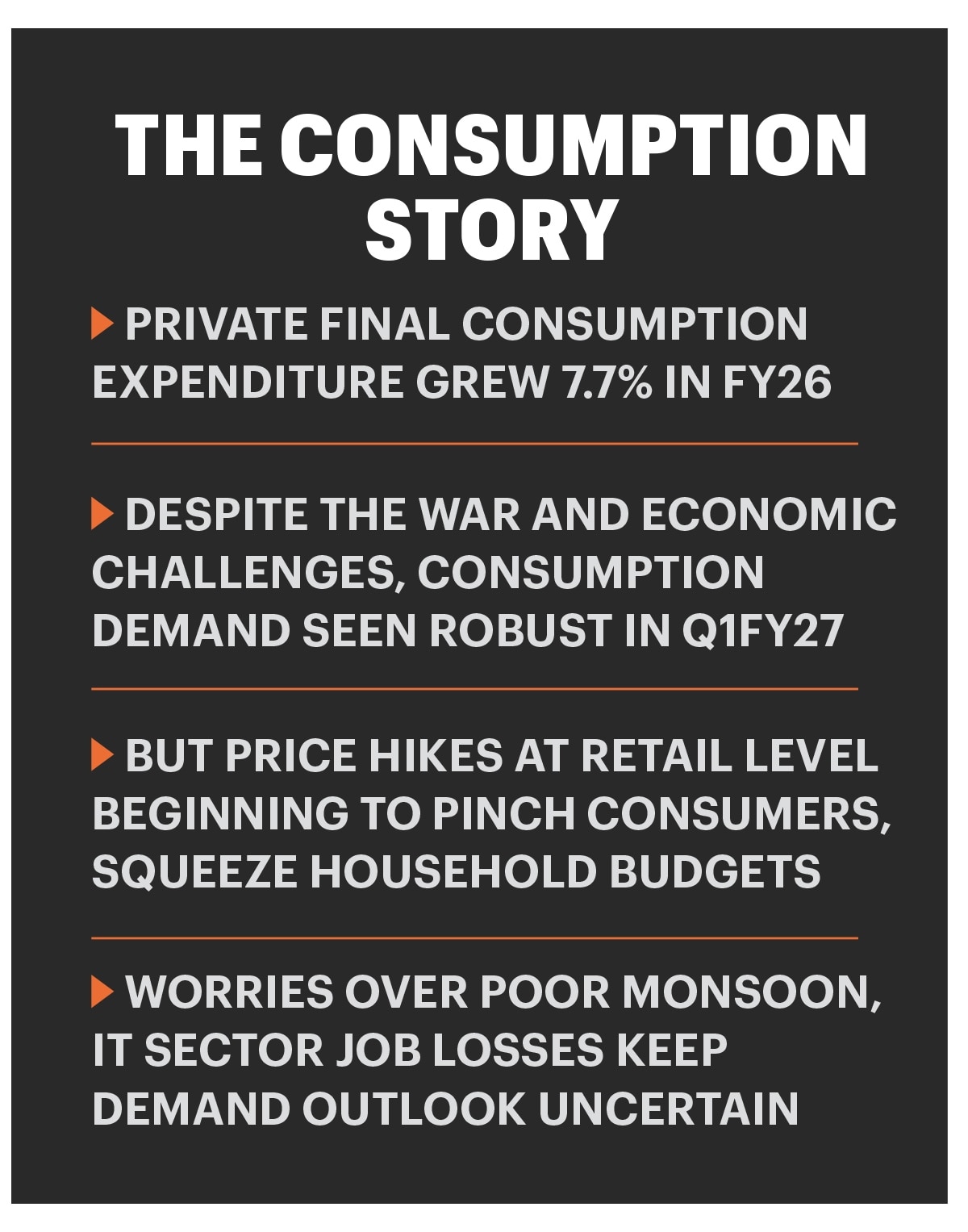
Till now, consumer demand has remained not only steady, but robust. Companies and policymakers have highlighted that consumers seem to have brushed aside the impact of the war. Demand indicators like collections from GST, bank credit, and factory output have shown resilience and have pointed towards steady private demand.
India’s economic growth relies heavily on its domestic market, with private consumption serving as a key driver. Private final consumption expenditure grew by 7.7% in FY26 and was one of the main drivers of growth last fiscal year, buoyed by GST and income tax cuts when the 50% tariffs by the US on Indian exports was seen to be a major risk.
“Overall, high-frequency indicators depict broad resilience in economic activity during the first quarter of FY27,” said the finance ministry in its monthly economic review for June 2026, noting that while some indicators suggest a moderation in momentum, domestic demand conditions remain supportive. It is however hopeful that the recent de-escalation of geopolitical tensions in West Asia will improve global risk sentiment, ease commodity price pressures, and support domestic economic activity.
Analysts also believe that India Inc continued to do well in the first quarter of FY27 on the back of robust consumer demand.
Naveen Trivedi, Executive Director, Institutional Research—Consumer Sector at Motilal Oswal Financial Services echoes this sentiment. “While a lot of companies have hiked prices, consumer demand has remained healthy across sectors. Even in jewellery, top players continue to do well, and the customs duty hike has got adjusted with the correction in international prices of gold,” he says.
Kashyap Javeri, Fund Manager & Head of Research, Emkay Investment Managers concurs and says that despite the turbulence in West Asia, the aggregate demand seems unimpacted.
Pockets of Worry
This situation could very well be dampened by a spell of bad monsoon. After what was the fifth driest June since 1901 with a 40% rainfall deficit, India is expected to see below average rains in July with super El Niño conditions likely to intensify further. The rainfall deficit is now seen at 18%.
Bhardwaj warns that the risk from deficient monsoons will need to be watched. “While the adverse impact El Nino in the past is not very conclusive, any sustained surge in food inflation could flare.
r inflationary expectations. Overall, rural demand may take a hit if food shocks materialise,” she says.
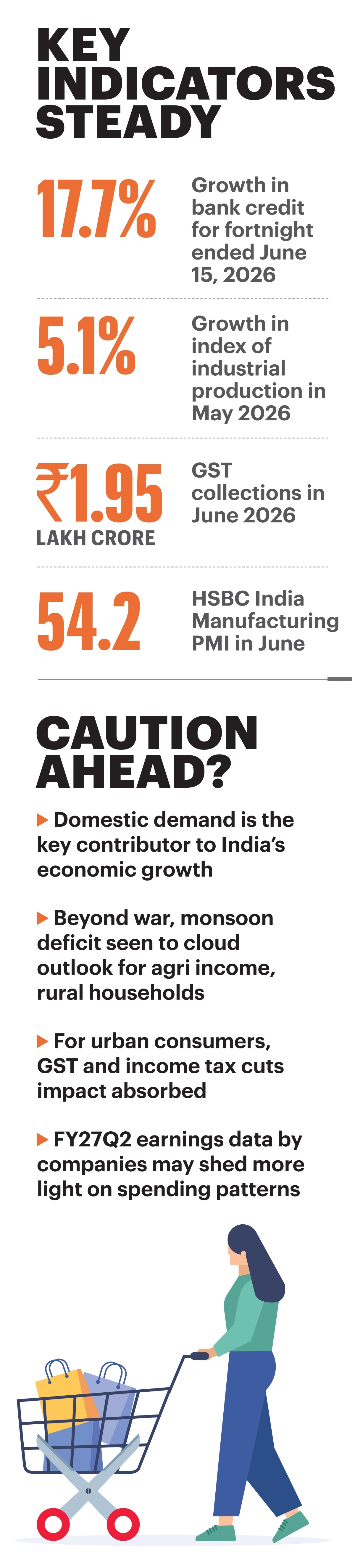
Pockets of worry can already be seen. “Even before the start of the monsoon season, rural demand appears to be coming off its peak, as seen for both tractor as well as two-wheeler sales growth,” said a recent report by QuantEco Research.
A likely interest rate hike by the RBI later this year of anywhere between 25 and 50 basis points will further temper urban consumption. Even prior to this, housing sales declined by 6% in April-June 2026 across seven major cities, Anarock data revealed.
But the coming months will reveal exactly how households have fared amidst these challenges and whether they are choosing to cut down on expenses.
Trivedi of Motilal Oswal also says that one will have to see what happens to demand in the second quarter of the fiscal.
Javeri of Emkay notes that a prolonged inflationary scenario can be troubling but doesn’t seem to be a case as of now. “We have seen now for past many years that floods or fluctuation in temperatures have more negative impact on the foodgrain output than below normal rainfall. And hence, we would not be too much worried about inflation in food product. Having said that, one month of below par rainfall means reservoirs may show lower than LPA storage for rabi season,” he says.
But in a year when the economy is already battling the aftereffects of the West Asia war and normalcy is seen to come back only over the next six months, expectations were pegged on Indian consumers to power up the growth engine for another year. With the uncertain monsoon outlook, the question now is whether their pockets are deep enough to support this.
@surabhi_prasad


