












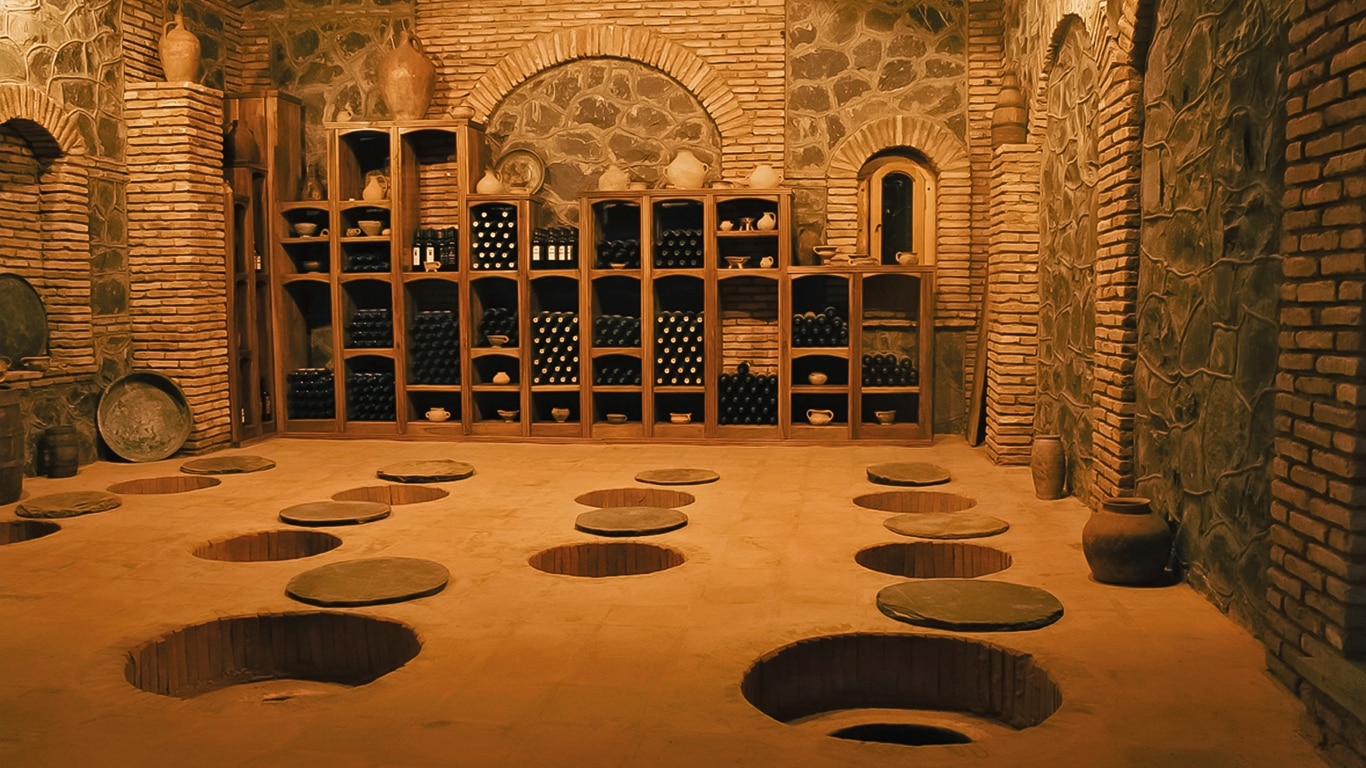

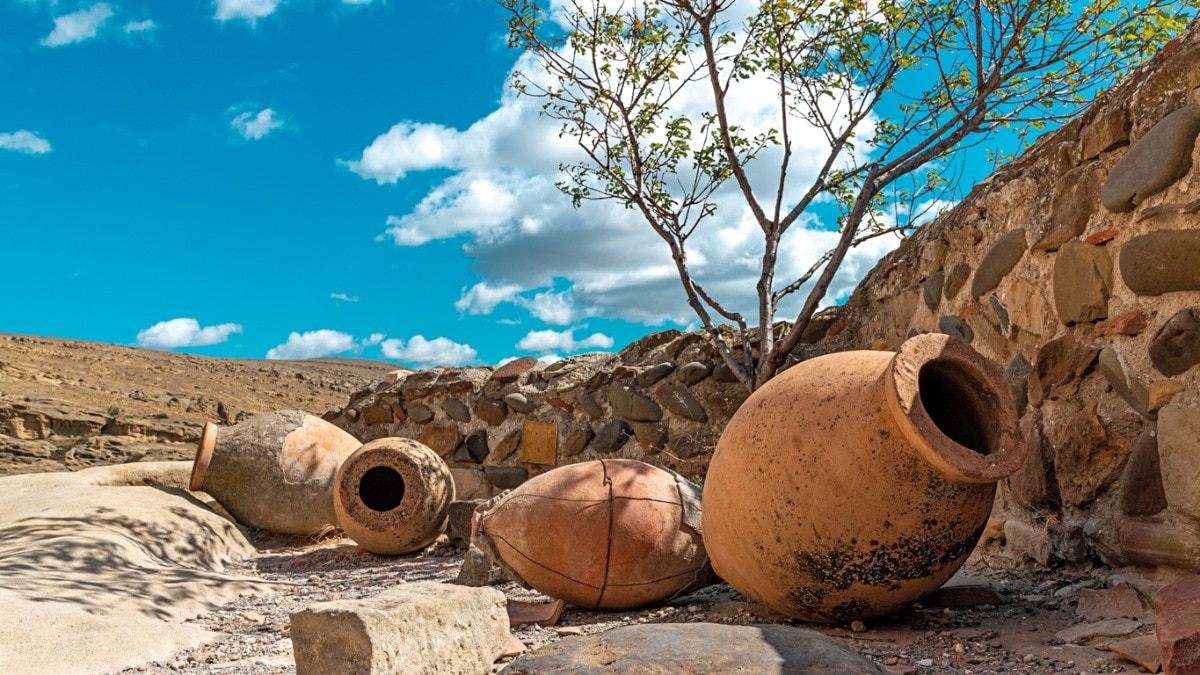
Guess how many years Georgia has been making wine? Eight thousand years. No wonder, this mountainous country beside the Black Sea, wedged between Russia in the north and Turkey, Armenia and Azerbaijan in the south, is widely celebrated across the world as wine’s birthplace. And there is archaeological evidence. Chemical analysis of pottery from the Neolithic sites of Gadachrili Gora and Shulaveris Gora found evidence of grape wine dating to 6000–5800 B.C., pushing viniculture here back roughly 8,000 years! What’s remarkable is how it still survives.
Wine is not simply something poured into a glass in Georgia. It appears in religion, hospitality, landscape, and even the national iconography. Look up at Kartlis Deda—the 20-metre Mother of Georgia who watches over Tbilisi—and she holds a bowl of wine in one hand for friends and a sword in the other for enemies. Step into an Orthodox church and you hear the story of Saint Nino, the fourth-century missionary credited with bringing Christianity to Georgia, whose distinctive drooping cross was fashioned from grapevine shoots and bound, according to tradition, with strands of her own hair.
Walk through Tbilisi and you find wine everywhere—from tasting rooms and tiny family-run wine estates and cellars to vines climbing across courtyards. But to really understand the over 500 varieties of grapes that the country produces and its wine culture, drive a couple of hours from Tbilisi to Kakheti, Georgia’s great wine country, where vineyards spread across valleys beneath the Caucasus. It is the place to understand why Georgian wine tastes so unlike the European styles most drinkers know.
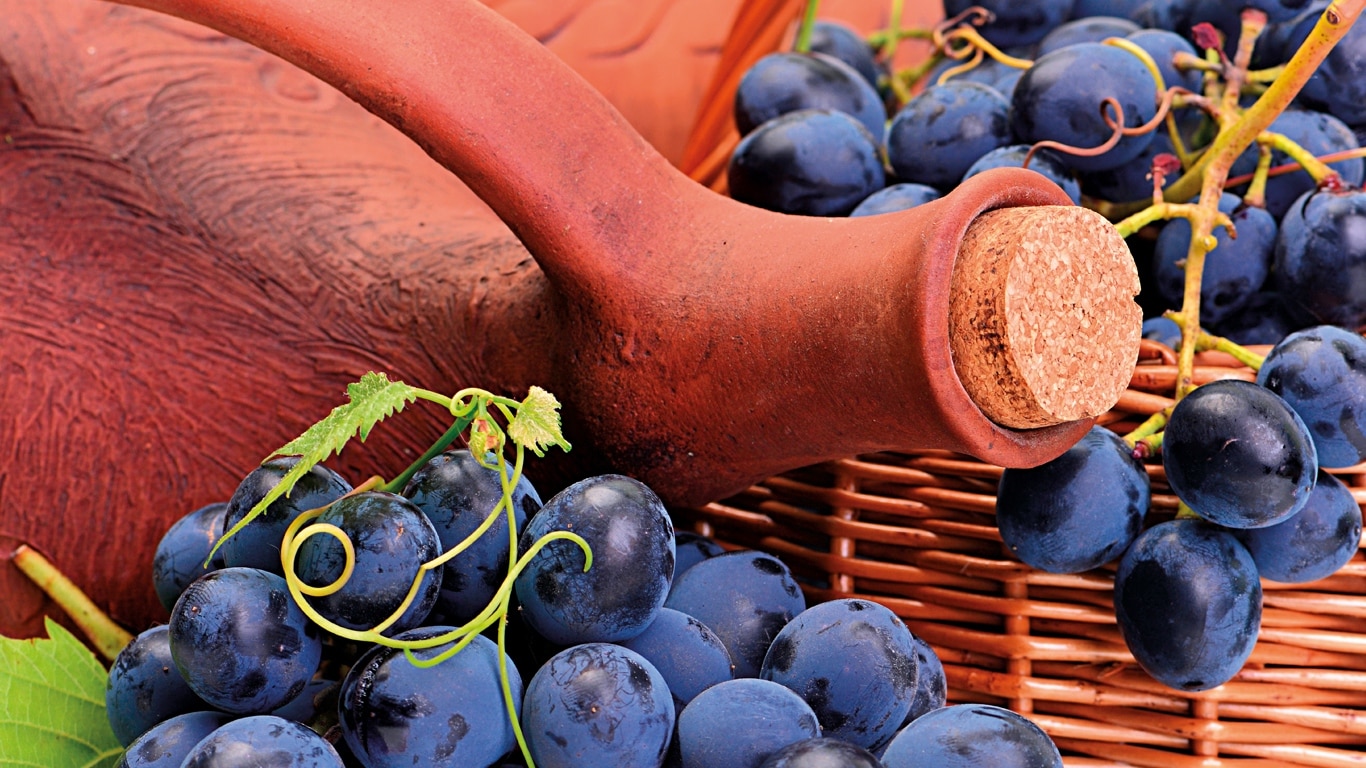
The key to Georgian wine is the qvevri. These large, egg-shaped earthenware vessels are buried in the ground, a method that naturally moderates temperature during fermentation and ageing.
Grapes ferment with their skins, seeds and pulp, including white grapes, creating wines that are deeper in colour, more tannic and often more savoury and structured than conventional whites.
Georgians generally call them amber wines. In 2013, UNESCO inscribed the ancient Georgian qvevri wine-making method on its Representative List of the Intangible Cultural Heritage of Humanity.
Then there are the grapes themselves. Indigenous varieties such as Rkatsiteli, Mtsvane, Kisi, Khikhvi and Tsolikouri dominate many whites, while the inky Saperavi is its best-known red. Together with long skin contact and qvevri ageing, these varieties produce wines that can be floral, herbal, honeyed or dried-fruit scented, but also textured, acidic and distinctly food-friendly. They come alive beside the Georgian table: khinkali (dumpling) filled with meat and broth, salty cheeses, tomato salads, and khachapuri—a traditional cheese-filled bread.
At the Giuaani Winery in Manavi, Kakheti, around 45 kilometres from Tbilisi, the family’s winemaking history reaches back to the 19th century, with an old qvevri on the property dating to 1894.
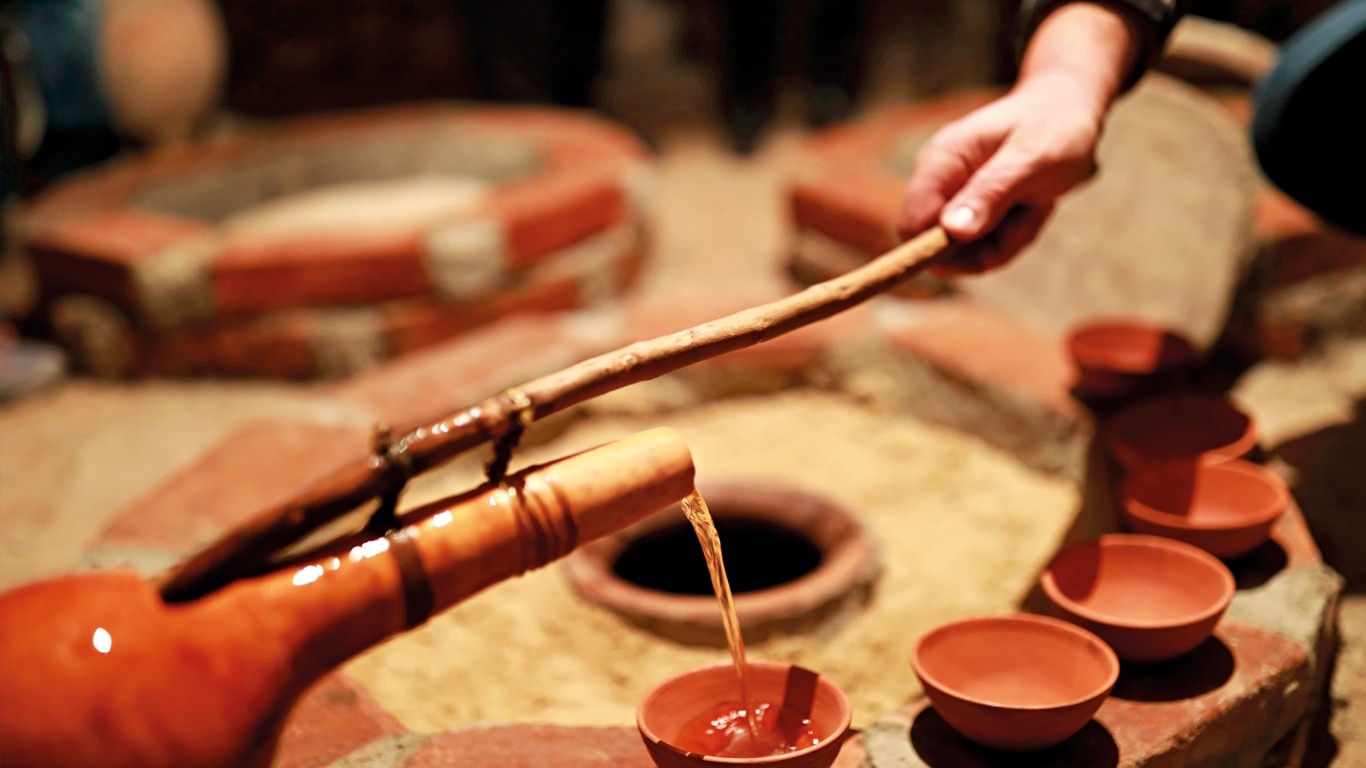
Today, the winery works with a combination of qvevri, stainless-steel tanks, and oak barrels, making both Georgian-style and European-style wines.
Nika Tchitanava, Brand Ambassador and Sommelier at Giuaani, explains that the harvest runs from mid-September to late October, and is done by hand.
The winery has 36 qvevri, or clay pots, each holding 2,000 litres.
For its Georgian-style wines, destemmed grapes go into the vessel with skins, seeds and pulp. As fermentation produces heat and carbon dioxide, the solids rise to the top and must be pushed back down with wooden sticks every three hours. “Even at night we wake up and push the solids back in,” he says. This goes on for the first month. The qvevri is then sealed and left for another five months. “Georgian-style wine takes six months in total,” he explains.
Nothing is wasted. Once the wine is separated, the remaining grape material is used to make chacha, Georgia’s potent grape spirit. The qvevri are cleaned before being used again, and Tchitanava says a vessel can remain in service for around 30 to 40 years.
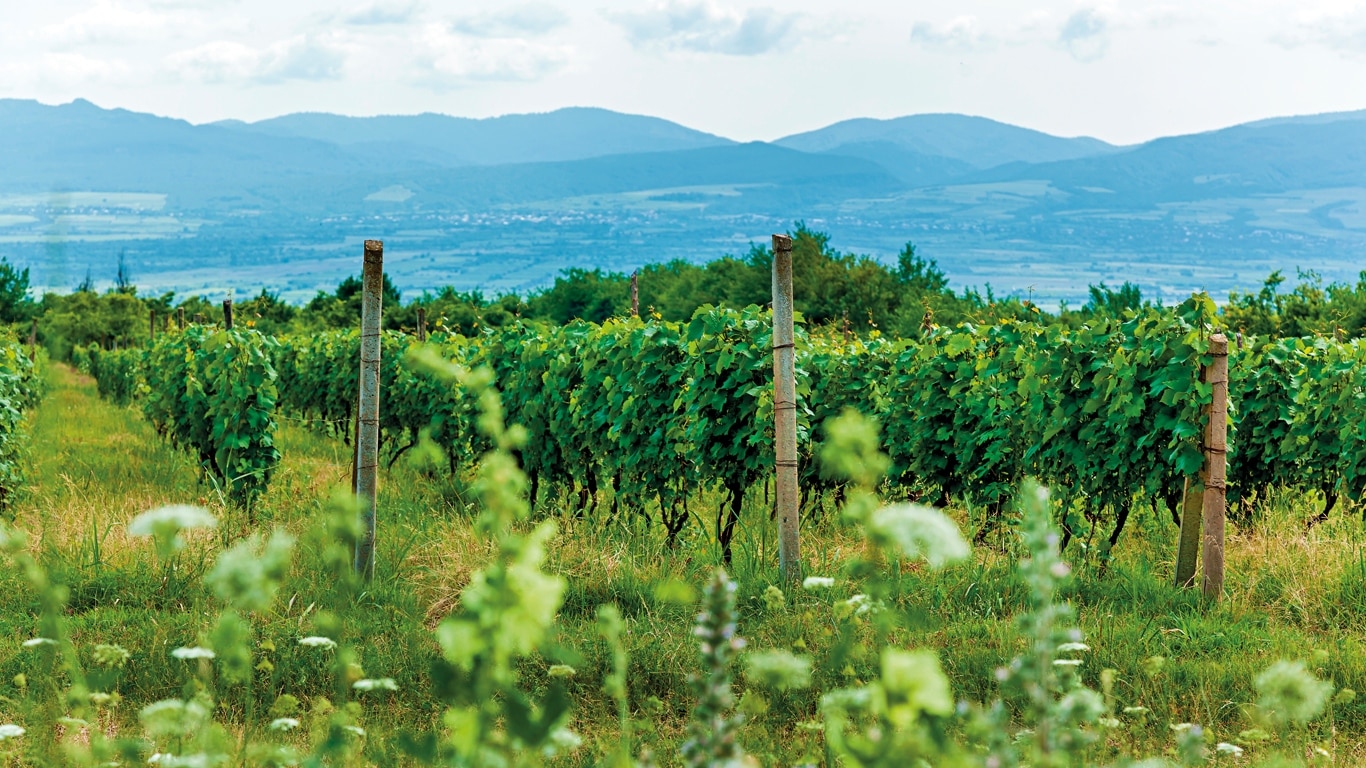
Giuaani produces more white wines because Manavi’s climate and soils are particularly suited to white grapes. “Once the wine is removed from the qvevri after six months, depending upon the grape, some are straight away transferred into bottles, while some are aged in oak barrels and still others age in bottles,” continues Tchitanava.
He also says that ideally all Georgian-style wines need to be served at 13 to 16 degrees Celcius for white wines and up to 20 degrees Celcius for red wines to maintain the tannins and acidity levels. Wine’s place in Georgian life becomes clearest in places where you do not expect to find it at all. At Vardzia, the extraordinary medieval cave city cut into a cliff in southern Georgia and associated with Queen Tamar, Georgia’s first female ruler, wine was part of the infrastructure. At its height, the complex contained dozens of wine cellars; Georgia’s official tourism portal records 28 cellars housing 235 qvevri. Monks prayed, lived, and stored wine within the same rock-cut world.
What began in clay jars millennia ago is now a global business. According to Georgia’s National Wine Agency, the country exported approximately 89.7 million litres of wine worth $267.9 million in 2025, reaching 71 countries, including India, though in very small numbers.
So next time, may be give Bordeaux a pass and visit Georgia instead.


