













Maharashtra has been among the most industrialised states of the country. BT’s India@100 research shows the state had a GSVA (gross state value added) of over `3.95 lakh crore in FY25. It also tops in power, with availability rising 52% over the past decade, which is fueling the state’s massive industrial and infrastructure development.
Under Chief Minister Devendra Fadnavis, the state has been giving infrastructure a massive push, from Mumbai-Nagpur Samruddhi Expressway and Navi Mumbai Airport to the upcoming Vadhavan port and the proposed Third Mumbai to the south of the state capital. Infrastructure development is creating new industrial zones and transforming backward regions like Gadchiroli into metal and mining hubs. At the same time, the state is eyeing a large chunk of new opportunities such as Global Capability Centres and data centres.
In an interview with BT, Fadnavis throws a light on the massive transformation underway and his big vision for ushering in economic growth. Edited excerpts:
Q: Maharashtra has set ambitious target of scaling the economy to $1 trillion. What are going to be the key growth drivers in this journey?
A: Maharashtra is already India’s largest sub-national economy, with a Gross State Domestic Product of $660 billion, contributing nearly 14% of the country’s GDP, projected to grow by 7.9%. Our Industries, Investment & Services Policy 2025 extends dedicated incentives to 27 emerging districts across Vidarbha, Marathwada and North Maharashtra. We are backing that ambition with a $100 billion multi-modal infrastructure push, Vadhvan Port, Mumbai–Ahmedabad bullet train, new Pune Airport, and metro networks in Mumbai, Pune and Nagpur.
Our industrial base leads with 31% of India’s FDI, 15% of national exports, one of the largest contributions to India’s manufacturing GSVA (2024-25), strong leadership in automobiles, over 20% of India’s pharmaceutical output, and 30% of ammunition output.
Maharashtra ranked 1st in the NITI Aayog's Export Preparedness Index 2024, reflecting the state’s strong export ecosystem, world-class logistics infrastructure, and diversified industrial base. The next leg of growth comes from knowledge, not just factories—700+ Global Capability Centres, alongside Edu City and Medi City, together bringing in $4 billion and over 30,000 jobs to Navi Mumbai.
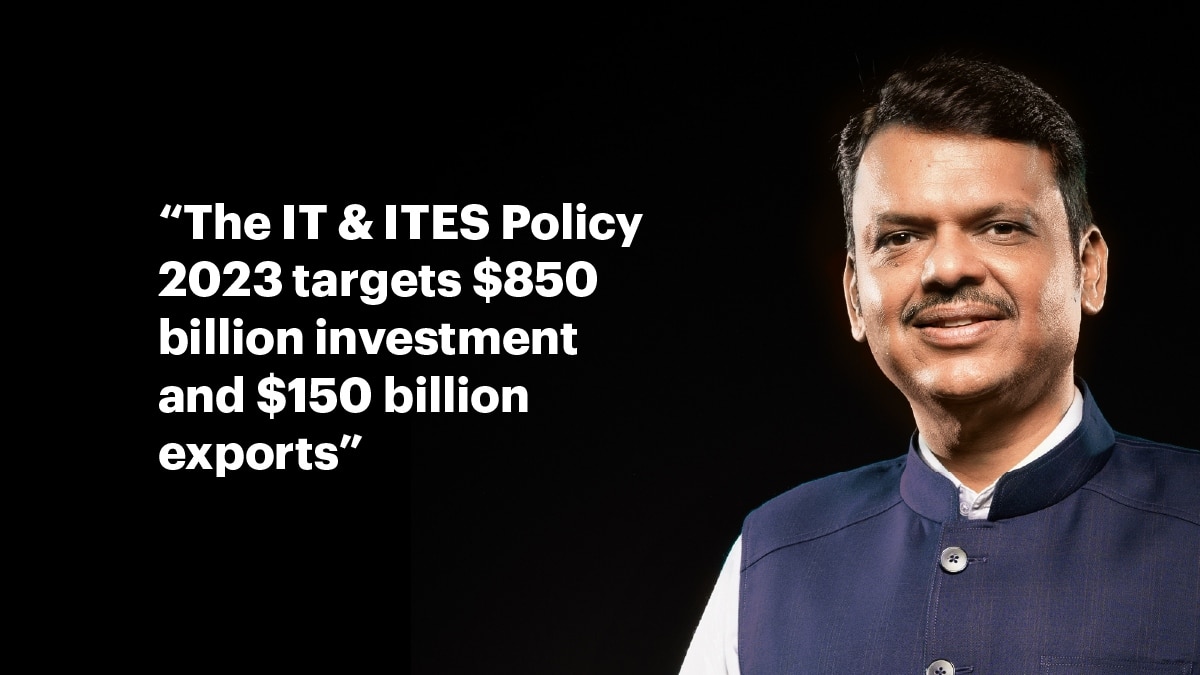
We are converting intent into investments; $361 billion in MoUs at WEF 2026 alone, with the potential for 40 lakh jobs, on the back of one of the highest MoU conversion rates in the country. Additionally, sector-specific growth engines are being driven through targeted policies. The IT & ITES Policy 2023 targets $850 billion investment and $150 billion exports. The Industries. Investment & Services Policy targets $850 billion in investment and $150 billion in exports.
Q: The Centre has had a massive focus on Make in India. How is Maharashtra positioning itself as a go-to destination for manufacturing companies at a time of growing competition from other states?
A: Maharashtra ranks first in manufacturing gross value added, with 15.95% share of the country’s total, anchored by automotive, defence, pharmaceutical and data centres.
The state is developing dedicated projects in every region—steel city in Gadchiroli and Chandrapur, Aurangabad Industrial Township Ltd (AURIC) in Chhatrapati Sambhajinagar, pharma city in Raigad, an electronics cluster in Pune, the PM MITRA Textile Park in Amravati, a leather cluster in Raigad, and the upcoming Dighi Port Industrial Area. The state is also developing three dedicated defence corridors spanning Pune–Chhatrapati Sambhaji Nagar–Ahilyanagar, Nagpur–Wardha–Amravati–Saoner, and Nashik–Dhule. Maharashtra was recognised as a top achiever in key reform areas under the Centre’s Business Reforms Action Plan 2024.
Global manufacturers have responded with capital. Maharashtra leads every other state under the PLI Scheme, with 85 units in automobile and auto components, 41 in food products, 22 in white goods, and 19 in specialty steel. Overall, Maharashtra has over 240 PLI-approved manufacturing units.
The Maharashtra Industrial Development Corporation (MIDC) is the direct link between government and industry, handling land acquisition and disposal, and giving investors a one-stop point for investor relations across over 143 large industrial areas and 108 mini-industrial areas.
Additionally, AURIC exemplifies what institutional depth can build. A special purpose vehicle formed as a joint venture between National Industrial Corridor Development Corporation and MIDC, AURIC spans 10,000 acres in Chhatrapati Sambhajinagar. It has attracted investment commitments of over `92,000 crore and generated around 55,000 jobs. It is India's first greenfield smart industrial city built on a walk-to-work, plug-and-play model, ICT-enabled, powered by 24x7 reliable and cost-effective electricity.
The Dighi Port Industrial Area, being developed over 15,000 acres in Raigad district, is envisioned as a major port-led industrial hub catering to sectors such as engineering, food & beverage, pharmaceuticals, logistics, and allied manufacturing industries. The MAITRI Act, 2023, gives investors time-bound, legally enforceable clearances, backed by an AI chatbot, an instant incentive calculator, a step-by-step investor wizard, a 24x7 toll-free call centre, a real-time tracking dashboard, a secure entity locker, and a fully paperless digital verification process.
We are establishing a dedicated Commissionerate of MSME under the Department of Industries, Investment & Services. It will be the nodal mechanism for MSME policy, credit access, innovation and grievance resolution.
Q: How key are mega infrastructure developments like Mumbai-Nagpur Samruddhi Expressway and Vadhavan port to boosting the state’s industrial landscape?
A: Mega infrastructure investments in power, logistics and connectivity convert our industrial ambitions into industrial output. Samruddhi Mahamarg, a 700-km expressway built at a cost of $6.9 billion, carrying 11 million daily riders, opened to traffic in June 2025, enhancing connectivity across 24 districts. The Shakti Peeth Expressway, an 856-km corridor linking Nagpur to Goa at a cost of $10 billion, will extend this same connectivity-led growth model into new regions.
Navi Mumbai International Airport, built at a cost of $2.6 billion with a planned capacity of 90 million passengers a year, began operations in October 2025, giving the Mumbai Metropolitan Region a second international gateway. Metro projects across Pune, Mumbai and Nagpur, backed by $21.8 billion in investment and carrying nine million daily riders, are reducing commute times. The Mumbai-Pune bullet train is also in the pipeline, expected to cut travel time between the two cities to 48 minutes.
Maharashtra has a total installed generation capacity of 60.6 GW, with around 50 power sourced from renewable energy, providing long-term energy security for industries and infrastructure projects. It has achieved 31.3 GW of renewable energy capacity as of January 2026, with 24.3 GW added since 2015, supported by proactive state policies.
Renewable capacity has more than doubled over the past decade. The recently approved Mukhyamantri Saur Krushi Vahini Yojana 2.0 aims to shift 100% agricultural electricity demand to daytime supply by September 2026 and add around 16 GW of solar capacity by March 2027.
Q: Once a naxal stronghold, Gadchiroli has today emerged as a major mining belt that is seeing huge investments from companies like JSW and Lloyds Metals. How key is this region going to be for the state’s and country’s economic growth?
A: The investment momentum in Gadchiroli opens a largely untapped resource base—60% of Maharashtra’s total area with potential mineral reserves lies within the Nagpur division, of which Gadchiroli is a part. MIDC has proposed new industrial estates in Gadchiroli district’s Armori and Chamorshi, with land acquisition already underway; it is intended to draw MSMEs and value-added investment in forest and mineral processing.
Lloyds Metals & Energy is investing `45,000 crore, building a 4.5 MTPA integrated steel plant and a 4 MTPA pellet plant, expected to create 30,000 jobs. JSW Group is investing `1,00,000 crore to build what will be the world’s largest steel plant, at 25 MTPA capacity, with land acquisition already underway.
Over 40 projects in Gadchiroli and Chandrapur are expected to bring investments of nearly `6,70,000 crore and create more than two lakh jobs, transforming the region into a major industrial and employment hub. These are not standalone factories. Each comes with environmentally conscious design and social infrastructure that makes a mining belt liveable: townships, hospitals, and CBSE schools are being built alongside the plants.
We are backing this with connectivity that didn’t exist before. An airport for Gadchiroli is in the pipeline, and the Nagpur–Chandrapur expressway will connect directly to the Samruddhi Mahamarg. Gadchiroli already sits close to Nagpur International Airport and the Nagpur ICD, both roughly 170 km away, and we are extending logistics links, including slurry pipeline connectivity.
Gadchiroli is positioned to become India’s steel city. Alongside this industrial growth, we remain committed to protecting Gadchiroli’s land, water and forest with afforestation and sustainability built into the plan.
Q: Last year, Maharashtra became the first state to approve a policy for shipbuilding, repair and recycling. Could you tell us more on the vision and the timelines?
A: Our aim is that Maharashtra must contribute at least one-third of India’s entire shipbuilding, repair and recycling output. We are targeting 0.17 million GT by 2030, scaling to 1.35 million GT by 2047, against India’s national targets of 0.5 and 4.0 million GT, respectively. This translates into real investment of over `6,600 crore by 2030, growing to over `18,000 crore by 2047. It has the employment potential of over 40,000 by 2030, rising to over 1,40,000 by 2047.
The core of this vision is our Marine Shipyard Clusters, bringing shipbuilding, ship repair and ship recycling units together with ancillary industries, skilling facilities and shipyard support facilities in a single cluster-based approach. This reduces logistics costs, shares common infrastructure, and cuts project execution cycles significantly.
We have backed this with real financial incentives, not just intent. Developers get a capital subsidy of 15% of project cost. The policy also offers incentives for skill development and setting up of ship building, repair and recycling facilities.
Q: With the Navi Mumbai airport now operational, how are things progressing on the broader development of the Third Mumbai, which is envisaged to transform the Mumbai Metropolitan region?
A: The government has formally notified 124 villages across 323 sq. km with MMRDA (Mumbai Metropolitan Region Development Authority) appointed as the New Town Development Authority. A participatory land acquisition model has also been introduced, giving local communities a genuine stake in this development.
The Raigad Pen growth hub will be the first city developed under Third Mumbai, envisioned as a business district on the lines of BKC. It is located 15 to 20 kms from Navi Mumbai International Airport. Built on a plug-and-play model, it will allow investors to begin operations immediately, and will host global capability centres, fintech hubs, and a walk-to-work urban design. CIDCO (City and Industrial Development Corp) is currently finalising the master plan for the Aerocity, which will bring commercial, retail and logistics development around Navi Mumbai International Airport as part of the broader Third Mumbai ecosystem.
Edu City will host over 10 global universities and serve over one lakh students, positioning Maharashtra as a global education hub and help retain student talent. Medi City, spread over approximately 250 acres, will attract $1.2 billion in investment and create over 10,000 jobs, strengthening healthcare services, medical research, and medical tourism.
Q: You spoke of data centres and GCCs. AI is gaining traction. Over time, what kind of opportunities will the state offer in these new sectors? A: As Maharashtra already hosts over 700 GCCs, nearly 24% of India’s total. We are now extending this into Tier-II and Tier-III cities such as Nashik, Nagpur and Chhatrapati Sambhajinagar, to build new GCC growth corridors beyond Mumbai and Pune.
The Maharashtra GCC Policy 2025 targets 400 new GCCs and nearly four lakh high-skilled jobs, backed by fiscal and non-fiscal incentives. The state is developing dedicated GCC Parks, envisioned as self-sustaining business districts, alongside world-class business districts, combining university partnerships, GCC-focused skilling programmes, internships and industry-led curriculum development to build local talent pipelines.
This momentum is already visible on the ground. Accenture has leased around 6 lakh sq. ft. of office space in Pune, Kimberly-Clark India has operationalised its GCC in Pune, Nielsen has operationalised its GCC in Mumbai, and Brookfield has announced plans to invest up to $1 billion in developing Asia’s largest GCC hub in Powai.
The Maharashtra Global MedTech Zone is being developed as a world-class hub for medical device manufacturing and innovation, with the policy encouraging GCCs in medical technology and digital health to co-locate within this zone. Similarly, the Innovation City is envisioned as a next-generation cluster for deep-tech start-ups, with the policy promoting GCCs in frontier sectors such as AI, blockchain and robotics within this ecosystem.
@thenachiket


