












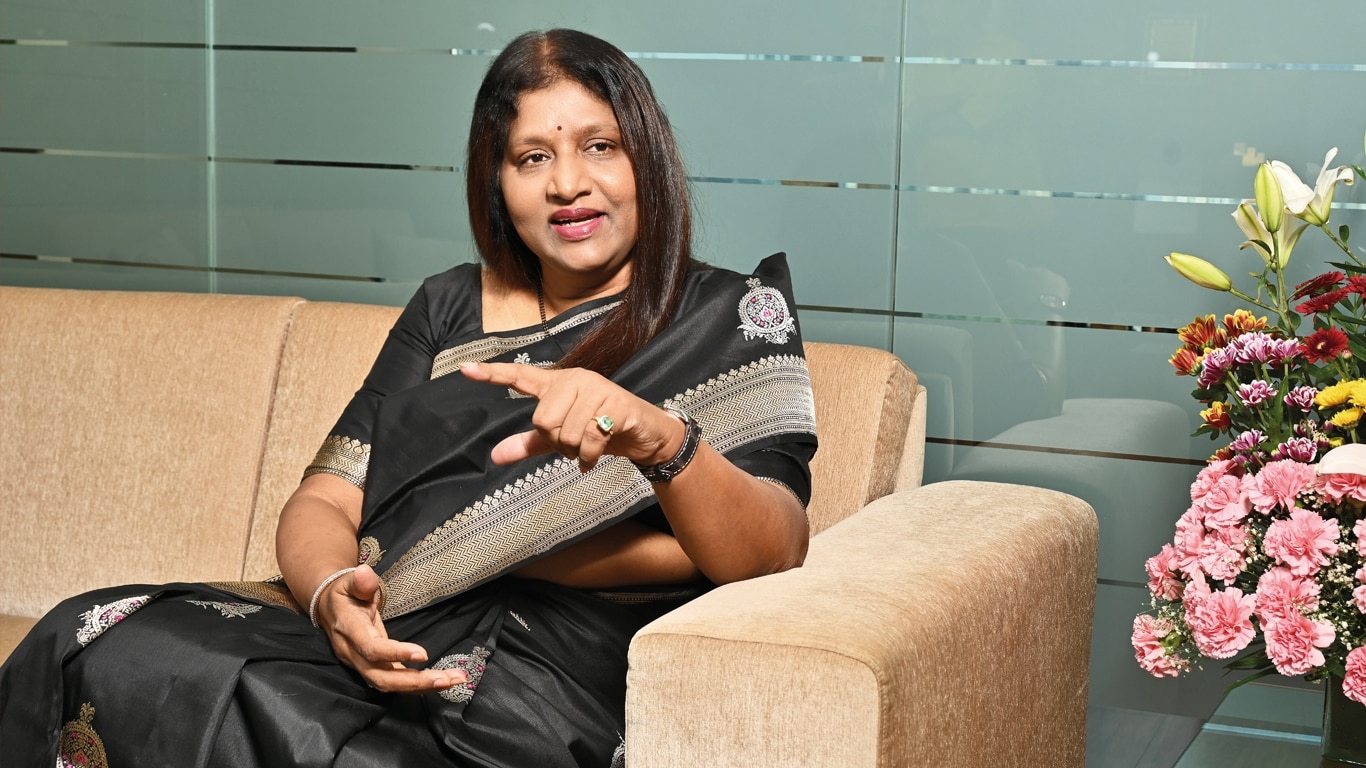

“It may sound trivial, but whether to attend my child’s PTA meeting in school or an important meeting in office has been among the toughest decisions I have had to take,” Vishakha Mulye, the MD and CEO of Aditya Birla Capital, tells Business Today during an interview.
Mulye is a well-known figure in the financial services space, having worked in two large institutions—ICICI Group and Aditya Birla Capital.
Many women would have gone through the same dilemma in their careers. While Mulye sees clear improvement for women in the corporate world and an increasing presence in leadership positions, she also feels many more need encouragement, support, and confidence to stay the course.
Mulye, who has ranked eighth in the listed universe in the BT Most Powerful Women 2026 ranking, has spent three decades working across banking, insurance, and private equity at ICICI Group, and was involved in major milestones like the merger of ICICI and ICICI Bank. She has been able to leverage those learnings as she leads Aditya Birla Capital which, under her leadership, has emerged among the top five diversified NBFCs in India.
Edited excerpts:
Q: You have been a career banker and have played a key role within Aditya Birla Group as well as earlier at ICICI. How has that shaped your life and what have been the learnings?
A: I have been extremely fortunate to work with two large organisations—ICICI Group and Aditya Birla Group, which have played an important role in shaping India’s business landscape.
I spent almost 30 years at ICICI. I started as a management trainee and got the opportunity to work with some great mentors and leaders who shaped my thinking. I joined ICICI in 1993, when the financial sector was opening up and India’s economy was growing rapidly. Therefore, I had the opportunity to work across every facet of financial services.
I was also fortunate to be involved in several important milestones, including the ICICI-ICICI Bank merger. We executed some of the largest equity and debt raises of that time, including a landmark $5 billion equity raise for ICICI Bank.
When I came to Aditya Birla Capital, it gave me an opportunity to leverage everything I had learned over 30 years. The last four years at Aditya Birla Capital were very exciting as we have built scale, added new businesses, built teams and implemented some important strategic decisions like the merger of ABFL with ABCL. We have also significantly strengthened our capital base, raising approximately `11,250 crore.
If I were to talk about the key learnings, there is no substitute for integrity and sound judgement, particularly when you are managing people’s hard-earned money and trust. The second learning is the importance of investing in people and building strong teams. Markets are volatile, and what really helps you scale a business and take it to the next level is having the right people in the right roles.
The third learning is the importance of responsible growth.
Finally, as a leader, it is important to know not only what you need to change, but also what you should not change. Preserving the character, values and strengths of an institution is equally important. Getting that balance right is a critical part of leadership.
Q: Taking charge in 2022, you envisioned the One ABC strategy. Could you tell us more about the idea and how things have panned out since?
A: The unique thing about ABCL is that we are probably amongst the very few franchises, other than banks, who have the ability to provide complete financial solutions to our customers. We have all products within ABCL spanning lending, insurance, investments and payments to serve customers’ diverse financial needs and aspirations across their life-stages.
As a manufacturer, you have control on the product design as well as product delivery. That’s where the genesis of our One ABC journey comes from. Our strategy is One ABC, One P&L, driven by three main drivers of One Customer, One Experience and One Team, by leveraging data, digital technology and AI.
Q: What are the key growth drivers today?
A: India presents an enormous long-term opportunity for financial services. Rising incomes, increasing formalisation, greater digital adoption, and the growing financial aspirations of individuals and businesses are expanding the addressable market.
At Aditya Birla Capital, we are well positioned to participate in India’s financial services growth opportunity. Our lending portfolio has grown more than threefold, from `55,180 crore in March 2022 to approximately `1.7 lakh crore in June 2026. Over this period, we have moved from being the ninth-largest to the fifth-largest diversified NBFC. This scale-up has been accompanied by a significant improvement in asset quality.
We identified housing finance as a key growth opportunity in 2022 and have since built a full-stack housing finance franchise spanning prime, affordable and construction finance. Lending will continue to be an important growth driver for us. The opportunity remains significant, and our focus will be on scaling these businesses. We also believe our asset management, life insurance, and health insurance businesses are well-positioned to capture the long-term opportunity.
Q: Today, we are increasingly seeing women in leadership roles. Yet, at the same time, there is also a large gap that still exists. Have things become easier for women to climb the leadership ladder, or are there still things that need to be sorted?
A: Things have certainly improved. Today, we see more women taking on leadership roles, managing large teams and leading businesses, in ways that were far less common a decade ago. Organisations are more conscious of the need to build diverse leadership pipelines.
I think women do think differently from men. Therefore, there is a strong business logic for diversity, and gender is an important part of that. At Aditya Birla Group, we consciously believe in diversity, not only gender but all forms of diversity. A lot of positive change has happened. Now, we need more and more women to believe in their capabilities and walk this path without giving up.
Q: How have you addressed diversity at Aditya Birla Capital?
A: At Aditya Birla Capital, we believe that diversity is integral to building a stronger, more innovative and future-ready organisation. Women represented 33% of our workforce in FY26, and we continue to strengthen representation at senior levels.
We have initiatives like our diversity council. I personally interact with young women, and we have created support groups because many times you become uncertain. It happened in my own career. When I had my first child, I evaluated my options, and that was despite having a very loving and supportive husband and in-laws. At that time, fellow women colleagues and seniors came forward and assured me that this phase would pass and things would settle. I am grateful that I got that advice.
We try to replicate that at Aditya Birla Capital. We have created support groups and have a very senior HR leader heading our diversity initiatives. The biggest support often comes from someone simply assuring you that what you are going through is normal and that things will work out.
The period when many women choose to start a family is also when they move into more senior roles and take on greater responsibilities. That is why women need encouragement, support and confidence to stay on the path.
Q: How important is culture in driving overall successful organisational change?
A: For me, culture becomes real when it is reflected in everyday decisions—how growth is pursued, how risk is managed, how capital is allocated and how accountability is upheld. During our transformation journey, we reinforced a few non-negotiables—integrity, disciplined execution, collaboration across businesses and functions, prudent risk management, capital efficiency, and a digital-first, customer-first mindset.
We embedded these behaviours through our ‘I’M ABC’ culture framework, where I’ stands for Integrity, ‘M’ stands for Mindset-Digital, ‘A’ stands for Accountability and Ownership, ‘B’ stands for Being Collaborative and Sensitive and ‘C’ is for Customer-First Approach. We also aligned governance, performance metrics and incentives with these behaviours. We keep reiterating these values in our interactions with employees. Even when we hire people, we assess these attributes.
Q: What is the biggest challenge you see?
A: The [financial] markets are extremely volatile right now. What worries me more today are the external challenges, what is happening around the world and the impact that can have on India, the financial sector and, in turn, on us.
Q: How do you see these external challenges from an India perspective? We do see a lot of concerns: whether it is rupee or foreign inflows, among other things.
A: I am a born optimist. And I really believe there is a huge amount of resilience in India. So, I don’t see anything different happening this time. India’s underlying economic fundamentals are stronger today. The country has made significant progress in technology and digital infrastructure, while corporate balance sheets are healthier and relatively less leveraged, improving their ability to withstand periods of uncertainty. While global uncertainty and elevated commodity prices could have some impact, India is in a much stronger position to absorb these pressures.
Q: In your journey, what was the toughest decision you had to take?
A: One of the toughest decisions, I would have taken in my life, was whether to attend my child’s PTA (parent teacher association) meeting or an important meeting in the office. Managing personal and professional commitments is always tough.
@TheNachiket


