
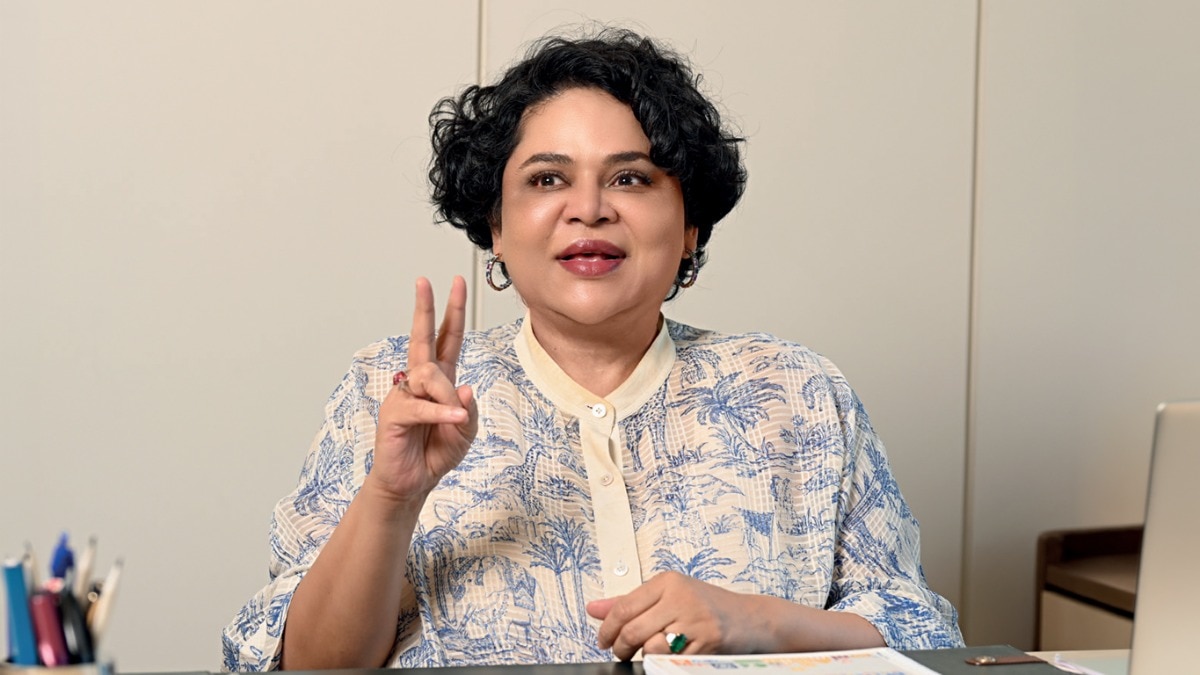
Sminu Jindal, a commerce graduate from Shri Ram College of Commerce, joined Jindal Saw, part of the OP Jindal Group, as a management trainee at the age of 19 in 1992. She did not let her reduced movement ability due to a childhood accident impact her business prowess. In 2001, she took over as the Managing Director of Jindal Saw and has been successfully steering the business by diversifying in the oil and gas sector.
The US-Iran conflict is adversely impacting the steel business. Jindal, however, remians optimistic. She says the war provides new opportunities as the world is now thinking beyond shipping routes and looking to invest in pipelines for movement of oil and gas. She also talks about similar possibilities in India.
In an interview with Business Today, Jindal talks about the National Steel Policy and its impact on the high-grade imported steel required for the piped business. She also spoke about her work with people with reduced mobility and association with the Ministry of Sports ahead of the Commonwealth Games 2030 in Ahmedabad. Edited excerpts:
Q: How has the West Asia war impacted business?
The US-Iran war has disrupted the whole economy, especially in terms of transportation. It’s becoming very tough to reach our places of contract because of uncertainty around the Strait of Hormuz. But we are hopeful that next year should be brighter, and we are hedging ourselves better.
We’ve got our Indian operation in terms of water pipelines, as well as we do a lot of other projects with different oil majors. So, it’s keeping a little bit of our neck above water, but it’s not a happy situation.
Our order books for the pipe business alone are over a million tonnes as of now. Approximately 20% of our volume that goes to West Asia is currently impacted right now. We have orders but we are not able to ship. The only issue is logistics because both the Gulf and the Red Sea are also closed. Otherwise, 80% of the other business is going as per plan.
Even though it looks very bleak, I don’t see myself doing very badly. Some businesses will definitely be impacted. I wouldn’t say that we are going to match the numbers we did last year.
Q: Has there been any delaying of orders and reworking of strategy due to the current geopolitical situation?
Jindal SAW was looking at divestment in West Asia. So, you can make out that there is going to be a little bit of stalling, and what was going to come probably in four months will now probably come in a year. But it can be sooner than that the minute the situation changes.
But right now, conservation is something that we think is prudent to do.
I think there are other areas where we are trying to improve ourselves because when you are down, that allows you to improve yourself technologically, to look at things in a better fashion when orders start coming in. We are also looking at AI interventions and better technologies as part of investments.
We have quite a lot of orders. We are unable to process them because there is no transport currently, but we are also working on that. You know, we are working with our people, with our customers in particular, and we are looking at solving these issues.
Q: What is your growth trajectory for the sector?
There is also a positive side of the whole situation for the pipeline business. Oil prices have doubled, therefore investment in pipelines will happen. It is an opportunity for us.
The countries in West Asia are looking at alternative pipelines. Till now, their only option was to use the Gulf route, and now they are looking more at the Red Sea and the Mediterranean Sea. So, in the short term, there is stress for all of us, but in the long term, we see huge benefits.
Q: What kind of policy support is needed from the government?
We would like the government to take cognisance of the specialised high-end imported steel required for pipelines. Just securing your steel players is not enough. I hope the steel Bill takes this fact into cognisance and is able to distinguish between high-end steel and others.
India has a lot of steel mills, and they don’t concentrate on this high-grade steel. It (the levies on imported steel) will give us a big disadvantage in the global market. We are also in touch with all the steel mills on how to expand their basket.
Today, India is importing a million tonnes steel for oil and gas for re-export. The government must give certain benefits and certain criteria to make sure that the pipe market doesn’t go dry and special grade steels are handled differently. We shouldn’t get bogged down by our own policies.
Q: You have been working towards dignity for people with reduced mobility. What’s next for Svayam?
Right now, we are really concentrating on the Commonwealth Games (to be held in Ahmedabad in 2030)—particularly the para games. We are not ready with different modes of transport, sensitising people, and accessible infrastructure for para-athletes. We need to work towards making the transport, hotels, stadiums, and places of recreation accessible for everyone. We are working with the sports ministry and are hopeful things will work out.
Q: What is your strategy for the rest of FY27 and the outlook ahead?
We’re looking at diversifying and concentrating on other areas. We’ve got all types of coatings and offshore projects. So, things like that keep us afloat. Other investments everywhere else are also doing fairly well. And we are hopeful that more pipe plans will come in, but the shipping routes need to open.
Pipelines are going to be something that will be demanded all over the world because everybody is realising that their overdependence on Hormuz is a negative. So, the world is already looking at the Red Sea and cross-country pipelines and is not waiting only for transportation through ships.
In India, there is focus on PNG connectivity, ONGC getting into exploration work, and alternative gases coming into the picture. The carbon capture pipelines are going to come. Hydrogen may not be in its purest form but in mixed form. So, a whole lot of different thinking in terms of (oil and gas) transport is on the cards.
India has announced Samudra Manthan worth Rs 86,000 crore for deep-sea exploration, and this will give immense opportunities for offshore (pipeline) supplies.
@richajourno













