
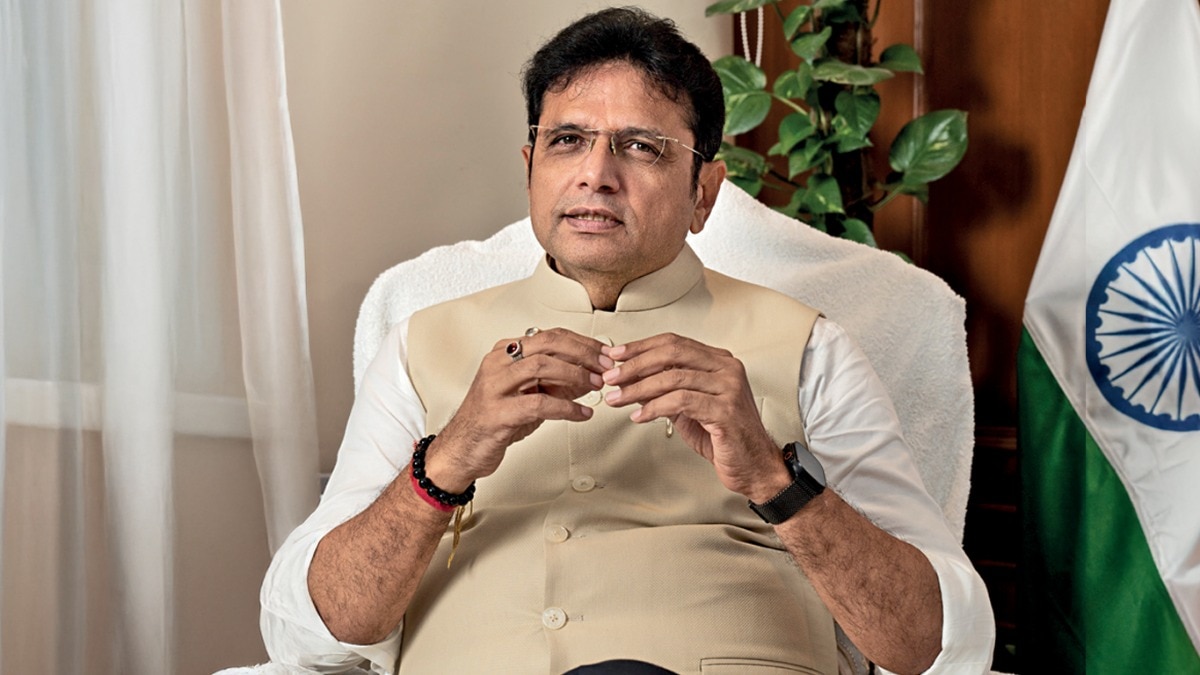
As India charts its journey towards becoming a developed economy by 2047, Telangana is betting on technology, talent and innovation to emerge as a global manufacturing hub. Telangana has been the state to look out for in terms of exports, showing the fastest growth amongst emerging states in the period between FY18 to FY25 when it reported a 191% jump in the seven-year period. Even in the five years between FY20 to FY25, it logged the fastest growth amongst emerging states of 160% in exports, according to the Business Today study.
In an interview with Business Today, Telangana’s Minister for Information Technology, Electronics, Communications, Industries & Commerce and Legislative Affairs, D. Sridhar Babu, outlines the state’s vision for AI-led manufacturing, semiconductors, global capability centres (GCCs), sustainability, and why he believes governments must enable innovation rather than merely regulate it. Edited excerpts:
Telangana has built a strong reputation in IT, pharmaceuticals, and life sciences. How do you plan to translate that strength into becoming a leading manufacturing destination by 2047?
As I often say, India cannot afford to export the flour and import the bread. We must create value here at home. That is why I do not see this as a choice between IT, life sciences, and manufacturing. I see it as the natural evolution of Telangana’s growth story.
The manufacturing economy of the future will be driven by software, AI, robotics, R&D, and precision manufacturing. Telangana already has the capabilities to lead. Our vision is to build a $3-trillion economy by 2047 and increase Telangana’s contribution to India’s GDP from 5% to 10%. Achieving that means moving decisively up the global value chain—from providing services and assembling products to designing, engineering, and manufacturing the technologies of the future.
By 2047, I want Telangana to be known not only as India’s technology capital, but as one of the world’s leading innovation ecosystems.
Hyderabad has emerged as India’s leading Global Capability Centre (GCC) hub. How can GCCs contribute to the state’s manufacturing ambitions through R&D, engineering, and product development?
Manufacturing has changed. It no longer begins on the factory floor; it begins in research labs, engineering centres, and product design studios. That is why GCCs have become so important.
Today’s GCCs are not back offices. They are where companies develop new products, design semiconductors, build robotics and AI platforms, run simulations, and solve complex engineering problems. The intellectual property created in these centres ultimately shapes what gets built, how it gets built, and how globally competitive it becomes.
We are already seeing this in Telangana. Over the last 30 months, Hyderabad has attracted 150+ GCCs, creating 150,000 high-value direct jobs and over 600,000 indirect jobs. Nearly 46% of India’s greenfield GCCs chose Telangana, with companies such as Vanguard, Southwest Airline, Nationwide India, The Hartford, McDonald’s, L’Oréal, Netflix, and Marriott have established their first engineering centers here.
More importantly, we are bringing together innovation centres across diverse industry domains to unlock cross-domain innovation, accelerate knowledge transfer, and create collective value. This ecosystem is already encouraging companies such as Lilly and Align Technologies to establish manufacturing facilities.
Telangana has been proactive in AI and emerging technologies. How do you see AI transforming manufacturing, supply chains, and industrial productivity over the next decade?
I believe AI will define the next decade of industrial growth. It is going to transform manufacturing through smarter production, improved quality, lower costs, and more efficient plant operations.
Our role is to create talent and the right environment for businesses to embrace AI with confidence. For Telangana, this is an opportunity to move up the value chain, build globally competitive industries, and create high-value jobs for our young people.
How is Telangana building an innovation ecosystem for next-generation manufacturing?
Innovation happens when academia, start-ups, industry and government work together with a shared purpose. That is the ecosystem we are building in Telangana. Every globally competitive innovation ecosystem rests on four foundations. The first is talent. We are bringing industry into the classroom, so our workforce is ready for tomorrow’s jobs. The second is innovation. Through AIKAM (global AI innovation hub), TGDeX (Telangana Data Exchange Platform), and platforms like 1Bio (single-use bioprocess scale-up facility), we are connecting academia, researchers, start-ups, and industry to turn ideas into products faster. The third is infrastructure. Investments in AI City, Bharat Future City, the Regional Ring Road, Metro expansion, and airport connectivity are creating an environment where businesses and talent can thrive. Finally, policy. We remain committed to a stable, transparent, and industry-friendly regulatory environment that gives businesses the confidence to invest and grow.
I do not see this as a choice between different sectors. These industries are increasingly interconnected. A semiconductor designed today could power an electric vehicle, enable an AI-powered medical device, or become part of a defence platform. They all depend on advanced engineering, AI, robotics, electronics, research, and skilled talent. We are home to over 1,500 technology companies, nearly 300,000 AI professionals, and more than 50,000 chip designers.
Semiconductor investments have become highly competitive globally. How is Telangana positioning to attract semiconductor and electronics manufacturing projects?
Hyderabad is home to companies such as AMD, Qualcomm, Micron, and Allegro MicroSystems, with thousands of engineers working on chip design, embedded systems, and advanced electronics. Institutions, including IIT Hyderabad, IIIT Hyderabad, BITS Pilani Hyderabad, and JNTU, provide a strong talent pipeline while working closely with industry on research and product development.
We are strengthening this ecosystem through Electronic City in Bharat Future City, hardware prototyping facilities such as T-Works, and continued investments in innovation and industry partnerships.
A good example is the OSAT proposal that originated in Telangana under the India Semiconductor Mission. Although the project was eventually approved in Andhra Pradesh, it demonstrated that global companies viewed Telangana as a credible destination for semiconductor manufacturing because of its mature ecosystem. As the India Semiconductor Mission evolves, I believe national investments should increasingly recognise states that have already demonstrated such capabilities.
As companies diversify global supply chains, what opportunities do you see for Telangana in attracting multinational manufacturers?
This is a significant opportunity for Telangana because we are not starting from scratch. Over the years, we have built globally recognised ecosystems in aerospace and defence, life sciences, electronics, and semiconductors.
Global companies, including Boeing, Lockheed Martin, Safran, and Tata Advanced Systems, have established major operations here. In life sciences, Genome Valley, along with companies such as Dr. Reddy’s Laboratories, Bharat Biotech, Biological E, and Aurobindo Pharma, has made Hyderabad one of the world’s leading centres for vaccines and pharmaceutical manufacturing. For multinational manufacturers looking to diversify supply chains, Telangana offers skilled talent, strong research institutions, reliable supplier networks, and a mature innovation ecosystem
What policy reforms or infrastructure investments are you prioritising to further improve the state’s ease of doing business?
For us, ease of doing business begins with ease of governance. Investors should spend their time building businesses, not navigating the government. That is why we are making government faster, simpler and more transparent by streamlining approvals, integrating services, and strengthening our single-window interface for investors. Our objective is straightforward: faster decisions, greater transparency, and stable policies. At the same time, we are investing nearly $15 billion in strategic infrastructure because ease of doing business is not only about approvals; it is about giving businesses the confidence to build, scale and grow.
What role do skilling, reskilling, and higher education institutions play in ensuring Telangana has a workforce equipped for advanced manufacturing?
Talent is Telangana’s greatest competitive advantage. In fact, we often say that talent is our greatest infrastructure. Building world-class talent takes years, and that is the investment we are making today. To sustain our advantage, we are creating a talent pipeline that begins in school and continues through higher education, industry-led skilling, and lifelong learning. Nearly two million government school students are being introduced to AI with the support of more than 28,000 teachers. Through Young India Skills University, industry is helping shape curricula for tomorrow’s jobs.
In life sciences, we have launched the Telangana School of Life Sciences to provide hands-on industry training in pharmaceutical manufacturing, biologics and quality systems in partnership with companies such as Granules and Biological E. We are also partnering with Deakin University through the AIKAM Telangana AI Innovation Hub to strengthen research, innovation, and AI capabilities.
As climate considerations become central to investment and economic growth, how is Telangana embedding sustainability into its long-term development strategy?
For us, sustainability is not a separate agenda; it is central to our growth strategy.
Telangana has nearly 1.7 billion sq ft. of registered green building space, among the highest in India. Through HYDRAA and the Musi River Rejuvenation Project, we are restoring lakes, rivers, and public spaces, while Bharat Future City is being developed as India’s first net-zero city.
Technology is equally central to governance. MeeSeva delivers 387 citizen services across 38 departments, while initiatives such as the Digital Cabinet Project, Digital Assembly, and Digital Council are making governance more transparent and efficient.
We are also investing in the future workforce through India’s first Green Skills & Applied AI Centre of Excellence, established with Microsoft, 1M1B Foundation and MeitY Startup Hub, to equip young people with AI and sustainability skills for the next generation of manufacturing and life sciences.
As you look towards 2030, what are the key milestones that will define Telangana’s story?
We have set ourselves an ambitious goal of becoming a $1 trillion economy by 2030. Beyond the numbers, success for me will be when Telangana is known as the place where the world’s most innovative companies come, not because of incentives, but because they cannot imagine building the future anywhere else.
It will be when a young graduate from Karimnagar, Khammam or Nizamabad no longer feels the need to leave home to build a global career. It will be when a start-up from Warangal becomes a global company, and when research from our universities is transformed into intellectual property, products, and globally competitive enterprises.
I want Telangana to become India’s benchmark for how government and industry work together. Too often, governments regulate while businesses innovate. I believe governments should enable innovation.
If you had to make a one-minute investment pitch to a multinational manufacturer considering India, why should they choose Telangana?
Every state can offer land, incentives, and infrastructure. What we offer is trust. We do not see companies as investors who come, establish operations, and leave. We see them as long-term partners. Our role is to help them grow through talent, world-class infrastructure, and faster decision-making. We are not just an investment destination. We are value partners.
@tweettokarishma













