


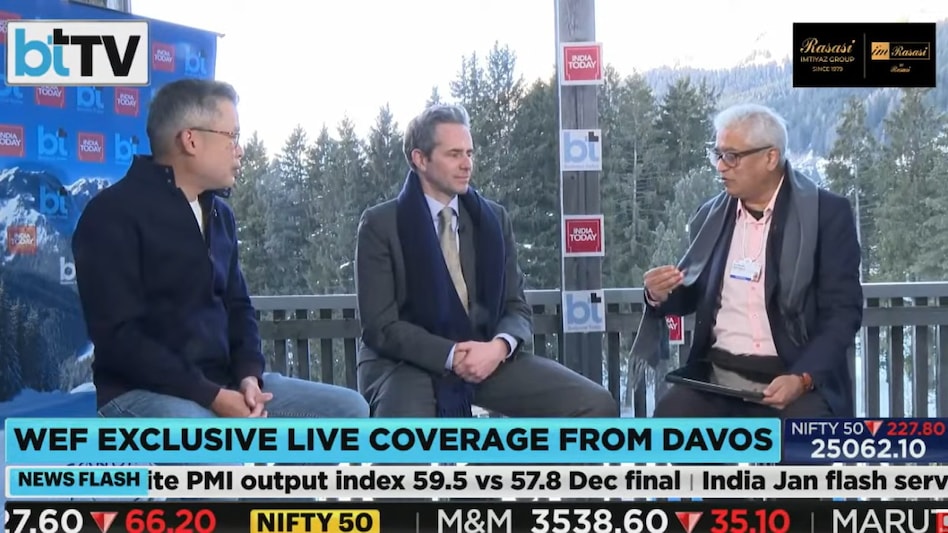
 WF Davos 2026: Jaime Ho and Jamil Anderlini discuss the difficulties in picking sides between US and China
If nations are wary about siding with either the US or China as the two superpowers take on each other then they only have to look at Singapore that has nimbly navigated the fine line, said experts at the World Economic Forum 2026 in Davos.
Speaking to Business Today, Jamil Anderlini, Editor-in-Chief (Europe), POLITICO, and Jaime Ho, Editor, The Straits Times, talked about how important it is for middle and smaller powers to stick to an alliance of like-minded nations.
 UPI MDR on select person-to-merchant transactions to be implemented after Diwali
 'Chips are the future': Tata Sons' N. Chandrasekaran flags demand, management risks in India’s semiconductor push
 'We grow with the world, not at anyone's cost': PM Modi on India's economic growth
 Nandan Nilekani bets on India for scaling AI, says IT service demand will continue to grow
 Nifty50 to hit 26,000-26,500 in next 4-5 months: Monarch Capital
  Riyadh Airport Strike: Hyderabad Man Among Dead As Houthi Attacks Raise Regional Tensions
 PM Modi, Vijay’s Viral Metro Ride: A New Political Equation In Tamil Nadu?
 “Reforms Are Our Conviction”: PM Modi Cites India’s 7.8% Growth at Bloomberg Forum
 Bonfiglioli Transmissions IPO Explained | MD & CFO on Growth, Valuations and Outlook
 Blackstone President Jonathan Gray On India's Investment Boom & Global Risks | BNEF 2026
 Paytm, Pine Labs, One Mobikwik shares rebound after up to 6% fall; UPI MDR rollout post Diwali
 Shyam Metalics secures mining rights for Phutamura coal block; check stock reaction
 Tata stock: Multibagger in red since two years, trend reversal on cards?
 Nifty vs FD: What ₹1 crore invested at past market bottoms would be worth today
 Jio Platforms IPO: Why Religare sees re-rating in Reliance Industries; check target, upside
 Nandan Nilekani’s vision to stop exam paper leaks puts AI and digital testing in focus
 Methodology: How MDRA ranked India’s top B-schools
 Master of Business Ambiguity is the new MBA, writes Professor & Director of IIM Kozhikode, Debashis ChatterjeePaytm, Pine Labs, One Mobikwik shares rebound after up to 6% fall; UPI MDR rollout post DiwaliShyam Metalics secures mining rights for Phutamura coal block; check stock reaction












