Recent trends and data from sources like DAAD and OECD suggest that international graduates from German universities often command significantly higher starting salaries (sometimes 20-30% more, or even higher in STEM/IT fields) compared to professionals entering Germany with foreign credentials. The difference doesn’t lie in a German education, but in course selection, internship opportunities, and understanding which universities feed directly into which corporate hiring pipelines.
The Education-to-Employment Advantage
Germany hosts over 420 English-taught Master's programs across engineering, business, technology, and sciences, providing international students with the opportunity of a world- class education at a fraction of the cost. Many world-renowned public universities are largely tuition-free for all students, including international ones, though most require a mandatory semester fee (around €100-€350) for administration and transport. While Affordable German cities with lower living costs (especially rent) include Leipzig, Dresden, Halle (Saale), Magdeburg, Jena, Chemnitz, and Bochum, often offering total monthly budgets (including rent, utilities, food) around €700–€900 for students.
While yes, the cost is one of the biggest reasons why Indian students are drawn to Germany, Shlok Agarwal, founder of EduOptions Germany, says that, “We’re seeing a massive shift in how student views Germany and German education. They're not just selecting programs based on academic reputation, but analysing which universities have the strongest industry partnerships, which specialisations lead to the highest-demand roles, and how to structure their entire student journey toward optimal employment outcomes.”
A German degree solves the challenges most students face regarding employment, as Germany provides an 18-month post-graduation job-seeking period, and importantly, focuses on teaching the students practicality rather than just theory, preparing students for life after graduation.
What makes EduOptions, a study abroad consultancy, and Shlok Agarwal stand out among other consultancies is the fact that Shlok himself has studied in Germany.
Recalling his experience, Shlok says, “I remember how chaotic my first week was in Germany. On one hand, you’re filled with adrenaline and overwhelmed, yet on the other hand, I realise how different the social cues are in Germany than back home.”
“My time in Germany was spent beyond attending lectures; it was also about learning the social norms, experiencing Germany like a local, and learning how to thrive in a place when you’re from a foreign land, quite literally.”
The Job Landscape
Understanding Germany's salary structure helps students make informed choices regarding course selection.
● As of 2026, Jobs in IT & Software Engineering for entry level ranges from €55,000 – €72,000. The key cities for demand in this field are Berlin and Munich.
● Jobs in Mechanical/Automotive Engineering for entry-level range from €52,000 – €68,000. The key cities for demand in this field are Stuttgart and Wolfsburg.
● Jobs in Medicine & Healthcare for entry-level range from €58,000 – €75,000. The most in-demand jobs are in this field, as you can easily find a job nationwide.
● Jobs in Business & Finance for entry-level range from €50,000 – €70,000. The key cities for demand in this field are Frankfurt and Munich.
● Jobs in Natural Sciences (Biotech/Chem) for entry-level range from €48,000 – €62,000. The key cities for demand in this field are Leverkusen and Ludwigshafen.
● Jobs in Architecture / Social Work for entry-level range from €40,000 – €50,000. The key cities for demand in this field are Berlin and Hamburg.
Geography impacts both salaries and career trajectory, as salaries in Munich, Stuttgart, and Frankfurt are typically 10–20% higher than in Eastern Germany (Leipzig, Dresden), but the cost of living (rent) is also significantly higher. Also, while many IT and Engineering roles are in English, fluency in German (B2/C1 level) can increase your starting salary offer by 10–15% in medium-sized companies (Mittelstand).
EduOptions Consultant also noted this pattern in their students, that the students who adapted the German language were able to blend into the country better, culturally and professionally. Learning the German language, although it is not mandatory, can unlock opportunities within mid-sized firms that may not operate in English.
The 18 Month Period
After graduation, International students receive 18 months of a job-seeking timeline, an ample amount of time for thorough career decision-making, and no rushed judgment. Shlok says that, “This is one of the biggest advantages of choosing Germany, students can be highly selective rather than being desperate. They can choose a position that aligns with their career goal rather than accepting first offers because of a time constraint.”
Many students have reported back to EduOptions saying how they began receiving interview calls even before they graduated, particularly in engineering, IT, and applied sciences, where demand continues to outpace supply.
Beyond Admissions
Shlok explains that when many students walk in, they’re more focused on well-known universities or “trendy” cities without considering whether those options are aligned with their industry interests.
“Germany is highly spread out. The best engineering opportunities aren’t always in Berlin or Munich. Automotive thrives around Stuttgart and Wolfsburg, renewable energy is strong in Hamburg, fintech is concentrated in Frankfurt, and manufacturing technology dominates cities like Dortmund and Essen. When students align their career interests with the right university, they thrive better.”
EduOptions Germany is also known as EduOptions Abroad, as it is one of the leading consultancies recognized for its high success rate in placing students in Germany, and also focuses on various other countries. They have 15+ years of experience and have placed more than 8000 students all around the world.
EduOptions doesn’t just make students documentation-ready; they prepare their students for the world they will step into. They help students with accommodation and connect them with their vast network of past students, which enables them to settle and adapt more quickly. They advised students on how to find part-time work, manage their finances, and much more.
Germany is becoming a leading structured and reliable destination for Indian students who are looking for career-driven, practical education. The country’s low tuition costs, with world-renowned industry integration, and generous post-study work rights have created a system where education functions as an entry point into one of the world’s most stable labour markets.
Shlok clarifies, “The opportunity in Germany is significant, but not automatic or mandatory. Success depends on strategic course selection, language adaptation, and a professional network. Those student who sees Germany as a career ecosystem are more likely to succeed than students who just see it as a study abroad destination.”
In the evolving landscape of Germany, a study abroad consultancy like EduOptions is playing a structural role, located in Mumbai and Pune respectively. Helping students navigate the maze that is studying abroad. They’re shaping their students beyond just higher education, transforming their academic ambition into a sustainable, rewarding career.


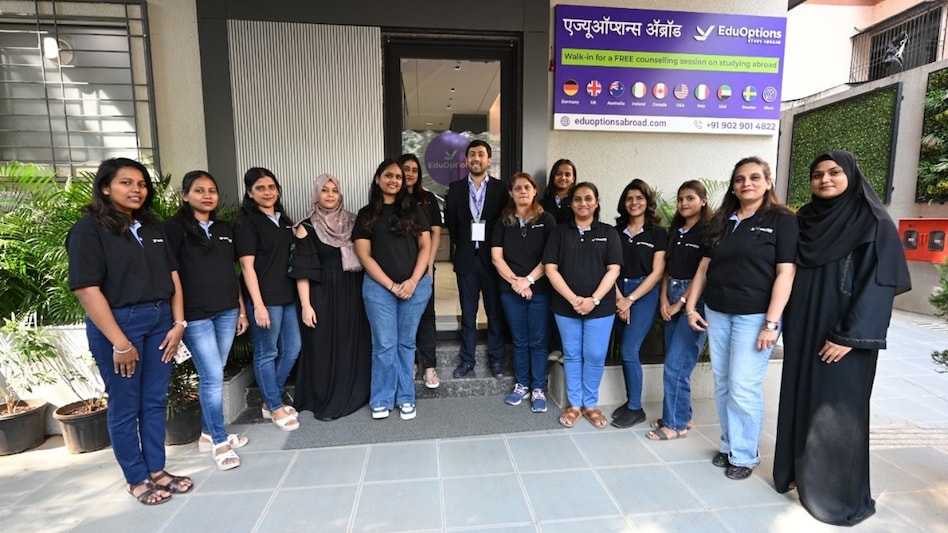 EduOptions is a study abroad consultancy, expert in Germany guidance
 'AI ending humanity is nonsense': Ex-Infosys CEO Vishal Sikka rejects growing doom warnings
 'Majority among two is two': Tata Trusts says Chandrasekaran reappointment failed AoA condition, has no legal effect
 ICAI plans further reforms to scale up homegrown accounting firms
 'Modi admin has done a phenomenal job': Blackstone's Jon Gray on what changed in India
 'SC/ST Act is being weaponised': Tech CEO backs IIT Bombay Professor, calls for case withdrawal
 Gold Price Target 2026: Expert Sees MCX Gold At ₹1.8 Lakh By Year-End Amid Strong Demand
 Health Insurance: Why Pre-Existing Diseases And Waiting Periods Matter For Buyers
 Crude Oil Above $100: How High Energy Prices And Rupee Weakness Impact Gold Prices In India
 CEA On India’s Manufacturing Rise, Atmanirbhar Bharat And Modi’s Economic Policy
 Health Insurance Buying Guide: 7 Things First-Time Buyers Must Check Before Choosing A Policy
 SpaceX weight in Nasdaq 100 to jump to 2.82% following quarterly index rebalance: Report
 Tata Motors or Ashok Leyland? Analyst reveals his preferred auto stock for near-term gains
 Maharashtra Scooters, Dixon Tech, Bharat Dynamics, Jai Corp among stocks to turn ex-dividend on Monday
 Jindal Supreme, SS Retail, Hero Motors IPOs subscribed up to 181 times on final day; details here
 Sensex, Nifty post sixth weekly loss; TCS, Titan among top laggards, slip up to 4%
 From terrace Wi-Fi to IIT Delhi: How this Mumbai student secured AIR 2,456 in JEE Advanced
 Hormuz crisis exposed the world's energy weak spots: Why the next shock could hurt more
 ‘Just have to know what floats your boat': Former Uber CMO on quitting Rs 1 crore job for farm life
 Could AI really kill us all? Here’s what MIT researchers fear and what they don’t
 Major milestone: Rajasthan's 700 MWe nuclear reactor begins initial fuel loading, enters key commissioning stage












