









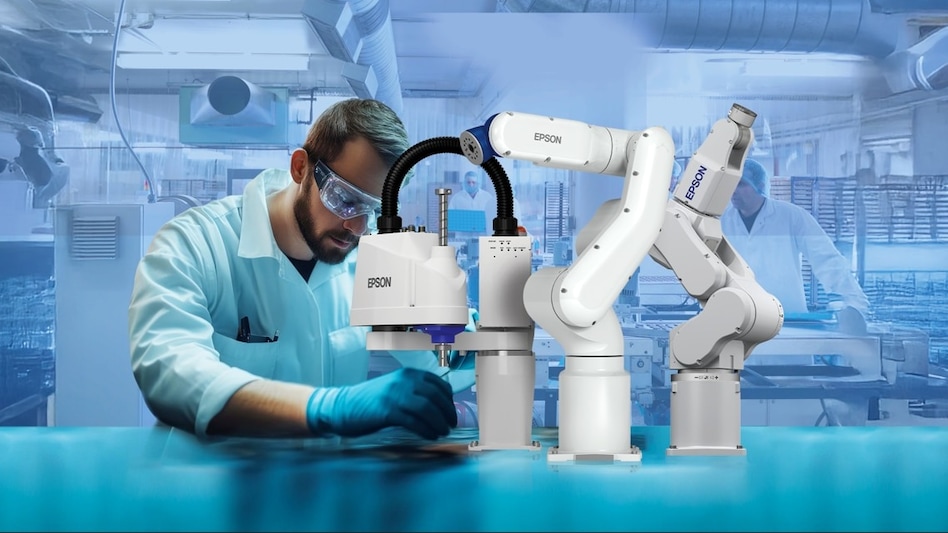
 Epson SCARA & Compact 6-Axis RobotsEpson SCARA & Compact 6-Axis Robots
India’s manufacturing industry stands at a once-in-a-generation crossroads. As global supply chains shift and domestic ambitions grow under “Make in India,” manufacturers face intense pressure to deliver world-class quality, speed and efficiency. Government incentives, strong investment and a vast consumer base create enormous potential, but competition is fierce. To stay ahead, manufacturers must adapt quickly.
Industrial robotics is reshaping production. By automating repetitive, precision-heavy tasks, robots boost productivity while freeing workers for higher-value functions such as programming, process optimisation and innovation. Robots excel in operations requiring speed and accuracy and take on labour-intensive roles that improve safety and consistency across production lines.
India’s Rapid Rise in Robot Adoption
In 2023, India installed 8,510 industrial robots, a 59% year-on-year jump and the fastest growth rate globally1, pushing the country to seventh place in annual installations. Automotive manufacturing led with 42% of deployments, driven by a 139% surge1. Yet robot density remains just 7 units per 10,000 manufacturing workers, far below the global average of 1412. This signals vast room for adoption, especially in electronics, packaging, consumer goods and battery manufacturing.
Driving Precision and Productivity
Epson’s robotics journey began in 1983 with precision assembly robots developed for its own factories. Today, Epson robots are deployed on production lines across the globe, delivering precision and reliability to manufacturers.
In India, Epson’s SCARA and Compact 6-Axis Robots are widely used. SCARA Robots deliver high speed and precision for pick-and-place, assembly and inspection tasks across electronics, pharmaceuticals and food processing. Compact 6-Axis Robots offer human-arm-like flexibility for machine tending, assembly and material handling in compact spaces.
With India’s robot market expected to grow strongly from 2025 to 20313, demand for higher throughput, lower costs and consistent quality will only accelerate.
“Automation enables people to focus on higher-value work and drive greater innovation,” says Samba Moorthy, President, Epson India. “As India advances toward becoming a global manufacturing hub, robotics will be key to elevating efficiency and precision.”
The Road Ahead
To compete globally, India needs more than low costs. It needs productivity, precision
and flexibility to tailor solutions to client needs. Robotics delivers all three. As SCARA and Compact 6-Axis Robots become more accessible, the moment to transform is now. Achieving manufacturing excellence demands that we keep advancing and adapting to new technologies.
1 2024-SEP-24_IFR_press_release_World_Robotics_2024_-_India.pdf
2India's rise of the robots: Country among top 10 markets in installations | IBEF
3https://www.6wresearch.com/industry-report/india-robots-market-2020-2026
 'BSNL belongs to people of India, no plans for privatisation': Jyotiraditya Scindia in Lok Sabha
 FPIs sell Rs 6,434 crore worth of Indian stocks daily in March; what’s next?
 After Larijani, Israel says it has killed Iran intelligence minister in Tehran
 AI’s next phase to drive higher computing demand, not less, warns Deloitte
  Cabinet approves ₹33,660 crore BHAVYA scheme, 100 plug-and-play industrial parks to be developed
 From SRK To Ambani: Indian Celebs’ Dubai Luxury Homes In Focus Amid Israel-Iran War
 Market Commentary With Amit Khurana | Value Buying Or Short Bounce?
 What’s Hot: Top Brokerage Calls & Market Strategy | Vinit Bolinjkar
 Shipping Ministry: 25 Indians Repatriated As Ports Stay Congestion-Free And LPG Operations Continue
 Nifty Valuation Decode, Should You Enter Now Or Wait?
 JBM Auto, Olectra Greentech, Ather Energy, Ola Electric shares jump up to 19%; here's whyFPIs sell Rs 6,434 crore worth of Indian stocks daily in March; what’s next?
 Waaree Energies, Indosolar shares gain up to 11% today; here’s why
 Sensex, Nifty gain 3% in 3 days; investors get richer by Rs 9 lakh crore. What's next?
 PG Electroplast shares rise for 3rd day; should you buy, hold or sell?