








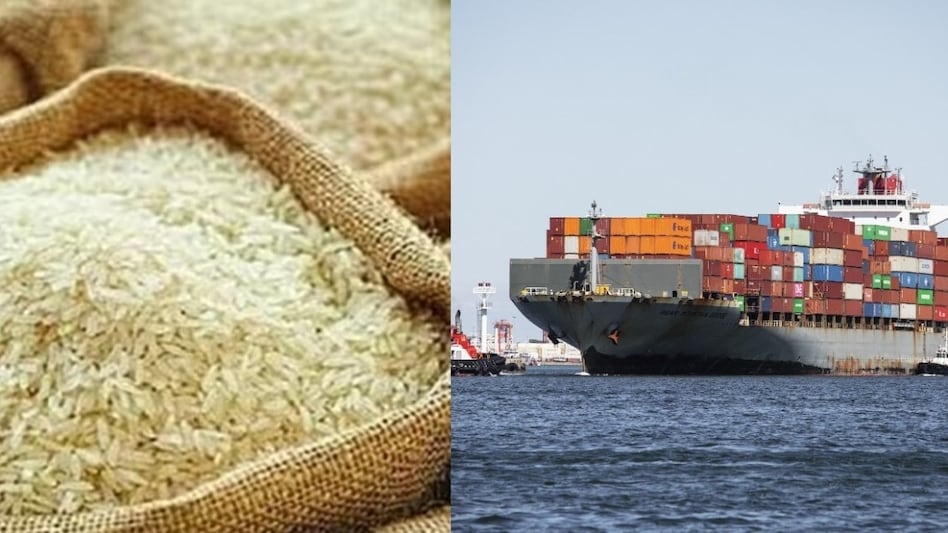
 4 lakh tonnes of basmati rice are stuck at ports in India and at high seas while in transit, as per reports4 lakh tonnes of basmati rice are stuck at ports in India and at high seas while in transit, as per reports
The US-Israel-Iran war shows no signs of a truce, making life tough for small basmati rice millers in several states across India. India's Basmati exports have virtually come to a standstill since the war began, as physical blockades and soaring logistics costs have left large consignments bound for West Asian markets stranded at various ports.
The virtual closure of the Strait of Hormuz, which is a critical chokepoint through which the vast majority of India’s rice consignments reach Iran and the wider Gulf region, has led to this situation. Some reports have estimated that 4 lakh tonnes of basmati rice are stuck at ports in India and at high seas while in transit.
The blockage of basmati exports has led to a price crash in local markets. Prices at which India’s small millers sell basmati rice to exporters have already fallen by 8-9%, before recovering late last week, though they are still lower by 5% compared to the last week of February. But the hit has been far worse for farmers, who sell paddy to these small millers. The realisations of farmers have crashed by up to 9% since the war started.
Ranjit Singh Jossan, VP, Basmati Rice Miller & Exporter Association, Punjab, told Business Today that local basmati purchases by small millers have almost come to a halt due to the war, which has deeply impacted basmati exports.
“Already, the price a farmer gets for paddy or dhaan is down 8-9% but if the war drags on for even one to two months more, farmers could be looking at a 10-15% decline in the selling price of paddy.”
Jossan said that as of now, the impact of the war on paddy farmers has been contained somewhat since the crop arrives in mandis during September-October months, and 80-90% of the crop had already been sold off before the US-Israel-Iran war began. The most severe impact of the unprecedented export disruption of basmati rice has been felt in Punjab, Haryana and Uttar Pradesh, three states that account for a bulk of India’s high-quality basmati rice meant for exports.
Agri exports suffer
According to data from the Global Trade Research Initiative (GTRI), much of India’s farm export basket is at a grave risk as the US-Israel-Iran war enters its second week. In calendar 2025, the entire West Asian market accounted for more than a fifth of India’s total agricultural exports at $11.8 billion.
One of the top agri export items to the region from India is rice, and West Asia accounts for 36.7% of our rice exports. In other words, more than a third of India’s total rice exports are sent to this region. Vinod Kumar Kaul, Director General of the Indian Rice Exporters Federation (IREF), said that within the rice basket, basmati is predominantly exported to West Asia.
According to him, two-thirds of India’s total annual basmati exports of 60 lakh tonnes are shipped to the West Asian region. Markets for Indian basmati include Iran, Iraq, Yemen, Syria, Saudi Arabia, Jordan, Lebanon, Israel and the UAE. So while the West Asian markets account for about a third of India’s total rice exports, for basmati rice, the share of this region is far higher at two-thirds.
Kaul said that even if one were to consider the average price of $900 per tonne, the four lakh tonne basmati stuck would mean $360 million worth of cargo at risk. “We are talking to the government about ways to improve the situation for basmati exporters,” he said, adding that of the stuck basmati cargo, only about 20% may be offloaded in the domestic market.
Meanwhile, GTRI founder Ajay Srivastava said that among agricultural exports, rice faces the largest potential impact from the disruption in global commodity supplies due to the US-Israel-Iran war. India exported $4.43 billion of rice to West Asia in 2025, making Gulf markets crucial for producers in Punjab, Haryana, Uttar Pradesh, Andhra Pradesh and Telangana.
“India’s agricultural exports have developed a deep dependence on West Asian markets over the past decade, particularly for products such as rice, bananas, spices, meat and dairy products. In 2025 alone, India exported nearly $11.8 billion worth of agricultural and food products to the region, accounting for more than one-fifth of the country’s total agri exports. The Gulf has been a natural destination due to its geographic proximity and large Indian diaspora. But the ongoing conflict in West Asia, along with disruptions to shipping routes and rising insurance costs, is now creating uncertainty for exporters and could directly affect farmers and food processors across several Indian states,” he said.
 US-Israel-Iran War Live: Arrivals to Dubai being held due to potential missile attack
 ‘Those responsible have to deal with it…’: India refuses IEA’s call to release strategic oil reserves
 Iran war: Govt prioritises LPG supply to households, hospitals, educational institutions amid energy constraints
  Sensex, Nifty climb in opening trade: Why stock market is rising
 West Asia crisis impact: Amid commercial gas shortage, Bengaluru's iconic Vidyarthi Bhavan staring at a shutdown
 Tehran Chokes Under Toxic Smoke After Fuel Depot Strikes, Fears Of Acid Rain Rise Across Capital
 War Could Push Oil Higher, But Markets Fear Rupee Volatility & FII De-Risking: Neelkanth Mishra
 Market Capitalization Of Companies Listed On NSE Now Exceeds 130% Of GDP: Tuhin Kanta Pandey
 Supply Disruptions Push Oil To $120: What Happens Next? Vandana Bharti Explains
 Nifty Correction After All-Time High: Opportunity Or Warning?
 BEL, HAL, BDL, Astra Microwave: 4 defence stocks to buy amid Iran war; target prices
 Innovision IPO kicks-off, should you apply: Check issue details, fresh GMP, ratings & moreSensex, Nifty climb in opening trade: Why stock market is rising
 Uno Minda shares rise 4% as Jefferies says valuations rich but justified; target price
 Groww, LG India, Orkla among 10 stocks with fresh brokerage interest for upto 41% rise