


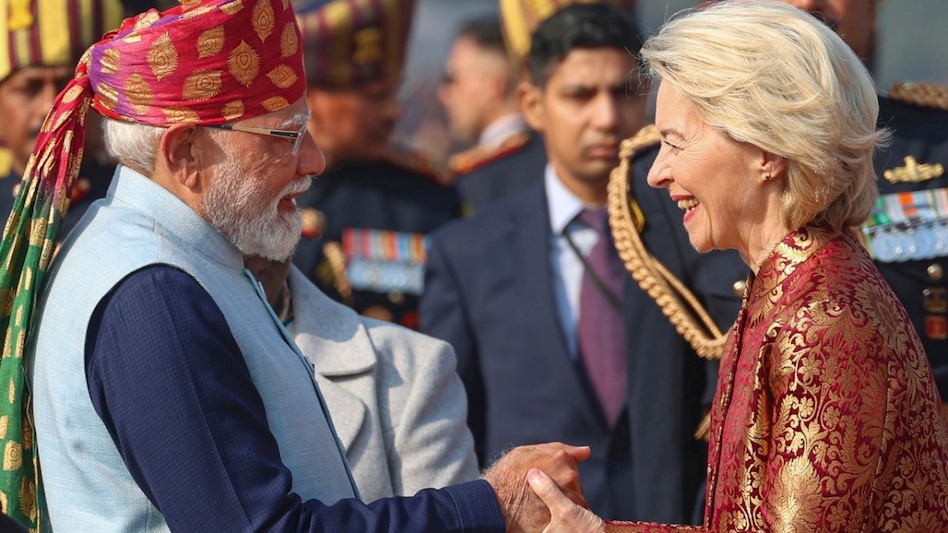
 The India–EU FTA is expected to help Indian exporters diversify markets. (Photo: PTI)
India and the European Union are set to formally declare the end of negotiations on a comprehensive free trade agreement at a summit in New Delhi today, delivering a long-awaited breakthrough after almost two decades of talks. Prime Minister Narendra Modi will host European Commission President Ursula von der Leyen and European Council President Antonio Costa, with the meeting also expected to firm up a strategic defence partnership and a mobility framework.
The agreements are likely to anchor a wider India–EU plan as both sides navigate shifting geopolitics and uncertainty triggered by Washington’s recent trade and security moves.
Commerce Secretary Rajesh Agrawal confirmed on Monday that the negotiations have reached the finish line.
"Negotiations have been successfully concluded. The deal has been finalised," Agrawal said, describing the pact as balanced and forward-looking from India’s perspective. He added that the agreement would help integrate India more closely with the European economy, PTI reported.
Von der Leyen, who was the Chief Guest at India’s Republic Day celebrations, also flagged the larger strategic argument for the partnership. "A successful India makes the world more stable, prosperous and secure, and we all benefit," she said in a post on X earlier in the day.
Agrawal said legal scrubbing of the text is currently underway, with both sides aiming to complete formalities and sign the agreement at the earliest. The pact is expected to be signed later this year and could take effect early next year. While it will need approval from the Union Cabinet in India, it must also be ratified by the European Parliament — a process that could take several months.
Commerce and Industry Minister Piyush Goyal has previously called the India–EU FTA "the mother of all deals", reflecting its scale and strategic significance. Negotiations began in 2007, making it one of India’s longest-running trade talks.
The agreement spans 24 chapters covering trade in goods, services and investment, and is accompanied by parallel negotiations on investment protection and Geographical Indications.
Summit schedule: Raj Ghat to Hyderabad House, then business event
On Thursday, the programme will begin at 11.10 am with a wreath-laying ceremony at Raj Ghat, followed by a meeting with Prime Minister Narendra Modi at Hyderabad House. Joint press statements are scheduled at 1.15 pm.
Later in the day, at 3.05 pm, von der Leyen will attend a business event at Bharat Mandapam. She is also expected to meet the Vice President at 4.30 pm, followed by a meeting with the President at Rashtrapati Bhavan at 6 pm.
Von der Leyen will depart Delhi at 9.30 pm, while Costa is scheduled to leave the capital on Wednesday.
Tariff relief focus for labour-intensive exporters
The pact is expected to offer duty-free or preferential access for a large basket of Indian exports, especially in labour-intensive categories such as textiles, chemicals, gems and jewellery, electrical machinery, leather and footwear.
At present, the EU’s average tariff on Indian goods is around 3.8 per cent, but duties on labour-heavy products are close to 10 per cent. India’s weighted average tariff on EU goods stands at 9.3 per cent, with sharp duties on automobiles, plastics, chemicals and pharmaceuticals.
Under a standard FTA structure, both sides are expected to cut or remove tariffs on over 90 per cent of traded goods, while easing barriers in services such as telecommunications, transport, accounting and auditing.
Why the deal matters amid global trade disruption
The India–EU push comes as exporters adjust to disruption from sharply higher US tariffs, with Indian exporters facing duties of up to 50 per cent in some markets. The agreement is expected to help Indian firms diversify export destinations, reduce dependence on older routes, and lower reliance on China in trade and supply chains.
India's goods trade with the EU stood at $136.53 billion in 2024-25, with exports worth $75.85 billion and imports at $60.68 billion, making the bloc India’s largest goods trading partner. Services trade in 2024 was $83.10 billion, and India posted a trade surplus of $15.17 billion in 2024-25. The EU accounts for around 17 per cent of India’s total exports, while the bloc’s exports to India make up about 9 per cent of its global shipments.
India’s key exports to the EU include petroleum products, electronics, textiles and garments, machinery, chemicals, pharmaceuticals, gems and jewellery, auto parts, footwear and coffee. Major imports from the EU range from machinery and electronics to aircraft, medical devices, chemicals and plastics.

 US tariffs did little to lower export prices, shifted imports to cheaper, lower-quality goods: IMF paper
 India's top private banks defy West Asia shadow with strong Q1 credit growth. Here's why
 Govt warns departments against delays in NPS contributions; employees must get PPF-linked interest on late credits
 'Ready for...': Delhi CM says restaurants, cafes to stay open until 4am for FIFA World Cup 2026 final
 HDFC Bank Q1 results: Net profit rises 5% to Rs 19,060 crore; NII up 6.7%; key takeaways
 Trump Threatens Iran’s “Pickaxe Mountain”: Why This Nuclear-Linked Bunker Is Hard To Hit
 India Launches SHANTI Campaign For 2028-29 UNSC Seat As EAM Jaishankar Makes Global Reform Pitch
 Will BJP Project Yogi Adityanath As Its U.P. CM Face For 2027? Speculation Grows
 Sneha Mordani Ground Report: Can New Rules Stop Misuse Of High-Alcohol Medicines?
 Why FIIs Aren't Returning To India Yet | Punita Kumar Explains The Real Challenges
 RIL Q1 results: O2C recovery drives broadly in-line quarter, says Equirus Securities
 IDBI Bank Q1 results: Net profit rises 5% to Rs 2,115 crore; NIM falls 54 bps QoQ
  Adani Ports: Post 30% rally in six months, more upside likely for the Adani Group stock?HDFC Bank Q1 results: Net profit rises 5% to Rs 19,060 crore; NII up 6.7%; key takeaways
 ICICI Bank Q1 results: Net profit rises 15.9% to Rs 14,805 crore; asset quality stays stable









