


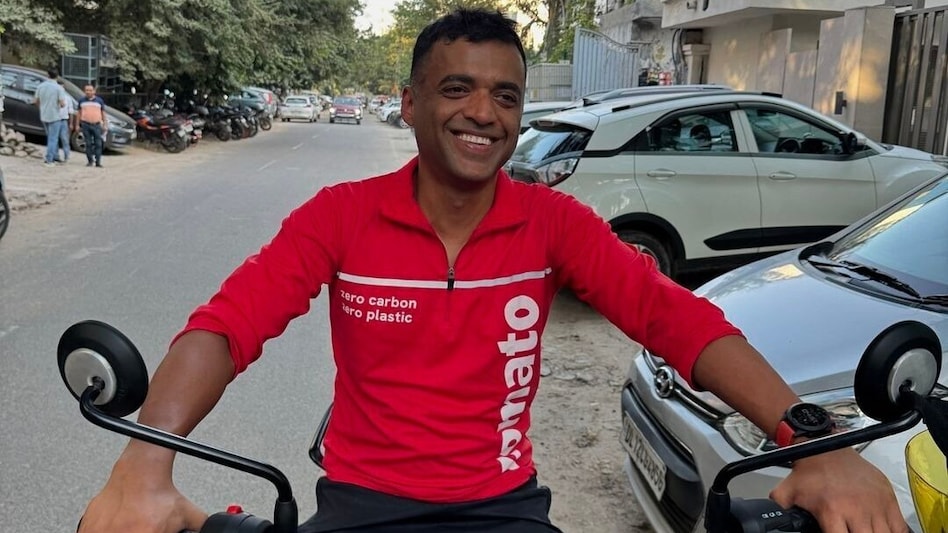
 A key point in Goyal’s defence is that most delivery partners do not treat gig work as a full-time occupation.
As debates around gig worker pay, job security and platform accountability intensify on social media, Zomato founder and CEO Deepinder Goyal has stepped into the spotlight with a detailed defence of the company’s earnings structure for delivery partners. His comments come amid growing scrutiny of app-based platforms, including Zomato and its quick-commerce arm Blinkit, over whether gig work offers sustainable livelihoods.
In a multi-part post on X (formerly Twitter), Goyal laid out data points on average earnings, tips and working hours, arguing that delivery partner incomes have seen steady growth and that headline criticism often ignores how gig work actually functions.
Breaking down hourly earnings
According to Goyal, the average earnings per hour (EPH) for a Zomato delivery partner in 2025 stood at ₹102, excluding tips — up from ₹92 in 2024, marking a year-on-year increase of nearly 11%. He said this upward trend has been consistent over a longer period, countering claims that platform wages have stagnated.
Goyal emphasised that earnings per hour are calculated based on the total time a delivery partner logs into the app, including waiting time between orders. While “busy hour” earnings — when partners are actively delivering — are higher, he argued that focusing on that metric alone would present a distorted picture.
“If someone were to work for 10 hours a day, 26 days a month, this translates to around ₹26,500 per month in gross earnings,” Goyal wrote. After accounting for fuel and vehicle maintenance costs, which he pegged at roughly 20%, net monthly earnings would be close to ₹21,000.
Part-time work, not full-time jobs
A key point in Goyal’s defence is that most delivery partners do not treat gig work as a full-time occupation. “Most delivery partners work for a few hours and only a few days in a month,” he noted, suggesting that comparisons with traditional salaried employment may be misplaced.
This framing has been central to the wider debate online, where critics argue that platforms benefit from worker flexibility while avoiding responsibility for minimum wages, social security and benefits. Supporters of gig platforms, however, say flexibility is precisely what attracts workers, many of whom use delivery work to supplement other income sources.
Goyal’s comments appear aimed at reinforcing the idea that earnings should be viewed through the lens of flexibility rather than fixed monthly pay.
Tips, transparency and Blinkit comparisons
Addressing concerns around incentives and tips, Goyal said delivery partners receive 100% of customer tips, with no deductions. The average tip per hour in 2025 was ₹2.6 on Zomato, up slightly from ₹2.4 in 2024. Tips, he added, are transferred instantly, and the company absorbs payment gateway charges.
However, tipping remains limited in scale. Only about 5% of orders on Zomato include tips, while the figure is lower — around 2.5% — on Blinkit, highlighting differences in customer behaviour between food delivery and quick-commerce.

 CBDT issues new crypto reporting guidance: No new tax, but exchanges must track and report all transactions
 Did Cockroach Janta Party's 'Chalo Sansad' 2.0 threat trigger Dharmendra Pradhan's resignation? What we know so far
 'Will discharge my responsibilities with complete humility': Pralhad Joshi after being appointed Education Minister
 Curious about Pralhad Joshi's wealth? A closer look at his assets, investments and liabilities
 On Cockroach Janta Party's lines, now E20 Janta Party demands choice of 100% petrol
 Best Healthcare Stocks: Gaurang Shah's Outlook On Apollo Hospitals, Fortis & The Manipal Health IPO
 Is Indo-MIM's IPO Valuation Justified? Here's Why The Company Sees Strong Growth Ahead
 Treasury Bills Explained: Why T-Bills Are One Of The Safest Short-Term Investment Options
 FDs vs Markets: Where Should You Keep Your Short-Term Money?
 Why Term Insurance Is Essential for Every Earning Member | Sum Assured & Coverage Explained
 Gland Pharma stock: Price target of Rs 3,250 likely in medium term, says analyst
  Metal recycling stocks to buy: Gravita, Pondy Oxides, Jain Resource among top picks
 TRIL shares: Should you average the falling stock? Here's 'fixed and final' stop loss
 Adani Power: 45 GW target, Rs 2 lakh crore capex plan among conference call highlights
  ITC Hotels, Chalet, Ventive, IHCL, SAMHI: Hotel stocks to buy despite travel disruptions
 'This is the behaviour of...' : Congress leader Kanhaiya Kumar detained by Delhi police after Kerala House altercation
 'You can do whatever you want?': Delhi HC questions EC over mandatory election duty for school teachers
 Mayor Zohran Mamdani taps tech-slayer Lina Khan to reshape New York City’s economy
 Planning a Nepal trip? You can now carry up to ₹25,000 in Indian cash. Here's what changedGland Pharma stock: Price target of Rs 3,250 likely in medium term, says analyst









