
In the past few months Madhur Vohra’s financial life has shrunk into the 15-inch monitor of his computer screen. What started as a tentative step into online banking two years ago has transformed into his anywhere, anytime one-click personal finance manager.
From tracking and paying for his three credit cards, to sending money to his parents in Indore, to repaying his home and personal loans to settling all his utility bills, the Delhibased back-office employee does everything from home—or office—at no cost to his time or money.
He is neither a tech geek nor a financial wizard, but he has achieved what the masters in technology and finance haven’t: organised all his finances under one simple webpage. The benefits are much more than savings in time, hassle, paperwork and money.
The middle-income class Vohra is not only banking easy, he is also banking more than ever before. “All I wanted was to take banking out of the bank. What I have achieved in the process is nothing short of financial empowerment and in some ways, even financial emancipation,” he says.
He is the average urban Indian with ordinary income and unenviable investments, but by using home banking (a combination of online, phone and mobile banking) intelligently he has organised his finances in a way that he now knows exactly where, when and how much he spends. What Vohra unintentionally stumbled upon is something most Indians are unintentionally not embracing. The power of banking from outside the branch.
Some are aware of it, some are even into it partly, but very few have adopted it to get the most out of it. That’s surprising, because it’s free and being aggressively offered by all banks—private or public, small or big, old or new. And these virtual bank interfaces have no opening and closing hours.

All convenience, no cost
Just like the remote changed the way you viewed television, ebanking has changed the way you bank. Why would anyone trudge down to the bank branch when he can get everything sitting at home? A decade ago, more so in the last seven years, the ATM took away the wearisome teller from our lives.
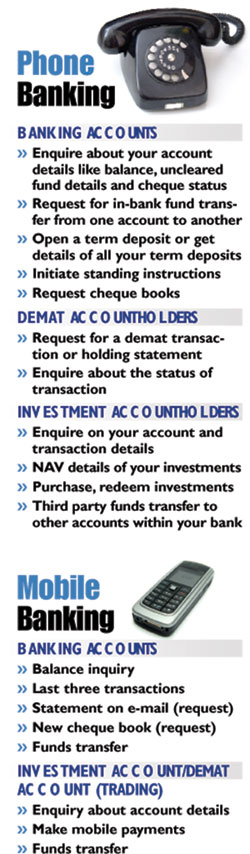 Now, home banking has cut off the entire branch and turned it into a 24x7 entity that fits snugly into everybody’s schedule. According to Guwahati-based businessman, Tapan Kumar, “I frequently travel out of town and am not at home when various utility and credit card bills trickle in. To avoid late fees, the hassles of signing cheques and wasting time in queues, I pay all my bills online from wherever I am.”
You can do banking when it is convenient to you, not bound by the 10 am to 2 pm working hours of your bank branch. You can access your account details and entire financial details with the click of the mouse—irrespective of whether it’s at 1 am, a public holiday or on a day when PSU bank employees have called a strike to protest the government’s privatisation policy. This is particularly useful for people who are constantly on the move.
Often we find time to pore over financial matters only after office hours, on weekends and on holidays. How many people can take time off from work because they need to go to their bank to know the total outstanding on their home loan and discuss refinancing options? How many bank branches are open on Sundays for a customer to drop in and start a fixed deposit? But your home computer or Net-enabled mobile phone would do all this and more without complaining.
Another advantage of online banking is that the accountholder can access information not readily available at the branch. This could be as simple as last month’s statement, which the bank will charge you for, but your net banking screen will give you last three months statements free of cost. For credit card, last 12 months’ bills are just a click away.
Convenience is not the only benefit flowing from home banking. There are people who drive 10 km one way to pay bills on the last date. Home banking eliminates the need for such expensive rush outs. As a bonus some banks and services companies reward you for paying electronically.
Once, people spent time to save money. Now they spend money to save time. Home banking fits in with this transition. The average Indian household in top 10 cities pays around 42 bills annually. If you spend 30 minutes and Rs 20 on fuel on paying each bill, you are spending almost one full day and Rs 1,000 every year on paying bills.
With Net banking you save a neat bundle and lots of time. Says Maninder Juneja, head-retail liabilities, ICICI Bank: “The number of transactions happening through non-branch channels has increased from 20% to 86% in the past 4-5 years”.
From chaos to control in your financial life
One of the most frequent customer enquiries at a bank is about the balance in the account. If you don’t know exactly how much you have in your bank, you will not know the best use to put it to. The real time nature of Net or phone banking allows people to seize investment opportunities just as they emerge.
Though financial planners advise mutual fund investors not to try and time the markets, it doesn’t hurt to pour in some money into your equity mutual fund when markets tank.
Last fortnight presented such an opportunity when the markets crashed by about 10% in two-three trading sessions. Anybody who had an online mutual fund account linked to his Net banking account could have just logged on and invested in a fund. Sure, such an investment could have also been done offline but how many people carry cheque books to office? Risk averse? How about buying some gold online when the price is really low?
Coming soon: banking in your pocket
Despite all these advantages of convenience, speed and savings, less than 10% of approximately 47 million bank customers in India have subscribed to Net banking. The biggest hurdle before home banking in India is the low penetration of computers and the Internet. There are just 17.70 Net-enabled computers per 1,000 population in the country. Though it is not as dynamic as Net banking, phone banking is the most popular self-banking channel today.
That may soon change, as mobile and Net banking converge on a complementary platform. Already, Net-enabled mobile phones are substituting the computer for a whole lot of services. In a country where mobile phone usage is proliferating at a breakneck speed with over 185 million users, m-banking is the future. Mobile banking will not only put banking in your pocket, it will also allow for specialised services.
According to V.P. Gulati, director, Institute for Development and Research in Banking Technology, in the near future, 50-60% of transactions are likely to move out of branches; 8-10% of transactions will shift to Internet and 10-25% to telebanking and mobile banking.
“Mobile banking has a huge potential as we see a convergence of Internet banking, tele-banking and merchant purchase all into mbanking. Our focus is now offering the entire m-banking service which includes query as well as m-commerce,” says Jaydeep Gupta, regional head, shared distribution, Middle East, South Asia and Africa, Standard Chartered Bank.
Once m-banking catches on, the handset can replace the debit and credit card system. As Pankaj Mahindroo, president, Indian Cellular Association, says, “The mobile wallet is the vision of the ICA. A voice-activated system is what will work best in the Indian context.” According to him, India being a cash economy, only those m-payment applications will work which allow a one-step transaction.
If there are hassles of typing an SMS command, keying in a pincode, waiting for confirmation, the application is perceived as “too complicated” and written off by a majority. The biggest boost to mbanking will be the lowering of prices for Net-enabled phones. Because then even the average Indian will be able to bank online, without bothering with the computer. Services like PayMate, which allow you to use your mobile phone to make purchases, pay utility bills and also your insurance premiums, will thrive.
Not just easy banking, it’s more banking
Branchless banking is much more than banking. As Vohra found out, it can pervade your entire financial portfolio. You bank much more than before, but with much less effort and cost. That’s unsurprising. Banks are emerging as financial superstores offering everything from insurance to mutual funds. They are no longer mere wealth accumulators or custodians; they now help in wealth creation and wealth management (see story Banks as Wealth Creators, page 54).
Banks are betting big on this for the sake of their future, if not for your convenience alone. Why would you bank with ABC and not XYZ if the proximity or personal equation with the bank ceases to matter, as will happen on Net and phone banking? Technology could make banks indistinguishable from each other.
But an intelligent use of it could also help banks deliver you customised banking right on your computer or home, so that you do stay with ABC and not switch to XYZ.

The glitches in e-banking
But before either banks or the customers aim higher, there are issues to be fixed. Phone banking is used mostly for enquiry and Net banking is still in a nascent stage.
The most common fear is that of security. Most people avoid Net banking because they fear their account will be broken into by hackers. “I don’t transfer funds electronically because there is a risk factor involved,” says Sanjay Roy, a Punebased businessman. But if some basic precautions are taken (like not revealing your password to anyone, ensuring that you are properly logged out after you finish, not keeping the transaction webpage on your list of favourites, avoiding the use of a cybercafe when banking), there is little reason to fear (see How to do Self Banking, pg 48).
Net connectivity itself is poor, which is where mobile banking is supposed to score on both cost and ease access. Banks are coming up with variety of innovations to beef up security at every stage of transaction (see graphic Trust Factor). While ICICI Bank has launched a new grid-based debit card, PNB has introduced a virtual keyboard that can be used to key in your login credential, thus defeating keyboard logging software, which may have been installed on the computer you are using.
HDFC Bank, on the other hand, has introduced NetSafe, a unique security solution that allows you to shop online through a virtual credit card. And Kotak Mahindra Bank has worked towards generating a virtual pre-set credit card that will let you e-shop within a 24-hour window. The validity of this virtual card expires after 24 hours, and any unused balance is transferred back to your bank account.
Courtesy all these measures, Irfan Khan, a Mumbai-based retired corporate executive, has not visited his bank branch for over three years. But at the same time he believes that the onus of security lies as much with the customer as with the bank. “With e-banking we have broken free from inefficiency but with that freedom comes responsibility. The best security measures are those taken at an individual level. After all, nobody can promise insurance against stupidity,” says Khan, who retired as the vice-president of corporate communications, Coca-Cola India.
All convenience, no cost
According to a study done by IBM Global Services Consulting Group, the cost of providing phone and Internet-based banking services is 25% of what traditional banking costs. Standard Chartered Bank’s Gupta goes so far as to claim that traditional banking is eight times more expensive than online banking, and mobile banking.
Therefore, newer banks are promoting hi-tech banking to reduce their costs. Some banks are entirely virtual, and immensely successful at that, ING Direct being the best example. When the ING Group decided to start retail banking operations outside the Netherlands (not yet in India though), it opted for the direct banking route instead of building or buying branch networks. Twelve years on, ING Direct has 17.5 million customers in nine countries.
While purely virtual banks may be a pipe dream in the Indian context, at least for a long time, nobody is denying the need to adopt e-banking channels side-by-side with branch expansion. Public sector banks, traditionally slow in adopting new technology, too are in sync with the time. Says Jagmandir Singh, a branch manager with SBI, “Today there is no business left for which you will have to come to the branch. About 60% of our customers in urban areas prefer to bank from home.”
But these banks also have a customer profile that will take time to adopt to new technology. Naresh Goel, a senior official of Syndicate Bank, explains, “The 40-plus age group in the country holds the purse strings and they aren’t tech savvy, or even early adopters of new systems.” The problem is also at the supply side. Even as new private banks embrace technology to reduce costs, the staff of many PSU banks tends to resist change. “Their inherent resistance to anything “different” is the prime reason for the lack of popularity of e-banking in the country,” says Goel.
But these are temporary glitches. The pull and push factor of branchless banking is too compelling for it not to become popular. And nobody is betting against it either. Only, most bankers believe that e-banking’s evolution will not completely replace the bank branch. Even now most customers wish to maintain a traditional banking relationship so banks can’t shed existing infrastructure in a hurry. Says Goel, “100% home banking is a dream but that is the ideal we must all work for.” E-banking means more selfreliance and less hand-holding. But then again, we all have to grow up some day.
With Narayan Krishnamurthy













