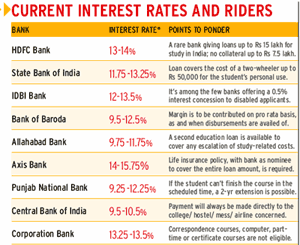
It took a 15-minute wait at an Axis Bank branch as an unusually helpful receptionist ran around the floor trying to find the person handling education loans-only to leave us with a phone number that was not accessible. The HDFC Bank branch in Connaught Place, Delhi, claimed it didn't handle such loans. The ICICI Bank does not even mention education loans on its exhaustive Website.
| Promises on hold |
|---|
| 1. Government to be counter-guarantor for all loans What this means: If implemented, the proposal will help those who can’t offer the collateral required for loans over Rs 4 lakh. |
| 2. Foreign universities to set up campuses in India What this means: World-class education will become more affordable as the existing loan caps will prove adequate. |
3. A loan waiver if you work with a govt agency |
At a time when Indian students are seeking ways to finance their higher studies-admission season is around the corner-such apathy on the part of private sector banks seems out of sorts. Is it because such loans are not profitable for them due to the RBI cap on interest rate, which is no higher than 1% over the benchmark prime lending rate?
Says Harsh Roongta, CEO, apnaloan.com: "Education loans in the country, as they exist, are basically a PR exercise for banks." That's why it's predominantly the public sector banks that are more aggressive on this front. Still, students are queuing up. Agrees Ashish Bindra, chief financial officer, Amity group: "About 25% of our students opt for education loans and this number is likely to double this year."
| Borrowing to study: Pros and cons | |
|---|---|
Advantages | Drawbacks |
| The entire interest paid is deductible from the taxable income under Section 80E. | The ceiling of Rs 20 lakh for studying abroad is often inadequate for the tuition fees. |
| The interest rates have dropped from around 14% in 2001 to as low as 9.25%. | Not everybody can provide the collateral security and a third-party guarantee required for loans above Rs 4 lakh. |
| The margin money requirement has been cut from 15-25% to 5-15%; a lower margin is asked for courses in India. | All scholarships are included in the margin money. However, chances are slim since many universities have withdrawn or pruned financial aid. |
| Assets like NSCs, insurance policies, bonds and even property papers suffice as collateral | pruned financial aid. n Not all courses, including good job-oriented ones, are eligible for loans. |
| The loan covers everything from tuition fee to laptop expenses and air fare. | Some banks insist on the student being insured for the full loan amount, which hikes their expenses. |
One reason for the rising demand for education loans this year is that the fear of a hiring and salary freeze is prompting many graduates to opt for higher studies. Simultaneously, professionals are going back to school for career enhancing courses to ride out the recession. For instance, the Indian School of Business, Hyderabad, has recently reported a 20-25% increase in the number of applicants for its executive programme.
Once the proposal to allow foreign universities to set up independent campuses in India gets the Centre's nod, the demand for education loans will multiply. In addition, the ceiling on loans for studying abroad-capped at Rs 20 lakh by most banks, which can barely finance one year of a foreign degree-proves to be a deterrent. This is why only about a fifth of the loans sanctioned are for overseas education. But when foreign universities open shop in India, the existing loan cap could prove adequate and there could be many more takers.
Other proposals on the anvil include the move to let the government stand as a counter-guarantor for needy students seeking a study loan. According to current norms, any loan above Rs 4 lakh needs to be backed by adequate collateral and a third-party guarantee. This explains Assocham's claim that less than 3% of Indian students take an education loan despite the disbursals increasing 30 times, from Rs 668 crore in 2001 to Rs 20,547 crore in 2008.
However, while we await such changes, the education loan can still work miracles within the Indian borders. Here's how to increase your chances of landing the best deal:
Rate of interest
Remember that the 'fixed' rate offered by banks may not be as rigid as you think. Many banks include a reset clause in the terms and conditions, whereby they reserve the right to revise the interest rate after two or three years, or whenever necessary. That's what Neha Bhutia discovered to her disadvantage recently. Says the 25-year-old consultant: "I took a loan of Rs 4 lakh from SBI in 2004 for my post graduation at a fixed rate of 9.25%. Suddenly, the bank hiked the rate to 11.25%, which caused my outstanding to shoot up to nearly Rs 5 lakh and I was caught unprepared." To avoid such a situation, check with the bank whether the rate of interest will remain constant for the full tenure of the loan. If not, a floating rate may be more economical.Most of the banks offering education loans have also signed MoUs with leading schools in the country, from IITs to IIMs and many in between. So if you have been accepted in such schools, you will be offered a lower interest rate.
Repayment option
Though all education loans come with a moratorium, you can avail of a lower interest rate if you start paying your EMIs immediately after the loan disbursement. You can also choose to pay only the interest during the period of study and start the EMIs after completing the course. Also, check if the bank imposes a prepayment penalty-for private banks like the HDFC Bank, this can be as high as 4% of the principal outstanding, while some PSU banks charge only if you are transferring the loan to another financial institution.
Processing fee
While most banks don't ask for an upfront fee, there are a few that do, particularly for foreign study loans. It won't hurt to ask the bank to waive the fee. Be on the lookout for ridiculous charges like 'agreement Xerox charges' that at least one PSU bank demands.