

Getting admission to an IIM is like a dream come true for thousands of MBA aspirants. But when Subodh Kumar got a letter from IIM-Lucknow informing him of his selection in 2002, he knew he had to clear another major hurdle— arranging the money for the twoyear course and other expenses. “At that time, our household finances were quite tight and it would not have been possible to pay for the course,” he says.
So Kumar took a Rs 3.5 lakh education loan for seven years from Allahabad Bank to cover all his expenses. Five years down the line, the consultant with PriceWaterhouseCoopers has prepaid the entire loan.
Manas Gulati, 23, was in a similar situation earlier this year when he got admission to a two-year communication management course at MICA, Ahmedabad. But funding the Rs 10.5-lakh course turned out to be the least of the problems for Gulati, even though he was leaving a lucrative Rs 50,000-a-month job and his parents were retired.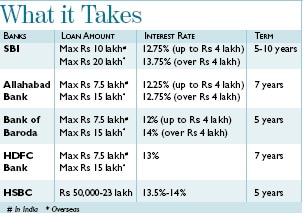
“It took exactly three minutes to get a loan of Rs 8.5 lakh, even without a collateral,” says Gulati. He wasn’t alone. Some 130 other students also benefited from the State Bank of India’s (SBI) tie-up with the institute.
Banks — whether nudged by the government or just plain eager to lend— are extending loans for funding higher education at attractive terms. The loan typically covers tuition and examination fees, as well as hostel and mess charges.
Most banks also extend this to cover books, equipment, even laptops. SBI provides Rs 50,000 for purchasing a two-wheeler while a loan from Bank of Baroda takes care of study tours too. For studies abroad, banks even provide one-way airfare.
Eligibility: Anybody who has qualified for, or has a confirmed admission in a college or institute makes the grade. For students getting into premier institutes, approval for a loan is easier as the starting salaries of these students is usually quite high. Most banks give loans only if the parent or guarantor has a regular—even if nominal—source of income.
For instance, HSBC has pegged the minimum income at Rs 75,000 a year. So even somebody earning Rs 6,500 a month can apply for an education loan for his ward. Some banks also do not insist on a guarantor. For Kumar, joining IIMLucknow would not have been possible if Allahabad Bank had insisted on one.
Loan amount: Most banks provide up to 90% of the total cost of the course. The loan amount could also be calculated as being six or 10 times the monthly salary of the parent. But banks like Bank of Baroda, Allahabad Bank and HSBC are ready to fund the entire cost of the course if a collateral of the same amount is provided for loans exceeding Rs 4 lakh.
Collateral: In case the monthly salary of the parent is low, it is the security and the collateral that can help jack up the loan amount. But banks usually overlook this for loans up to Rs 4 lakh. The usual security that banks generally take are National Savings Certificates, bonds, gold, property, etc. In addition to these, some banks might also require the applicant to have a life insurance policy equivalent to, or greater than, the loan amount.DOCUMENTS TO BE SUBMITTED |
| Admission notice: Proof that you have got admission to the course |
| Income source: Proof of income source of the parent and guarantor |
| Collateral: Assets such as NSCs, insurance policies, bonds, even property papers |
| Insurance: Some lenders insist on the student being insured for sum equal to loan |
For the Rs 7.5-lakh loan KC Choudhury took from Syndicate Bank for his daughter Kukla, a family friend stood as a third party guarantor. But not everyone is comfortable mortgaging their property and savings. Faridabad-based Roma Ghosh decided to limit the loan amount to Rs 4 lakh and took a personal loan of Rs 2 lakh to meet the expenses for her son’s graduation at SUNY Plattsburgh, US, in July this year.
Interest rates: The interest rates hardly vary between banks now. The rate difference arises in the slabs. It mostly goes up as the amount increases. For loans to study abroad the interest rates are usually around 14%, while for loans below Rs 4 lakh the rates are around 12%. The interest rates could be fixed or variable. A variable interest rate keeps changing half-yearly or yearly. The interest rate also goes up for unsecured loans.
The lowest possible interest rates are usually garnered by students of institutes that have a tieup with banks. The 9.25% interest on his Rs 8.5-lakh loan this June is the icing in Gulati’s case. “When most banks are asking for 13%, we got a great deal,” adds Gulati. The interest on the loan starts immediately after the day of disbursal. The interest is payable on a quarterly reducing basis, calculated on a simple interest basis. But once the repayment of the actual principal starts, the interest is calculated on a compounded basis. Allahabad Bank and BoB offer a special relief of 1% to girl students.
Repayment: The repayment usually starts six months after the course completion or the start of a job, whichever is earlier. But guardians can start repaying the simple interest amount during the tenure. Ghosh has started paying the interest of around Rs 4,000 per month from August to Bank of India for the loan she took for her son. It is this flexibility which is a big draw. Shaiwal Srivastav, 28, pays a lump sum of variable amount to Uco Bank for the Rs 7 lakh loan he took in 2003.
Disbursement of the educational loan is made directly to the institute. In the case of mess and hostel charges, the relevant amount is given to the authorities concerned. For airfare, the money is given directly to the airlines. Some banks do give the students themselves a certain amount on a monthly or quarterly basis for buying books and other material needed for the course.
Tax benefits: Repayment of an education loan is deductible under Section 80E. But only loans for higher education—fulltime studies in any graduate or post-graduate, professional, and pure and applied science courses— can claim deduction. The deduction will be available for a maximum of eight years starting from the day repayment begins.











