
There is no clear definition of a bear market. In the US, a bear market is when stock prices decline by at least 15-20%, coupled with underlying pessimistic sentiment. In India, though the decline in stock prices has been much greater, sentiments are still mixed. What do you do as an investor? In addition to the cover story of this issue, we give you a snapshot of past three bear phases, key learnings from each and quick tips to limit losses—or even make gains.
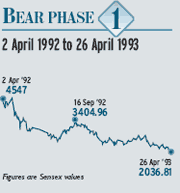
• Peak level of Sensex 4547 • Lowest point during bear phase 2037 • Number of bear phase weeks 56 • %decline from highest to lowest point -55% • Decline in number of points 2510 • Trailing P/E at the peak of the bull run NA • Trailing P/E at bottom of the bear phase 23.8 • Percentage return 6 months from lowest point in bear phase 34% • Days taken to cross previous peak level 881 | 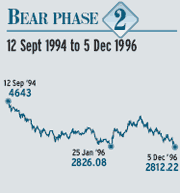
• Peak level of Sensex 4643 • Lowest point during bear phase 2736 • Number of bear phase weeks 116 • % decline from highest to lowest point -41% • Decline in number of points 1907 • Trailing P/E at the peak of the bull run 32.9 • Trailing P/E at bottom of the bear phase 15.1 • Percentage return 6 months from lowest point in bear phase 42% • Days taken to cross previous peak level 1,76 | 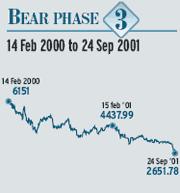
• Peak level of Sensex 6151 • Lowest point during bear phase 2627 • Number of bear phase weeks 84 • % decline from highest to lowest point -57% • Decline in number of points 3524 • Trailing P/E at the peak of the bull run 33.9 • Trailing P/E at bottom of the bear phase 13.6 • Percentage return 6 months from lowest point in bear phase 34% • Days taken to cross previous peak level 1,425 |
The average decline from highest to lowest point of the Sensex is 51%
The PE ratio tends to more than halve. The starting PE had been quite similar at just over 30x. We were at that multiple in January 2008 when the current correction began
Bear phases last for a shorter period than average bull markets
However, bear markets are accompanied by a prolonged phase of movements (within a range) which makes them appear longer than bull phases.
Bear market rallies tend to be powerful
No specific sectors are the biggest losers across all bear phases
The return from the low can be very strong
It is not possible to predict a bear phase. There can be various triggers that send stock prices crashing. Equally difficult is to predict the lowest level the markets will reach. The recent plunge in the markets is a case in point. But while there are no definite indicators, a study of past bear phases reveals five changes that have preceded the end of a bull run. Not all of these five signs necessarily occur before every market downturn. But look out for these signs of choppy times ahead:
1. Oil Prices
Before a bear phase — Oil prices often surge
Has it happened? — Yes, crude prices have touched $106 a barrel. But oil prices have been rallying for 2 years.
2. Treasury Yields
Before a bear phase — Treasury yields run up
Has it happened? — No, not as yet
3. Number of Rising Stocks
Before a bear phase — Fall in number of stocks rising in price
Has it happened? — Yes. Since mid-Jan none of the Sensex or Nifty stocks have gained
4. Corporate Earnings Growth
Before a bear phase — Growth in corporate profits slow down
Has it happened? — Sort of. Corporate earnings grew extraordinarily in recent times. So lower earnings in quarter ending Dec 2007 is not very alarming
5. Consumer Spending
Before a bear phase — Consumer spending falls
Has it happened? — Mixed signals. For instance the automobile industry is facing a demand slowdown. But mobile phones are still flying off the shelves













