Buying funds randomly does not a portfolio make. You must have a strategy that determines which funds to buy and how much to invest in each. Here are five questions to help you decide whether a particular fund should be in your portfolio. Turn overleaf to understand your fund’s investment style.
| Factor | Questions to ask yourself | Funds to invest in |
| Tenure | How long do I want to stay invested? Your financial goals have different maturity tenures. Invest in funds that give best results in the time horizon of each goal | • Short-term: Debt • Medium-term: Balanced, FMPs • Long-term: Equity |
| Asset Allocation | How do I want to split my investment? Funds invest in different avenues. Choose the ones that invest in asset classes which suit your desired asset allocation | • Heavy on equity: Diversified, ELSS, mid-cap, sectoral • Heavy on debt: Debt, FMPs • Mix of both: Balanced, MIPs |
| Risk Profile | How much risk can I take? Everyone has a different risk appetite. The funds in your portfolio must match it. Also, factor in goal-related risks while picking funds | • Low risk: Debt, MIPs, arbitrage • Moderate risk: Balanced, index, diversified • High risk: Mid-cap, small-cap, sectoral |
| Taxability | What tax breaks do I want? The tax on income from funds depends on the kind of fund and investment tenure. Choose ones that are the most tax-efficient | • Low tax: Debt for over 1 year • No tax: Equity, equity-oriented balanced for over 1 year • Both investment- and incometax-exempt: ELSS |
| Liquidity | Would I need money at a short notice? Your monthly surplus has two parts: ready-to-use cash and investible money. Choose funds that meet your cash-flow needs | • If money required at short notice: Liquid funds • If money not required immediately: Equity funds |
The composition of your portfolio will depend on several or all the factors listed above. It will also vary with age and change over time as you approach your financial goals. An investor needs to constantly rebalance his portfolio to suit his risk profile, tax considerations and cash-flow requirements.
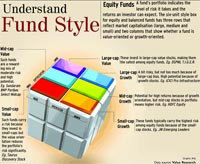
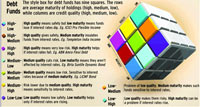
Understand fund style |
| Equity Funds A fund’s portfolio indicates the level of risk it takes and the returns an investor can expect. The six-unit style box for equity and balanced funds has three rows that reflect market capitalisation (large, medium and small) and two columns that show whether a fund is value-oriented or growth-oriented. |
| Debt Funds The style box for debt funds has nine squares. The rows are average maturity of holdings (high, medium, low), while columns are credit quality (high, medium, low). |