Today, some 30 lakh contracts worth almost Rs 50,000 crore are traded on the NSE in a day. The derivatives of 267 shares and six indices are traded on the NSE. The BSE has 126 scrips and seven indices.
FUTURES
• A futures contract gives you the right to buy or sell shares at a specific price in the future. The future price is usually higher than the prevailing market price of the security.
• Futures and options are sold in lots. Highpriced shares are offered in small lots of 50-60, while low-priced shares are available in big lots of 7,000-8,000.
• Futures and options expire on the last Thursday of a month. It’s possible to roll over a future by buying the next month’s contract, but it is not possible to roll over an option.
• Stock derivatives are available for up to three months in the future. So, in November, you can buy stock futures and options for November, December and January. But index derivatives can be bought up to three years in advance. Right now, Nifty options of 2011 can be bought.
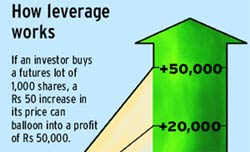
• Futures contracts are leveraged instruments. The investor pays just 20-25% of the value of the transaction as margin money. A 1% change in the share’s value means a 4-5% change in the value of the contract. The loss incurred is deducted from the margin and the investor is asked to pay the additional margin. If he can’t pay, the shares are sold.
| Unlimited profit, limited risk | ||
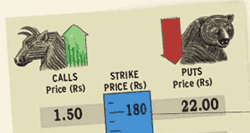
| If you are bullish >> | Buy Calls >> | The profit can be unlimited, but the loss is limited to the premium. |
| If you are bearish >> | Buy Puts >> | |
OPTIONS
Like futures contracts, options also give you the right to buy (through a Call option) or sell (through a Put option) a share at a future date. But you are not under any obligation to do so.Index options: If it is an index option, the option can only be exercised on the expiry date. These are European types of options and are denoted as CE (Calls) and PE (Puts).
Stock options: If it is a stock option, it can be exercised at the end of any trading day. These are American types of options and are denoted as CA (Calls) and PA (Puts).
Options are available for stocks and indices at price intervals called the strike price. For instance, if the price of the underlying share is Rs 100, options will be available in intervals of Rs 5. For an index, the strike price may be in intervals of Rs 50. The price paid for an option is called the premium. At the beginning of the contract month, the probability of a share moving in either direction is higher, so the premium is usually high. As the expiry date nears, the premium goes down progressively.
EXERCISING THE OPTION
A buyer can sell the option for a profit (or loss) on any trading day based on his reading of the market. He can also exercise a stock option if the transaction is profitable.
On the exercise and the expiry dates, the value of a Call option is calculated as follows:
Value of Call = Market price of share — Strike price
For a Put option, the calculation is the reverse:
Value of Put = Strike price — Market price of share