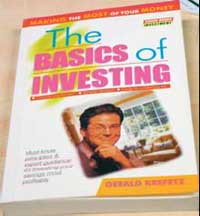
THE BASICS OF INVESTING |
This focused introduction to the basic principles of investing is aimed squarely at the middle-class layman. In systematic fashion, Gerald Krefetz introduces the basic concepts of saving and investing, develops each theme and moves logically from one theme to the next. In a refreshing display of honesty, the introduction explicitly makes the disclaimer that this book will not help to make you “powerful, popular, famous or an instant millionaire”.
By the time the reader is through with these 15 chapters, he may not be a millionaire. But he will have a clear idea of why he needs to invest and some knowledge about how to go about it. Of course, the understanding of intricacies will not be very deep. But there is enough depth to ensure that the process of first saving, and then investing, is carried out.
The reader would also have learnt a set of simple rules, which would prevent him making big errors through sheer ignorance. The book starts by making the argument for taking on the genuine risks involved in investing and trying to beat inflation, rather than sitting tight and suffering the certainty of loss as the cost of living rises and the value of money erodes.
It then introduces the idea of a parachute or safety net. The author suggests that a certain amount should be held in safe instruments (such as bank deposits) before the savings surplus is invested in higher-risk-higherreturn avenues. Simple rules are offered to judge the required level of savings for a given income, and related concepts like networth calculations are introduced. Even topics as basic as calculating simple and compound interest formulae are dealt with.Then the related but separate issues of risk-assessment and life-cycle investing are taken up. The reader is taught to examine and analyse his own propensities in terms of risk appetite. The arguments in favour of life-cycle investing, by taking more risks when you are young and gradually shifting into safer avenues as you grow older, are also introduced here.
The author displays common sense by not insisting that readers take on risk, regardless of appetite. It is a fact of life that a young but riskaverse person will not invest in high-risk instruments, no matter how logical it may seem.
Most financial planners alienate potential clients by refusing to acknowledge this psychological quirk. Krefetz suggests that the genuinely risk-averse stay away from equity and highly volatile bond instruments.
After this, the book takes us on a tour of various classes of financial instruments and revisits the subject of asset allocation (it was touched upon in the networth section). Naturally, it leads to the concept of diversification. Again, unusually, the author suggests that if you are a risk-taker by attitude, you should consider speculation with a small (5-10%) portion of your portfolio. It’s probably easier for a financial gambler to control the habit than for him to quit cold turkey.
The book even deals with investment styles. Some people prefer to be active money managers while others like to set broad parameters and leave details to the specialists. Krefetz discusses the pros and cons of both approaches and makes suggestions about the modalities of whichever approach you choose.
KNOW YOURSELF! |
| Risk-Averse: People who, in short, hate to lose. Losing causes them far more pain than winning brings in the way of pleasure |
| Risk-Neutral: Losing doesn’t depress them nor create anxieties. Gain is pleasurable but their emotional reaction to winning or losing is roughly in equilibrium |
| Risk-Lover: They get far more pleasure from winning than pain from losing.They are prone to gambling |
The last few chapters offer practical advice on portfolio construction and monitoring. There are case studies of people with real-life problems (dealing with inheritance, planning for children’s future, coping with the loss of jobs). There is also a general overview of sources of information.
In all, this struck me as an excellent primer on financial literacy. No prior knowledge is assumed, there is no jargon. The arguments are presented simply. The reader is not pressured into accepting the author’s point of view or investment style. Several possible directions are signposted and it is left up to the reader to find out more about them and the methods that suit him best.
However, there are two levels on which an Indian reader could feel dissatisfied. The first is that the book was written for an American audience and only a feeble attempt has been made to indigenise it. The differences between the Indian and the US economies are vast in terms of regulation, tax laws and macro-economic variables.
There are also significant differences in the behaviour patterns of the average middle-class Indian (savings rates of over 30%) and his American counterpart (savings rate of less than 5%). Large portions—the bits that deal with USspecific tax-efficient strategies and the US bond markets—are irrelevant.
The Indian edition could have delivered far more value if it had been adapted with a little more care.
The other problem is that Krefetz doesn’t really suggest a further reading list. This is because the book is intended to be the first of a quartet on financial planning where the subsequent volumes will deal with specific topics in greater detail. Despite these flaws, The Basics of Investing is a good place for a newbie to start his financial education.