
 There are certain textbooks that students are advised to buy on their enrolment day in the knowledge that they will continue to use and refer to these throughout their lives. In medicine, Gray’s Anatomy has that status; in economics it’s Samuelson.
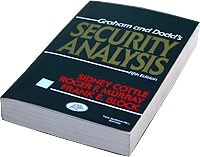
In financial analysis, it is Benjamin Graham and David Dodd’s Security Analysis. The first edition was authored in 1934 by the two legends, who inspired the foundation of the Institute of Certified Financial Analysts.
It laid down the foundations for what is now known as the value investing or fundamental approach to stock picking. In fact, it coined the term “value investing”. The book has never been bettered for its comprehensive and lucid coverage of the various aspects of financial valuation.
In 1929, the 34-yearold Graham was almost wiped out by the Wall Street Crash. He was then both a professor at Columbia University as well as a money manager.
His losses prompted Graham to seek methods that offered a margin of safety against the wild volatility that characterised the Wall Street Crash.
Dodd, then 32, was one of Graham’s students, who helped him develop those methods. He too would later become a professor at Columbia. Famously the only student to have ever received an “A+” in their lectures on financial analysis at Columbia BSchool was a certain Warren Buffett, who later volunteered to work with Graham for free.
It took five years for Graham and Dodd to publish Security Analysis which presented their distilled wisdom. It adopted a radical approach. Instead of following price momentum or tracking price-earnings ratios as traders and investors did, the duo suggested that it was better to use a variety of methods to value businesses. They said investors should only buy when the price was significantly lower than intrinsic value.
Graham and Dodd started with an assumption that pricing mechanisms contained many flaws. This meant that market price was rarely close to the intrinsic value. Through the meticulous dissection of balance-sheets, they taught readers to identify when mispricings occurred. They also recognised that patience was required to generate returns—in a depressed market, shares may trade below intrinsic value for long periods.
In essence, that is all value investing is about. Look at a balance sheet and work out how much a business is worth. Reduce that to per share value. Compare that value with the price. If the price is at discount, buy and hold until the discount disappears. If the price is at premium, ignore the stock.
It is a very conservative approach forged in the crucible of a big bear market when most stocks traded at massive discounts to value. The Graham and Dodd methods enabled diligent students to find the very best value stocks. Those who held through the next 10-12 years (as the authors did) received huge returns when the US economy boomed after WWII.
Security Analysis is not an easy book to absorb. It is not written in difficult English–it is blunt, to the point and there is a strain of wry humour running through it. But it does not offer quick fixes and assure readers that they can speed read their way to fortune.
Intrinsic value and market value |
| Intrinsic value is that which is justified by assets, earnings, dividends, rational future prospects and the management factor. |
| Market price will sometimes coincide with, and often fluctuate above or below intrinsic value. |
| Intrinsic value will change as earnings, dividends and other key factors change. But it will change in less volatile manner than price. |
| Intrinsic value is thus a moving target and a “central tendency” of price which hovers around value. |
To gain maximum benefit, you will have to go page by page, example by example, taking notes and then applying that approach in a hands-on fashion.
In Part I, an overview of financial markets, financial analysis and decision-making on the basis of financial analysis is given. That’s nine chapters including “soft topics” such as an assessment of the nature and quality of available information.
Part II is an examination of balance sheets, income statements, key ratios and cash flows in detail. It assumes that the reader will not have prior knowledge. By the time you have waded through these 13 chapters, you will know how to take any financial statement apart.
Part III is a four-chapter look at fixed-income instruments. This has been updated by Martin Leibowitz to reflect major changes in the nature of modern bonds and debentures. Part IV deals with the valuation of stocks and an understanding of instruments such as options and convertible debentures that are benchmarked to underlying shares.
Part V focuses on the reasons why a welltrained financial analyst has a unique perspective on the need for corporate governance. Seven decades before Sarbanes- Oxley Act (US’ corporate governance law) and Clause 49 of Sebi’s listing agreement, Graham and Dodd crisply elucidated the need for independent directors, transparent accounting standards and a strong defence of shareholders’ rights.
The authors do not promise to make anybody rich. Instead they give their readers a tool kit for survival.
If you’re a serious investor, buy the book and read it from cover to cover—this edition is serious value for money at less than Re 1 a page. Then take a look at your portfolio. If it gets a passing grade from Graham and Dodd, relax. You’ll end up rich.
Read our review of the book All About Investing on www. moneytoday. in type “verbose but informative” in the search box.













