
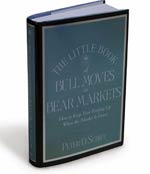
This 'little' book makes several 'big' points. Read them carefully if you wish to become a wily investor and make money in both the bull and bear markets. Peter D. Schiff does not provide any short-term tips to earn fantastic returns within a few months. Instead, he focuses on how to earn decent and consistent returns over the next decade. He feels that the current financial crisis marks the beginning of a long-term trend; it signifies that global, especially American, investors have to change their investment strategies.
According to Schiff what we are witnessing is the inevitable 'collapse' of the American economy. "The coming decade," he writes, "will witness a radical transformation of the American economy, marked by rising inflation, higher interest rates, and soaring commodity prices, coupled with a weakening dollar; declining markets in stocks, bonds, and real estate; and recession." Despite dramatic measures announced by the US policymakers, and optimistic predictions, there will be no hope for the world's only superpower, believes Schiff.
The Little Book Of Bull Moves In Bear Markets |
|---|
| Price: Rs 990 | Pages: 263 Author: Peter D. Schiff Publisher: John Wiley & Sons |
| Target audience: All investors |
| Quick Read Tip: Constant references to past events can be avoided. Focus on the tips for future investment tactics. |
| Language: Easy Style: Argumentative |
According to the author, several factors were responsible for this 'gloom and doom' end. As America became services-oriented, it stopped being a producer (of physical goods). Its trade deficit zoomed as imports exceeded exports. The huge national debt, owed mainly to China and other trading partners, also included domestic liabilities on account of social security and loan guarantees. But consumer spending continued to rise. Nearly 70% of America's GDP was consumer spending on imported goods using borrowed money. This was "not wealth creation… but wealth destruction."
Today, Schiff's advice to all investors is to simply get out of America. "Do not follow the typical Wall Street buy-and-hold mantra... This is a category five monster, and it will destroy all who remain in its path... Simply get out of the way and let the storm pass you by," he writes.
In the second half of the book, Schiff tells the investors "not only where to go, but how to get there". The changing scenario requires "unconventional thinking". There is a need to build a new investment structure, whose first building block should include commodities. "We are still in the early stages of a secular commodity bull market that will last at least another decade." In periods of high inflation, the profitable shine will come from gold and silver. "When purchasing power erodes to the point where fear starts giving way to panic, the price of gold will acquire a monetary premium," says Schiff.
For those interested in stocks, Schiff's advice is to invest in developed markets that still have a future, such as the Eurozone, Canada, Hong Kong, Japan and Australia. If someone believes in the high-risk, higher-reward mantra, he can consider emerging markets, such as China, India, Brazil and Russia.
While the book is an interesting read, don't follow it blindly. Many prophets of doom like Schiff have been proved wrong about the future of the American economy. Also, if the US recession lasts for a long time, most of the other nations as well as asset categories are likely to remain 'down and out' for several years.













